Begonia rajah
Begonia rajah Care Guide
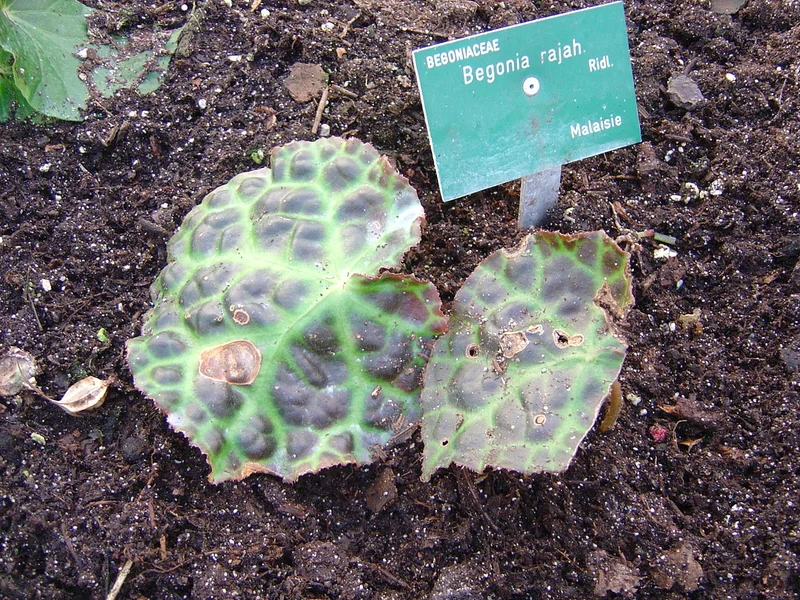 Featured photobegonia-rajah.jpg
Begonia rajah is a rhizomatous jewel begonia from the rainforests of Malaysia, producing some of the most spectacular foliage of any begonia species. The heavily puckered, asymmetric leaves are deep olive to near-black with a constellation of bright yellow-green iridescent spots arranged along the veins — a combination that creates a jewel-like effect under good lighting. It requires high humidity and careful watering to thrive but rewards attentive growers with a leaf display that has no equivalent in the plant kingdom.
Care facts at a glance
- Light
- Low light
- Water
- Water when the top 1–2 cm of medium has partially dried; approximately every 7 days in summer.
- Humidity
- 65–90 %
- Temperature
- 18–30 °C
- Soil
- Rich, well-draining, moisture-retentive mix: peat-free compost with added perlite and fine orchid bark. pH 5.5–6.5.
- Origin
- Lowland and montane rainforests of Peninsular Malaysia.
- Mature size
- Compact rhizomatous mound; 20–35 cm tall. Leaves 10–20 cm across.
Overview
Begonia rajah Ridl. was described in 1905 from Peninsular Malaysia. It is classified in the rhizomatous begonia group and belongs to the collectors' category known as 'jewel begonias' — species from Southeast Asian rainforests with iridescent or metallic leaf patterning. The yellow-green spots on B. rajah are produced by structural iridescence: microscopic lens-shaped cells in the leaf epidermis focus and reflect light differently from the surrounding dark mesophyll. The spots are most vivid in bright, diffuse light and less apparent in deep shade. The plant's naturally low-light forest-floor origin makes it more shade-tolerant than many showy begonias.
Care Priorities
- High humidity (65%+) is non-negotiable; the leaf spots fade and the plant stagnates below 55%.
- Never water the leaves — the rough, puckered surface holds moisture and rapidly develops Botrytis in these conditions.
- A terrarium or enclosed display case is the ideal growing environment for UK and temperate-climate growers.
- Repot carefully and minimally — the rhizome is shallow-growing; a wide, shallow container works better than a deep pot.
- Avoid direct sun; the dark leaf surface absorbs heat rapidly and sunburn appears within hours.
Common Problems
Leaf spots fading to a dull brownish-green usually indicates low humidity or insufficient light intensity — increase humidity and move to brighter indirect light. Botrytis (grey mould) develops rapidly in stagnant, humid air; maintain airflow even in a terrarium by briefly ventilating daily. Root rot from waterlogged medium is common; the rhizome is particularly susceptible. Fungus gnats indicate overly moist medium surface; allow the surface to dry further between waterings or apply a layer of grit to the surface.
Sources & further reading (2)
- botanical-garden — accessed 2026-05-27
- encyclopedia — accessed 2026-05-27
Frequently asked questions
Is it suitable for beginners?
B. rajah is best described as an intermediate-level plant. It requires consistent high humidity and careful watering, which makes it challenging in a typical heated living room without supplemental humidity. In a well-managed terrarium or plant cabinet with humidity control, it is actually quite stable and easy to maintain.
What makes the spots glow?
The spots are produced by iridoplasts — chloroplasts that have developed into flat, stacked, lens-shaped structures that reflect blue-green wavelengths as structural colour rather than pigment. In the right light angle they glow vividly yellow-green. The effect is identical in mechanism to the iridescence of butterfly wings.
Does it flower?
Yes — small, pale pink flowers on upright stems appear occasionally, particularly in spring and summer. They are pleasant but modest compared to the extraordinary foliage. Some growers remove flower stems to direct energy into leaf production, though this is a matter of personal preference.