Monstera deliciosa 'Thai Constellation'
Monstera 'Thai Constellation' Care Guide
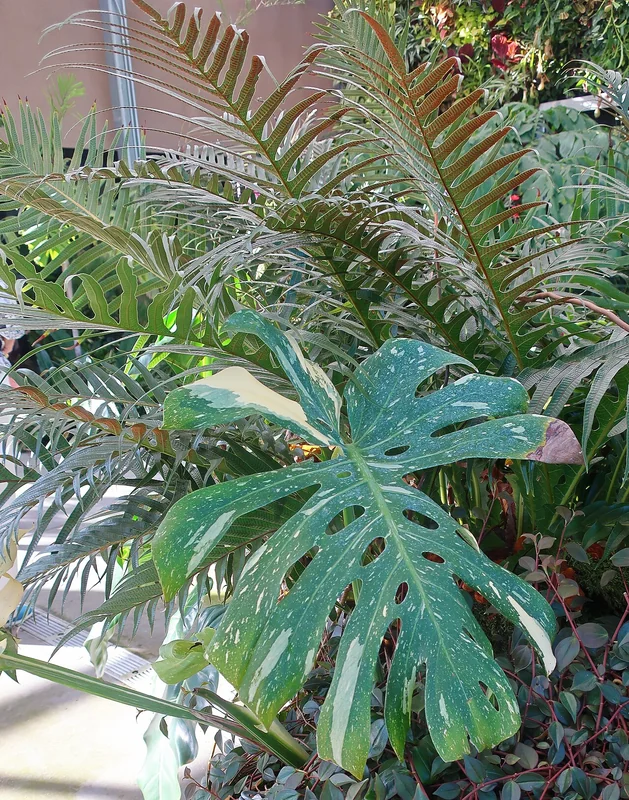 Featured photomonstera-thai-constellation.jpg
Monstera 'Thai Constellation' is a tissue-culture-produced variegated cultivar of Monstera deliciosa originating from a Thai laboratory, distinguished by stable, consistent cream to pale-yellow sector and speckle variegation across its large, fenestrated leaves. Unlike the unstable variegation of 'Albo Borsigiana', Thai Constellation's colouration is genetically stable and does not revert to all-green. The combination of the iconic Monstera leaf form with reliable, painterly cream variegation has made it one of the most prized and widely sought houseplants of the 2020s.
Care facts at a glance
- Light
- Bright indirect
- Water
- Water when the top 3 to 5 cm of substrate has dried; every 7 to 14 days in the growing season.
- Humidity
- 60–80 %
- Temperature
- 18–30 °C
- Soil
- Well-draining aroid mix: bark, perlite, and a small amount of potting compost.
- Origin
- Cultivar derived from Monstera deliciosa, native to the tropical rainforests of Mexico and Central America.
- Mature size
- Vining to 2 to 3 m indoors; leaves 30 to 60 cm long with mature fenestrations.
Overview
Monstera 'Thai Constellation' was produced by a tissue culture laboratory in Thailand by introducing a stable chimeric mutation that causes sectors of cells to lack chlorophyll, resulting in the characteristic cream-yellow variegation. Unlike naturally occurring albino mutations which can be unstable, the tissue-culture origin of Thai Constellation means the variegation pattern is reliably passed to all new growth, though each leaf's unique splash and speckle distribution makes every individual leaf a distinct natural artwork. Production has scaled considerably since 2022, reducing prices significantly from the peak of several hundred dollars per cutting.
Care Priorities
- Bright indirect light is more important for Thai Constellation than for standard Monstera; the reduced chlorophyll content of the cream sectors means the plant captures light less efficiently overall.
- Provide a moss pole or support to encourage climbing; vertical growth stimulates the production of larger, more fenestrated leaves with more developed variegation.
- The cream tissue is more susceptible to sunburn than green tissue; avoid any direct afternoon sun.
- Maintain humidity above 60 percent to prevent the cream leaf margins from browning at the edges, which is more visible on the pale tissue.
Common Problems
Browning of the cream variegated leaf margins occurs in low humidity or with fluoride in tap water; use filtered water and maintain humidity above 60 percent. Thrips cause characteristic silver-streak damage on leaves; they are harder to spot against the cream tissue than on all-green plants — inspect undersides carefully and treat with systemic insecticide. Root rot from overwatering is the most serious structural risk; the variegated plant has a lower metabolic rate than a fully green one and uses water more slowly. Reverted all-green shoots should be removed promptly to prevent them outcompeting the variegated growth.
Sources & further reading (2)
- botanical-garden — accessed 2026-05-08
- encyclopedia — accessed 2026-05-08
Frequently asked questions
Will the variegation revert to all-green?
Unlike 'Albo Borsigiana', Thai Constellation's variegation is tissue-culture stable and does not revert. All new growth should maintain the characteristic cream-speckle pattern throughout the plant's life.
Why are new leaves coming out all-green?
Occasionally a new leaf may show less variegation than previous ones due to growth rate and light variations. If multiple consecutive leaves are all-green, increase light and reduce fertiliser nitrogen. True all-green reversion is extremely rare in this cultivar.
What is the difference between Thai Constellation and Albo Borsigiana?
Albo Borsigiana (a compact form of M. deliciosa with unstable white variegation) can revert to green and has sharper, whiter colouration. Thai Constellation has softer, cream-yellow variegation, is stable, and has larger leaves. Both are highly prized.