Mammillaria gracilis
Mammillaria gracilis Care Guide
 Featured photomammillaria-gracilis.jpg
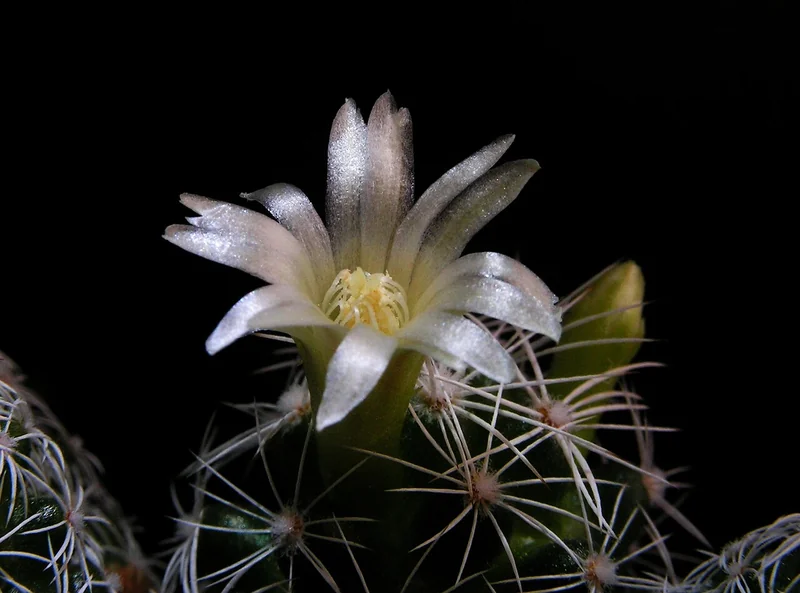
Mammillaria gracilis, the thimble cactus, is a diminutive, freely clustering Mexican cactus with tiny, thimble-sized stems densely covered in neat white radial spines. It produces small, pale cream to yellow flowers in spring and offsets prolifically, rapidly forming a dense, mounding colony of miniature stems. Its small size, ease of care, and charming appearance make it one of the most popular cacti for windowsills, dish gardens, and small pot collections. Offsets detach very easily — barely touching the plant dislodges them — facilitating effortless propagation.
Care facts at a glance
- Light
- Bright indirect
- Water
- Water when the substrate is completely dry; every 14 to 21 days in summer, once a month or less in winter.
- Humidity
- 15–50 %
- Temperature
- 5–35 °C
- Soil
- Fast-draining cactus mix: standard cactus compost with 50 percent added perlite or coarse grit.
- Origin
- Semi-arid hillsides of Hidalgo and Mexico state, central Mexico.
- Mature size
- Individual stems 3 to 8 cm tall; clumps spread to 20 to 30 cm across.
Overview
Mammillaria gracilis was described by Pfeiff and the species name means 'graceful' or 'slender' in Latin. It is native to the central Mexican plateau where it grows in shallow, rocky soils on dry hillsides. The stems are cylindrical, covered in spirally arranged tubercles each tipped with white radial spines and one or more thin central spines. The offsets are produced prolifically from the axils of the tubercles and detach at the slightest touch — an adaptation that promotes vegetative dispersal by animals brushing past the plant in nature. In cultivation this makes it one of the easiest cacti to propagate.
Care Priorities
- Strong light, including some direct sun, produces the whitest spine coverage and most compact growth; insufficient light causes pale, etiolated stems.
- Very small individual stems dry out quickly; check moisture frequently in warm weather, but water thoroughly when you do water.
- A cool, dry winter rest is essential for spring flowering; reduce watering to near-zero from October through February.
- Handle the clump carefully as the offsets detach very easily; displaced offsets left on moist substrate will root readily.
Common Problems
Root mealybugs are a hidden but common problem — they infest the roots in the substrate and are not visible until the plant is unpotted; if a plant declines without obvious reason, check the roots. Overwatering in small pots causes rapid root rot; tiny pots drain and re-wet quickly so use very free-draining substrate and allow complete drying. Etiolated, pale, thin stems with sparse spines are caused by insufficient light; move to a south-facing windowsill or use a grow light. The offsets that detach can become lodged in the clump and rot against the parent plant; remove displaced offsets promptly.
Sources & further reading (2)
- botanical-garden — accessed 2026-05-08
- encyclopedia — accessed 2026-05-08
Frequently asked questions
Why do offsets fall off so easily?
The fragile attachment is an evolved dispersal mechanism — in nature, animals brush past the plant and carry offsets away, dropping them elsewhere to root and form new colonies. In cultivation, gentle handling prevents accidental detachment.
How do I root a detached offset?
Allow the detached offset to callous for 2 to 3 days, then place it on the surface of dry cactus mix. Do not water for a week; the offset will initiate roots in search of moisture within 2 to 4 weeks.
Does it flower regularly?
Yes — after a cool, dry winter rest it typically flowers in spring, producing small cream to pale yellow flowers around the apex of each stem. Large clumps with many stems produce an attractive massed flowering display.