Lygodium japonicum
Lygodium japonicum Care Guide
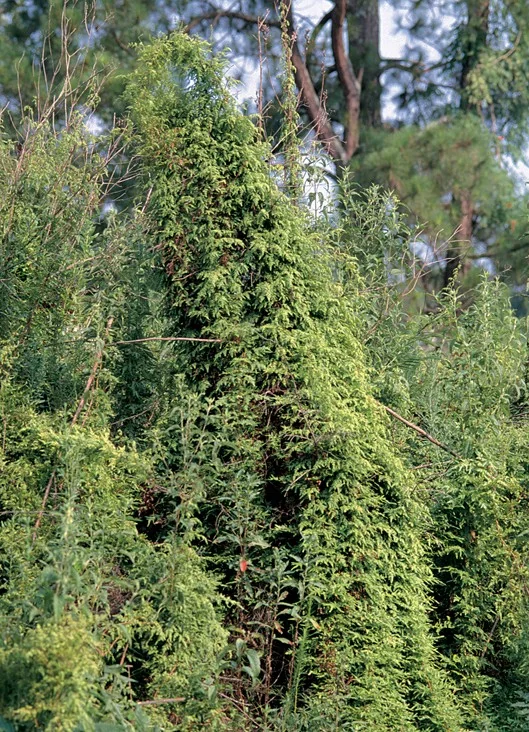 Featured photolygodium-japonicum.jpg
Lygodium japonicum, the Japanese Climbing Fern, is a remarkable vining fern from East and Southeast Asia whose fronds climb by twisting their rachises around any available support. Unlike all other ferns, whose fronds are non-climbing, Lygodium fronds grow indefinitely, spiralling upward to create a lacy, pale-green curtain effect. It is a fast-growing, elegant specimen for bright indoor trellises and makes a delicate alternative to the usual flowering climbers.
Care facts at a glance
- Light
- Bright indirect
- Water
- Keep consistently moist; water every 3–5 days in summer. Do not allow the root zone to dry out completely.
- Humidity
- 55–80 %
- Temperature
- 10–28 °C
- Soil
- Rich, moisture-retentive potting mix with perlite for drainage; slightly acidic pH 5.5–6.5.
- Origin
- Forests, thickets, and open slopes of East and Southeast Asia; Japan, China, Korea, India.
- Mature size
- Fronds climb to 3+ m; root clump 20–40 cm across.
Overview
Lygodium japonicum (Thunb.) Sw. was described by Swartz in 1801. The genus Lygodium is unique among ferns in that the frond rachis (midrib) is modified into a twining organ. Rather than being a simple, static structure, the frond grows continuously, twining around supports just as a climbing angiosperm does. The fertile pinnae are distinctly different from the sterile ones — fertile pinnae have finely divided, finger-like lobes with linear sori along their margins. In warm climates it can become invasive; indoors it is best kept trimmed.
Care Priorities
- Provide a trellis, wire mesh, or bamboo framework for the fronds to climb; without support, fronds tangle on themselves and lose the elegant cascading habit.
- Bright indirect light promotes fast, lush growth; in low light the fronds become sparse.
- Keep the root zone consistently moist but not waterlogged.
- Trim aggressively if growth becomes too dense — the plant responds well to cutting back and will resprout from the base.
Common Problems
Tangled, knotted fronds indicate the plant has run out of support to climb or has grown too densely. Provide new support and prune out the most congested fronds. Spider mites are the most common pest, particularly in dry conditions; the fine, densely climbing fronds are difficult to inspect and treat — use a systemic neem oil spray rather than trying to target individual mites. Root rot from soggy soil causes sudden wilting and frond yellowing; improve drainage immediately.
Sources & further reading (2)
- botanical-garden — accessed 2026-05-27
- encyclopedia — accessed 2026-05-27
Frequently asked questions
How is it different from other ferns?
Lygodium is the only climbing fern — all other ferns produce static fronds. The twining rachis that coils around supports is an extraordinary evolutionary adaptation unique to this genus, more analogous to the tendril of a pea than to a typical fern frond.
Will it take over my other plants?
In a container indoors, no — the root zone is confined and growth can be managed with regular trimming. Keep it on its own trellis and do not let it reach adjacent plants. Outdoors in warm climates, L. japonicum is considered invasive in some regions (e.g., southeastern USA).
Can I train it on specific shapes?
Yes — wire frames, moss topiaries, and elaborate trellises are all suitable. The fronds will coil around whatever support is provided, allowing quite precise shaping over time.