Hoya merrillii
Hoya merrillii Care Guide
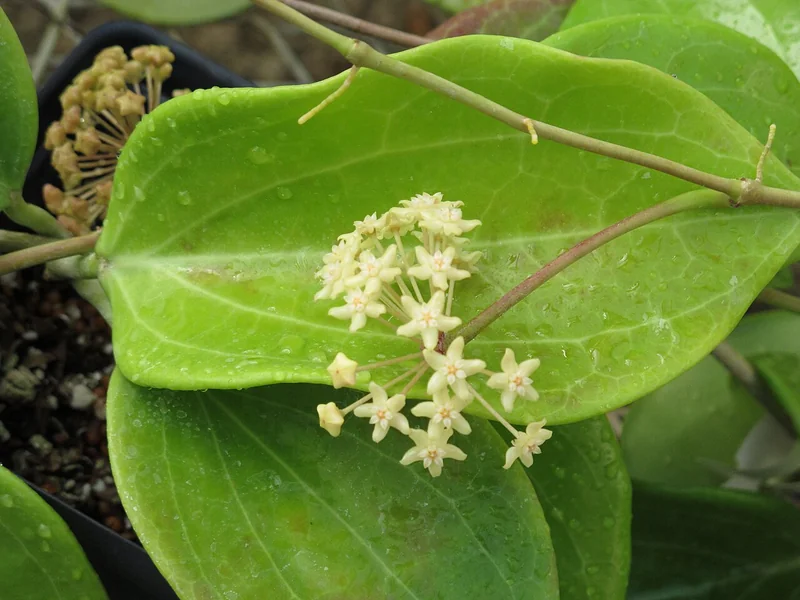 Featured photohoya-merrillii.jpg
Hoya merrillii is a Philippine hoya with thick, succulent-like glossy leaves and compact clusters of small, pure white star-shaped flowers with a contrasting yellow-red corona at the centre. Named for botanist Elmer Drew Merrill, it grows as an epiphytic vine in humid Philippine forests and is an attractive, moderately demanding species for intermediate to experienced hoya growers. Its high-gloss foliage and striking white flowers distinguish it from the majority of pink-flowering Philippine species.
Care facts at a glance
- Light
- Bright indirect
- Water
- Water when the top 3 to 4 cm of the substrate has dried; roughly every 10 to 14 days in summer.
- Humidity
- 55–75 %
- Temperature
- 18–30 °C
- Soil
- Chunky, free-draining hoya mix with bark and perlite.
- Origin
- Humid forests of the Philippines.
- Mature size
- Vining to 2 to 4 m; leaves 6 to 12 cm long.
Overview
Hoya merrillii was described by Schlechter and named in honour of American botanist Elmer Drew Merrill, who extensively documented the flora of the Philippines in the early twentieth century. It belongs to the large and diverse Philippine hoya flora, distinguished by its notably thick, glossy leaves that have a semi-succulent texture unusual among the group. The white flowers with coloured coronas are a consistent trait across the species and create a striking contrast against the dark green foliage when in bloom.
Care Priorities
- Bright, indirect light is essential for flowering; the thick leaves can tolerate some morning sun but avoid midday direct exposure.
- The thick-leaved nature provides good drought tolerance; allow thorough drying between waterings.
- Higher minimum temperature than some hoyas — maintain above 18 °C year-round to avoid chilling damage.
- Retain all spent peduncles; new flower umbels are initiated from the same spur each season.
Common Problems
Yellowing leaves that feel soft or mushy at the base indicate root rot; improve aeration in the substrate and reduce watering immediately. Scale insects can colonise the glossy leaf undersides and stem nodes; the hard waxy covering makes them resistant to simple sprays — treat with neem oil or systemic insecticide. Failure to bloom despite otherwise good health usually indicates insufficient light; move the plant to a brighter position and supplement with high-phosphorus fertilizer.
Sources & further reading (2)
- botanical-garden — accessed 2026-05-08
- encyclopedia — accessed 2026-05-08
Frequently asked questions
How do I distinguish H. merrillii from H. pubicalyx?
Merrillii has thicker, more succulent-textured leaves and white flowers, while pubicalyx has thinner, more flexible leaves and typically produces dark red to pink flowers with a stronger fragrance.
Is it widely available?
It is less commonly stocked than mainstream species but is available through specialist hoya nurseries and online plant communities. Expect to source it from a collector rather than a general garden centre.
How fast does it grow?
At a moderate rate — typical of Philippine hoyas in good conditions. Expect several new leaves per season with steady warmth, bright indirect light, and regular feeding.