Homalomena lindenii
Homalomena lindenii Care Guide
 Featured photohomalomena-lindenii.jpg
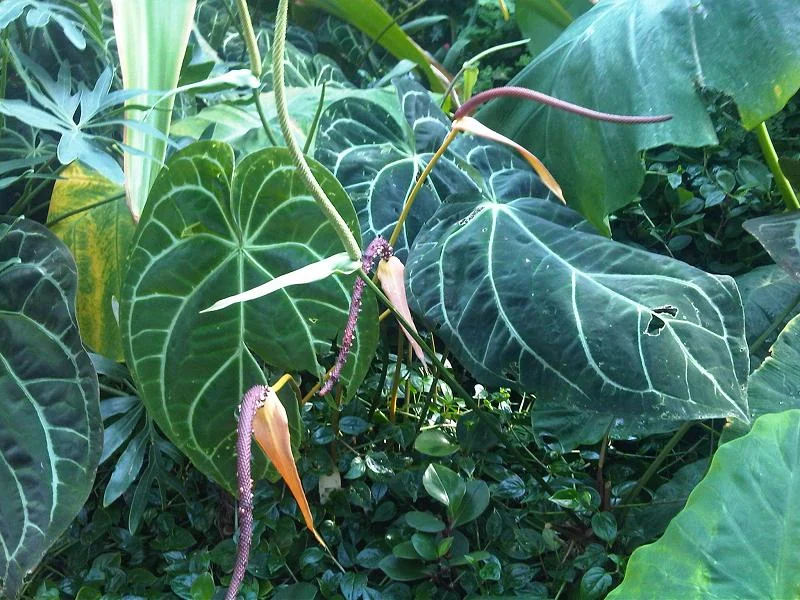
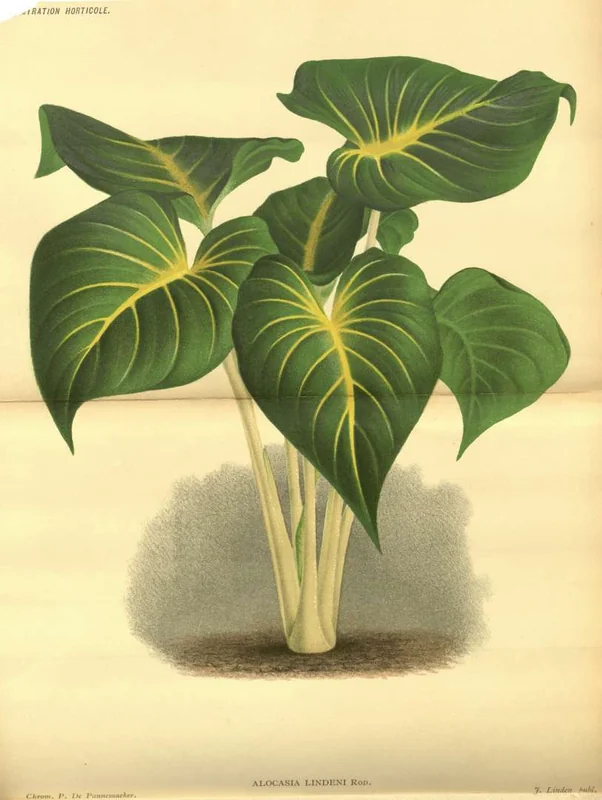
Homalomena lindenii is a Philippine aroid prized for its large, heart-shaped, velvety-dark-green leaves decorated with contrasting white to cream venation that radiates from the central midrib. It offers the visual drama of the more demanding Anthurium clarinervium or A. crystallinum but tolerates lower light and lower humidity, making it a more accessible alternative for aroid collectors. The compact clumping habit makes it ideal for medium-sized pots on shelves and desks.
Care facts at a glance
- Light
- Bright indirect
- Water
- Water when the top 3 cm of medium dries; approximately every 7 to 10 days in summer.
- Humidity
- 50–80 %
- Temperature
- 18–30 °C
- Soil
- Well-draining aroid mix: coco coir, perlite, and orchid bark in equal parts.
- Origin
- Humid tropical forests of the Philippines.
- Mature size
- 30 to 60 cm tall; compact clumping growth.
Overview
Homalomena lindenii was described by Bull in 1888, named for the Belgian horticulturist Jean Jules Linden. The species gained collector status in the 2020s as part of a broader resurgence of interest in Homalomena as a group. Its velvety leaf surface is caused by the same microscopic papillae responsible for the velvet effect in philodendrons and anthuriums, and the white venation results from a reflective epidermal layer above the green mesophyll. Unlike velvet anthuriums, H. lindenii does not require extremely high humidity to maintain leaf integrity.
Care Priorities
- Bright, indirect light brings out the full contrast of the white venation; low light causes the pattern to become less pronounced.
- The aromatic compounds typical of Homalomena are present — a gentle anise-like scent when leaves are brushed is normal.
- Feed every 3 weeks in the growing season; the slow growth rate means the plant does not need heavy fertilisation.
- Re-pot every 2 years in fresh aroid mix, using a pot only slightly larger than the root ball.
Common Problems
White venation that fades toward plain green indicates insufficient light — move closer to a bright window. Yellowing lower leaves at a slow pace is normal leaf cycling, but rapid yellowing paired with soft petioles indicates root rot; inspect the rhizome and improve drainage. Thrips are the most common pest, leaving a characteristic silvery streaking; treat with neem oil or spinosad, repeating every 5–7 days for 3 treatments. Brown leaf tips from low humidity respond well to a humidifier or pebble tray.
Sources & further reading (2)
- botanical-garden — accessed 2026-05-27
- encyclopedia — accessed 2026-05-27
Frequently asked questions
Is it the same as Homalomena 'Lemon Lime'?
No. 'Lemon Lime' is a Homalomena cultivar with green-gold variegation that is likely derived from H. rubescens. H. lindenii is a distinct species with dark-green leaves and white venation rather than colour variegation.
How does it compare to Anthurium clarinervium care-wise?
H. lindenii is considerably more forgiving. It tolerates lower humidity (50% vs 70%+ for A. clarinervium), lower light, and less precise watering — making it a good starting point for collectors interested in white-veined foliage plants.
Does the fragrance mean anything?
The mild anise-like scent when leaves are touched is a characteristic trait of the Homalomena genus and not an indicator of any problem. It is caused by phenylpropanoid compounds in the leaf tissues.