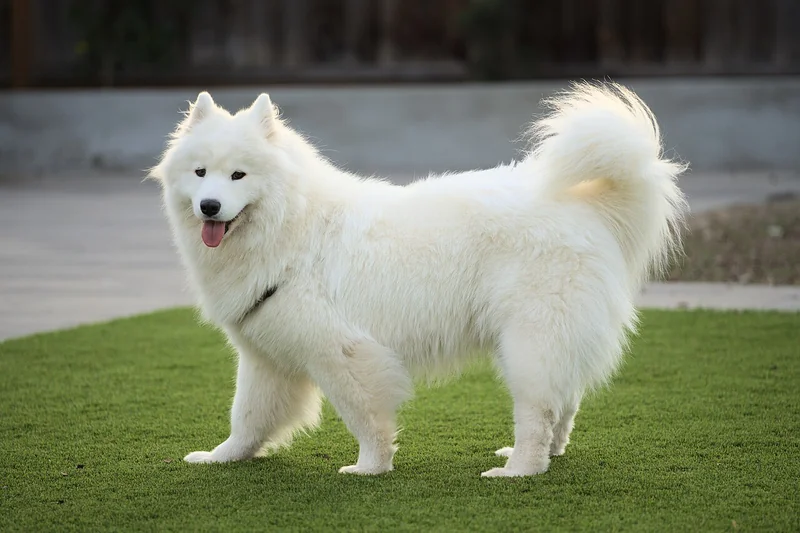
The Samoyed is a large, strikingly beautiful spitz-type working dog originating from northwestern Siberia, where the Samoyedic peoples — principally the Nenets — bred it for thousands of years to herd reindeer, haul sleds, and share their nomadic tents for mutual warmth in extreme Arctic cold. Its characteristic dazzling white double coat, perpetual 'Samoyed smile' caused by upturned lip corners, and dark, almond-shaped eyes are hallmarks of the breed. The AKC recognised the Samoyed in 1906. Males stand 53–60 cm and weigh 20–30 kg.
Quick facts
- AKC group
- Working
- Origin country
- Russia
- Origin period
- Ancient
- Coat type
- Double
- Coat colors
- Pure White, White and Biscuit, Cream
- Average lifespan
- 12-14 years
- Recognition
- AKC 1906 · FCI 1959 · UKC 1942 · Group 5 — Spitz and Primitive Types (Section 1: Nordic Sledge Dogs)
Origin
The Samoyed developed over thousands of years in the harsh sub-Arctic and Arctic tundra of northwestern Siberia — primarily the Yamal and Gydan Peninsulas — in close symbiosis with the Nenets (formerly called the Samoyed people by Russians) and related nomadic reindeer-herding cultures. The dogs shared the nomads' portable skin tents (chums) at night, sleeping against humans for warmth in temperatures that drop below −50°C. This intimate co-evolution produced a dog of exceptional sociability, stamina, and coat insulation. The breed was used for herding, hauling loads, and hunting.
Recognition
The Samoyed first reached Western Europe when British explorer Robert Scott brought specimens to England in the 1880s. Queen Alexandra of Denmark, consort of King Edward VII, became an ardent patron of the breed and maintained a royal kennel; her dogs trace to the Siberian imports and form part of the foundation of the Western studbook. The AKC recognised the Samoyed in 1906, making it one of the earlier spitz breeds admitted. The FCI (FCI No. 212) recognised the breed in 1959, assigning Russia and Finland as co-patron countries.
Standard
The AKC and FCI standards describe a medium-large, well-proportioned spitz of great beauty and dignity with a smiling expression — the upturned corners of the mouth and dark eye rims that prevent snow-blindness glare both contribute to the characteristic 'Samoyed smile'. The double coat is the breed's most distinctive feature: the outer coat is long, harsh, straight, and glistening white; the undercoat is soft, thick, close, and woolly. Accepted colours are pure white, white and biscuit, and cream. Males stand 53–60 cm; females 48–53 cm.
Sources & further reading (3)
- kennel-club-registry — accessed 2026-05-07
- encyclopedia — accessed 2026-05-07
- fci-standard — accessed 2026-05-07
Frequently asked questions
What AKC group does the Samoyed belong to?
The AKC places the Samoyed in the Working Group. The breed was developed as a sled-hauling, reindeer-herding, and companion dog by the Nenets people of Siberia. The FCI classifies it in Group 5 (Spitz and Primitive types), Section 1 (Nordic Sledge Dogs), alongside the Siberian Husky and Alaskan Malamute.
Why does the Samoyed always appear to be smiling?
The Samoyed's characteristic 'smile' is a structural feature caused by the upturned corners of the mouth, which are specified in the breed standard. This feature has a functional origin: the upturned lip corners prevent drool from forming and freezing on the face in sub-Arctic temperatures, which could cause frostbite. The dark, almond-shaped eyes with their dark pigmented rims also reduce glare from snow — both are adaptations to the extreme cold of the Siberian tundra.
Did Samoyeds participate in polar expeditions?
Yes. Samoyeds were used in several historic polar expeditions at the turn of the 20th century. Fridtjof Nansen used Samoyed-type dogs on his 1895 Farthest North attempt; Carsten Borchgrevink brought Samoyeds to Antarctica in 1898–1900; and Roald Amundsen used dogs that included Samoyed blood on the 1910–12 South Pole expedition. Their thick double coats made them better suited to Antarctic conditions than most other breeds.