Canis lupus familiaris
Black Russian Terrier
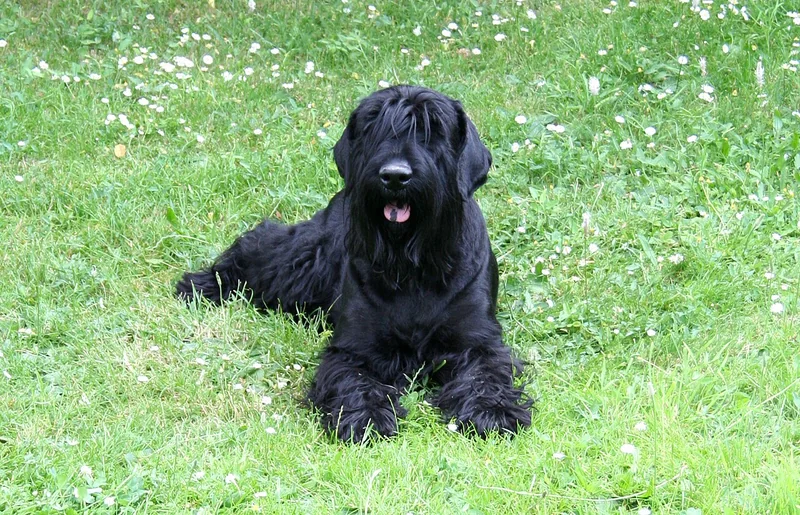 Featured photoblack-russian-terrier.jpg
The Black Russian Terrier is a large, powerful working dog developed in the Soviet Union during the late 1940s and 1950s at the Red Star (Krasnaya Zvezda) State Kennel near Moscow. Soviet military cynologists crossed seventeen breeds — including the Giant Schnauzer, Airedale Terrier, Rottweiler, and Newfoundland — to produce the ideal military working dog: large, confident, cold-tolerant, and all-black. Despite its name, the Black Russian Terrier is not a true terrier but a working breed. The AKC admitted it in 2004. Males stand 66–76 cm and weigh 36–65 kg.
Quick facts
- AKC group
- Working
- Origin country
- Russia
- Origin period
- Mid-20th century
- Coat type
- Double
- Coat colors
- Black, Black with Grey Hairs
- Average lifespan
- 10-12 years
- Recognition
- AKC 2004 · FCI 1984 · UKC 2001 · Group 2 — Pinscher and Schnauzer-Molossoid Breeds, Swiss Mountain and Cattle Dogs (Section 1.3: Schnauzers)
Origin
The Black Russian Terrier was an entirely planned creation of the Soviet state. Following World War II, the Red Star (Krasnaya Zvezda) State Kennel near Moscow was directed to develop a new working breed for the Soviet military and security services. Wartime losses of dog populations had created shortages of capable working animals. Colonel G. Medvedev oversaw the project starting in 1947, selecting and crossing breeds for size, protective instinct, cold tolerance, and an all-black coat that would provide camouflage in low light. Seventeen breeds eventually contributed, with the Giant Schnauzer dominant in the foundation.
Recognition
The Soviet Ministry of Agriculture approved the first breed standard in 1958. The breed was initially maintained exclusively by Soviet state kennels; civilian breeding began in the 1970s after the military deemed the breed established. The FCI recognised the Black Russian Terrier in 1984 (FCI No. 327) and assigned it — despite its name — to Group 2 (Pinscher and Schnauzer types) alongside the Giant Schnauzer, reflecting its primary ancestry. The AKC admitted the breed in 2004, placing it in the Working Group.
Standard
The AKC and FCI standards describe a large, slightly longer than tall, powerfully built dog with a strong, somewhat heavy head and a distinct beard and mustache inherited from its Giant Schnauzer ancestry. The double coat is coarse, slightly wavy, and 4–10 cm in length, always black, with minor salt-and-pepper or grey admixture permissible. The undercoat is dense and soft. Males stand 66–76 cm and weigh 36–65 kg; females are 64–72 cm.
Sources & further reading (3)
- kennel-club-registry — accessed 2026-05-07
- encyclopedia — accessed 2026-05-07
- fci-standard — accessed 2026-05-07
Frequently asked questions
What AKC group does the Black Russian Terrier belong to?
The AKC places the Black Russian Terrier in the Working Group. Despite its name, the Black Russian Terrier is not classified as a terrier in either the AKC or FCI systems — the FCI places it in Group 2 (Pinscher and Schnauzer types) based on its predominant Giant Schnauzer ancestry and working dog function. The name reflects its Soviet development program designation rather than a true terrier classification.
How many breeds contributed to the Black Russian Terrier?
Soviet military cynologists at the Red Star State Kennel used seventeen breeds in the Black Russian Terrier's development. The most significant contributors were the Giant Schnauzer (the dominant foundation breed), Airedale Terrier, Rottweiler, Newfoundland, Caucasian Shepherd Dog, and the now-extinct Moscow Retriever and Moscow Water Dog. The goal was to engineer an ideal working dog for the Soviet military and security apparatus.
When was the Black Russian Terrier recognised by the AKC?
The AKC granted full recognition to the Black Russian Terrier in 2004, placing it in the Working Group. The UKC had recognised the breed in 2001. The FCI recognised it earlier, in 1984 (FCI No. 327), following the Soviet state's publication of the first breed standard in 1958.