Canis lupus familiaris
Rough Collie
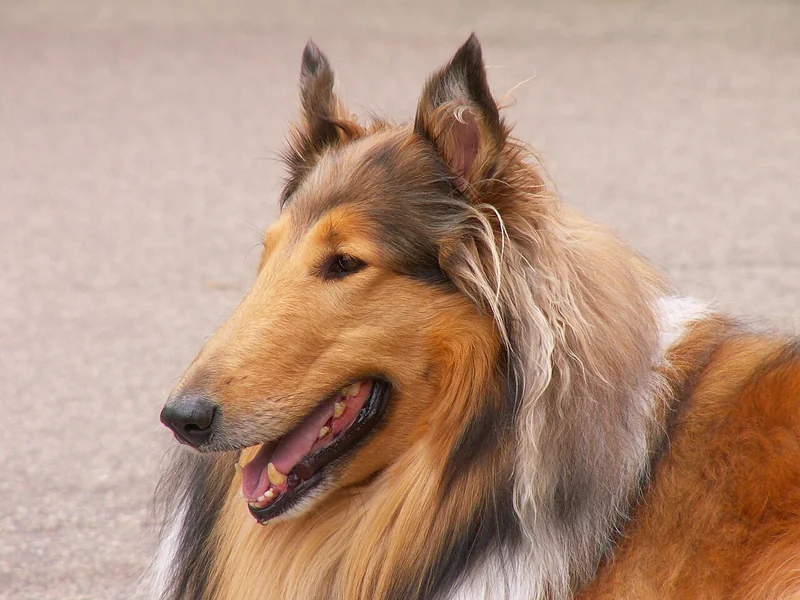 Featured photorough-collie.jpg
The Rough Collie is a large, long-coated Scottish herding breed developed in the Scottish Lowlands and popularised as a show and companion dog in the mid-19th century after Queen Victoria began keeping the breed at Balmoral. The breed's global fame was cemented by the fictional Collie 'Lassie' in novels, films, and television from 1940 onward. The AKC admitted the Rough Collie in 1885 and places it in the Herding Group. Males stand 60–66 cm.
Quick facts
- AKC group
- Herding
- Origin country
- Scotland
- Origin period
- 19th century (exhibited from 1860)
- Coat type
- Double
- Coat colors
- Sable and White, Tri-colour (Black, White, and Tan), Blue Merle and White, White
- Average lifespan
- 12-14 years
- Recognition
- AKC 1885 · FCI 1954 · UKC 1914 · Group 1 — Sheepdogs and Cattledogs (Section 1: Sheepdogs)
Origin
The name 'Collie' is of uncertain origin; proposed derivations include the Celtic 'col' (black), a reference to the black-faced sheep the dogs herded, and the Anglo-Saxon 'col' (coal). Working Collies in the Scottish Lowlands were small, active working dogs used to herd sheep on rough Highland and Lowland terrain. Queen Victoria's patronage from the 1860s radically transformed the breed's social status; she kept Collies at Balmoral and exhibited them at shows in London, sparking a fashion among the English aristocracy. Wealthy breeders in the 1880s introduced refinements — including the elongated head profile credited to Borzoi outcrossing — that produced the modern show type.
Recognition
The Collie Club was founded in England in 1881, the first single-breed dog club in the world. The AKC admitted the Collie in 1885, making it one of the earliest AKC-registered breeds. The FCI registered the Rough Collie (together with the Smooth Collie) under standard No. 156 in 1954, classifying both in Group 1, Section 1 (Sheepdogs) with Great Britain as patron country. The Rough and Smooth Collie are registered as separate varieties under the AKC but as a single breed with two varieties by the FCI.
Standard
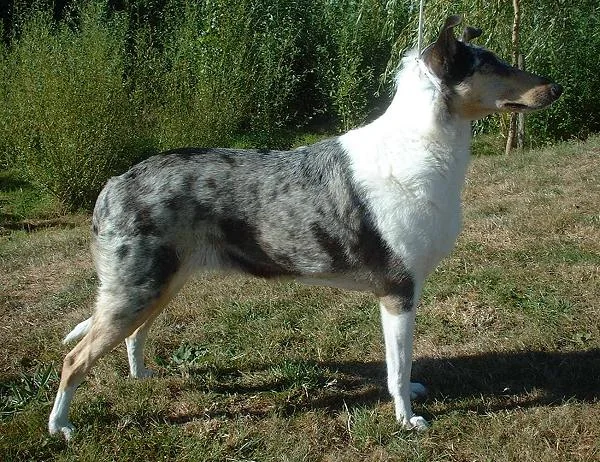
The AKC and FCI standards describe a large, lean, symmetrical dog with a distinctive narrow, blunt-wedge-shaped head — flat on top, tapering gradually from behind the ears to the end of the smooth muzzle. The double coat consists of a dense, soft undercoat and a long, harsh, flat outer coat that forms a full mane and frill. Recognised colours are sable and white, tri-colour, blue merle and white, and white. Males stand 60–66 cm; females 56–61 cm. The Smooth Collie is identical in type but has a short, flat outer coat.
Sources & further reading (3)
- kennel-club-registry — accessed 2026-05-27
- encyclopedia — accessed 2026-05-27
- fci-standard — accessed 2026-05-27
Frequently asked questions
What is the difference between the Rough Collie and the Smooth Collie?
The Rough Collie and Smooth Collie are identical in build, proportions, colour, and character; the only difference is coat length. The Rough Collie has a long, abundant outer coat with a full mane and frill; the Smooth Collie has a short, dense, flat outer coat. The AKC registers them as two varieties of one breed (Collie — Rough and Smooth); the FCI also registers them together as FCI No. 156 with two coat varieties.
When did the AKC recognise the Rough Collie?
The AKC admitted the Collie (Rough and Smooth varieties together) in 1885, making it one of the very earliest AKC-recognised breeds. The Collie Club of England had been founded in 1881 — it was the first single-breed dog club in the world.
Who was Lassie, and what impact did she have on the Collie breed?
Lassie is a fictional Rough Collie created by Eric Knight in his 1940 novel 'Lassie Come-Home'. MGM adapted it into a film series (1943–1951) and it became a long-running American television series (1954–1973). Lassie's portrayal of a loyal, intelligent rescue dog made the Rough Collie one of the most recognised breeds in the world and drove a substantial increase in registrations throughout the mid-20th century.