Canis lupus familiaris
Dogue de Bordeaux
 Featured photodogue-de-bordeaux.jpg
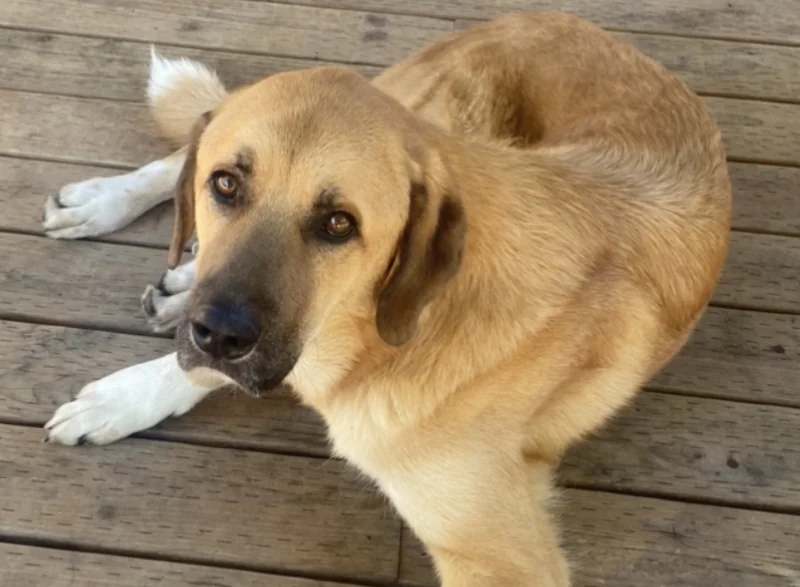
The Dogue de Bordeaux, also called the French Mastiff or Bordeaux Bulldog, is one of the oldest French dog breeds and one of the most ancient molosser breeds in existence. A powerful, athletic, and imposing guard dog, it is characterised by its massive head — the largest relative to body size of any dog breed — and its wrinkled fawn or mahogany coat. The breed gained international recognition when the 1989 American film 'Turner & Hooch' featured a Dogue named Beasley opposite Tom Hanks. The AKC admitted the breed in 2008. Males stand 60–68 cm and weigh at least 50 kg.
Quick facts
- AKC group
- Working
- Origin country
- France
- Origin period
- Ancient, documented from 14th century
- Coat type
- Short
- Coat colors
- Fawn, Mahogany, Golden
- Average lifespan
- 5-8 years
- Recognition
- AKC 2008 · FCI 1954 · UKC 1997 · Group 2 — Pinscher and Schnauzer-Molossoid Breeds, Swiss Mountain and Cattle Dogs (Section 2.1: Molossoid breeds, Mastiff type)
Origin
The Dogue de Bordeaux is among France's oldest dog breeds, documented in the Bordeaux region as far back as the 14th century. Historical records describe the breed's use as a war dog under French nobles, a guard and draught animal for butchers and farmers, and a hunting dog for boar and bears. The breed's ancestry is traditionally linked to the ancient Alano molosser dogs of the Iberian Peninsula or to Roman war dogs introduced to France; modern DNA studies suggest a complex European molosser heritage. The breed was widely distributed across southern France before the Revolution.
Recognition
The Société Centrale Canine (French kennel club) recognised the Dogue de Bordeaux in the 19th century. The FCI standard (FCI No. 116) was established in 1954, with France as patron country. The breed's popularity in France declined severely after World War II; Professor Raymond Triquet's revival efforts from the 1960s stabilised the population. The AKC admitted the breed to the Working Group in 2008. International fame came in 1989 when the film 'Turner & Hooch' featured the breed and drove global interest.
Standard
The FCI and AKC standards describe a very powerful, well-muscled dog — one of the heaviest-boned dogs in the world — with a massive, broad, short head that is the largest relative to body size among all breeds. The skull is covered with symmetrical wrinkles and loose skin. The muzzle is short and broad with characteristic large folds; the lower jaw curves slightly upward. The coat is short, fine, and close. Accepted colours are fawn (pale to dark) and mahogany; a black, brown, or red mask is standard. Males stand 60–68 cm.
Sources & further reading (3)
- kennel-club-registry — accessed 2026-05-07
- encyclopedia — accessed 2026-05-07
- fci-standard — accessed 2026-05-07
Frequently asked questions
What AKC group does the Dogue de Bordeaux belong to?
The AKC places the Dogue de Bordeaux in the Working Group. The breed is a large guard and protection dog historically used in the Bordeaux region of France for guarding estates, hunting large game, and as a draught animal. The FCI classifies it in Group 2, Section 2.1 (Molossoid breeds, Mastiff type) alongside other mastiff-type working breeds.
What is unusual about the Dogue de Bordeaux's head?
The Dogue de Bordeaux has the largest head relative to body size of any dog breed — a characteristic explicitly noted in the FCI and AKC breed standards. The skull is massive, broad, and covered with symmetrical wrinkles and loose skin. The perimeter of the head can exceed the dog's height at the withers. This extreme head morphology is a long-standing breed trait traced to its ancient molosser and mastiff ancestry.
When was the Dogue de Bordeaux recognised by the AKC?
The AKC granted full recognition to the Dogue de Bordeaux in 2008, placing it in the Working Group. The FCI had recognised the breed since 1954 (FCI No. 116). The breed's international profile rose sharply after the 1989 film 'Turner & Hooch', in which a Dogue named Beasley co-starred with Tom Hanks.