Canis lupus familiaris
Bolognese
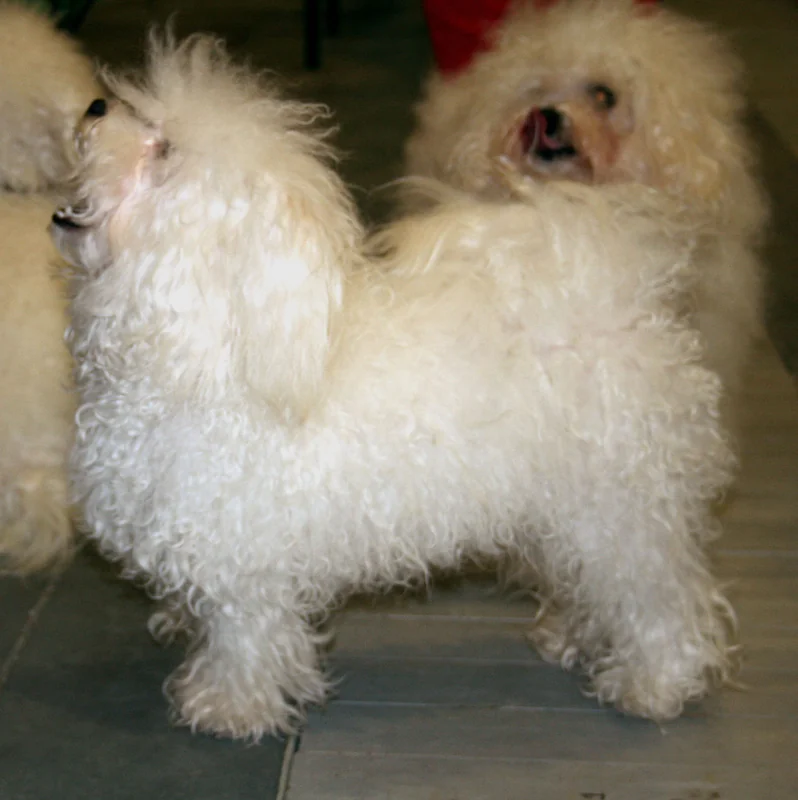 Featured photobolognese.jpg
The Bolognese is a small, entirely white, fluffy-coated companion dog of Italian origin, documented as a gift among the ruling families of Renaissance Italy from at least the 11th century. The breed takes its name from the city of Bologna and is classified by the FCI as a member of the Bichon family. The FCI registers it as No. 196. The AKC lists the Bolognese in the Foundation Stock Service. Males stand 25–30 cm.
Quick facts
- AKC group
- Toy
- Origin country
- Italy
- Origin period
- Medieval, documented from 11th century
- Coat type
- Curly
- Coat colors
- Pure White
- Average lifespan
- 13-15 years
- Recognition
- FCI 1990 · Group 9 — Companion and Toy Dogs (Section 1: Bichons and related breeds)
Origin
The Bolognese is a member of the Bichon family — a group of small, white, fluffy companion dogs that spread across the Mediterranean and western European courts during the medieval and Renaissance periods. The breed is named for the city of Bologna in Emilia-Romagna and is documented in Italian manuscripts from the late medieval period. Several Renaissance paintings include Bolognese or similar Bichon-type dogs in court settings; Titian's 1548 portrait of Clarissa Strozzi includes a small white dog closely resembling the modern breed. Cosimo de' Medici (1519–1574) sent two Bolognese as diplomatic gifts to Philip II of Spain.
Recognition
The breed had declined to near-extinction by the late 19th century. Gino Nunziante of Belgium and Italian breeders worked from the early to mid-20th century to revive the Bolognese from surviving specimens. The Ente Nazionale della Cinofilia Italiana (ENCI) granted recognition in 1990, and the FCI registered the breed under standard No. 196, classifying it in Group 9, Section 1 (Bichons and related breeds) with Italy as patron country. The AKC lists the Bolognese in the Foundation Stock Service. The Kennel Club (UK) recognised the breed in 1996.
Standard
The FCI standard describes a small, stocky, squarely built dog with a compact, well-muscled body. The distinctive coat is entirely white, fluffy, and covers the whole body including the muzzle and forehead — the coat appears wavy rather than tightly curled like a Bichon Frise, with individual longer, softer locks. No undercoat is present. The coat must be pure white without any off-white, cream, or yellow tinge. Males stand 27–30 cm; females 25–28 cm.
Sources & further reading (3)
- fci-standard — accessed 2026-05-27
- encyclopedia — accessed 2026-05-27
- kennel-club-registry — accessed 2026-05-27
Frequently asked questions
How does the Bolognese differ from the Bichon Frise?
Both the Bolognese and the Bichon Frise are white, small companion dogs of the Bichon family and share a similar general appearance. The key differences are coat texture and build: the Bolognese has a fluffier, looser, wavy-to-fluffy coat with no undercoat, while the Bichon Frise has a tighter, curlier double coat. The Bolognese is also slightly more square and compact in build, with a less rounded head than the Bichon Frise.
Is the Bolognese AKC recognised?
The Bolognese is not fully recognised by the AKC but is listed in the AKC Foundation Stock Service (FSS). The FCI has recognised the breed since 1990 under standard No. 196 with Italy as patron country. The Kennel Club (UK) recognised the Bolognese in 1996.
Why was the Bolognese popular among Renaissance nobility?
Small, fluffy white companion dogs were highly prized as luxury gifts among the Italian ruling families of the Renaissance because they were expensive to breed and maintain, visually striking, and could be carried in one's arms or lap — a public display of wealth. The Medici, Este, and Gonzaga families all kept Bolognese and used them in diplomatic exchanges. Cosimo de' Medici's gift of two Bolognese to Philip II of Spain in 1668 is one of the most documented instances of this courtly dog-gift tradition.