Canis lupus familiaris
Affenpinscher
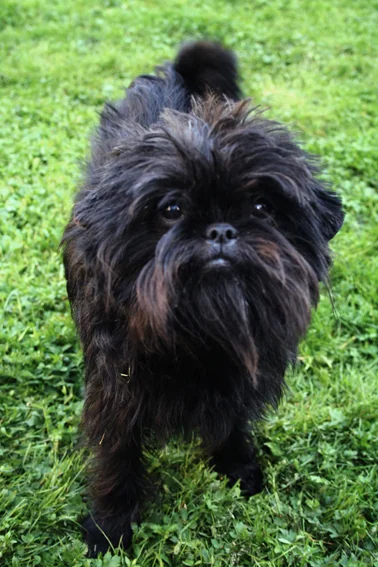 Featured photoaffenpinscher.jpg
The Affenpinscher is a 17th-century German monkey-faced ratter — downsized to toy size by 19th-century breeding. The Affenpinscher (German for 'monkey-pinscher', after the breed's distinctive simian face) is one of the oldest of the German toy breeds, depicted in 17th-century Dutch paintings (Jan van Eyck's 'Arnolfini Portrait' is sometimes claimed as a predecessor).
Quick facts
- AKC group
- Toy
- Origin country
- Germany
- Origin period
- 17th century
- Coat type
- Wirehaired
- Coat colors
- Black, Grey, Silver, Red, Black and Tan, Belge
- Average lifespan
- 11-14 years
- Recognition
- AKC 1936 · FCI 1954 · UKC 1948 · Group 2 — Pinscher and Schnauzer-Molossoid breeds-Swiss Mountain and Cattle Dogs (Section 1.1: Pinscher type)
Origin
The Affenpinscher is one of the oldest of the German toy breeds, depicted in 17th-century Dutch paintings — Jan van Eyck's 1434 'Arnolfini Portrait' is sometimes claimed as the earliest surviving portrait of an ancestor (though the dog in that painting is more probably a Brussels Griffon ancestor). The breed was developed in southern Germany as a working ratter — kept in farmhouses, stables, and shops of 18th-century Munich and Lübeck to dispatch rats and mice. The original Affenpinscher was larger (about 30-33 cm) and was downsized to the modern toy size (23-30 cm) by 19th-century selective breeding. The Affenpinscher contributed foundation blood to several other modern breeds, including the Brussels Griffon and the Miniature Schnauzer. The Pinscher Schnauzer Klub was founded in Cologne in 1895 and the AKC admitted the Affenpinscher in 1936.
Recognition
The American Kennel Club admitted the breed in 1936, the United Kennel Club followed in 1948, and the Federation Cynologique Internationale published the international standard (FCI No. 186) in 1954. The FCI assigns the breed to Group 2 — Pinscher and Schnauzer-Molossoid breeds-Swiss Mountain and Cattle Dogs (Section 1.1: Pinscher type).
Standard
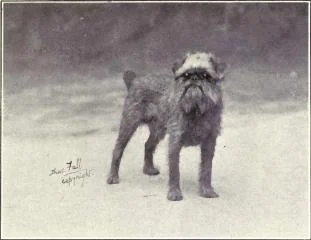
The AKC and FCI standards describe a balanced, sturdy, almost square, medium-boned terrier-like toy dog with a comically simian (monkey-like) facial expression — the feature for which the breed is named. The defining features are the round, prominent dark eyes, the short undershot jaw, and the rough, harsh, wiry coat that is shaggy on the head, neck, chest, stomach and legs forming the breed's typical 'monkey-face' beard and mane. Recognized colours include black, grey, silver, red, black-and-tan, and belge (a mix of red, brown, and black hairs).
Sources & further reading (3)
- kennel-club-registry — accessed 2026-04-30
- encyclopedia — accessed 2026-04-30
- fci-standard — accessed 2026-04-30
Frequently asked questions
What is the Affenpinscher's AKC group?
The American Kennel Club places the Affenpinscher in the Toy Group. The Toy Group gathers small companion breeds historically kept as lap dogs and household companions, including the Pug, Pomeranian, Maltese, and Cavalier King Charles Spaniel. The breed's foundation working role was as a 17th-century German monkey-faced ratter — downsized to toy size by 19th-century breeding.
When was the Affenpinscher officially recognized?
The American Kennel Club admitted the breed in 1936; the United Kennel Club followed in 1948; the Federation Cynologique Internationale published the international standard (FCI No. 186) in 1954.
What is the average lifespan of a Affenpinscher?
Kennel-club longevity surveys place the Affenpinscher's average lifespan in the 11-14 years range. The figure here represents the spread reported by the major parent-club studies and the Kennel Club (UK) purebred-dog health surveys.