Canis lupus familiaris
Biewer Terrier
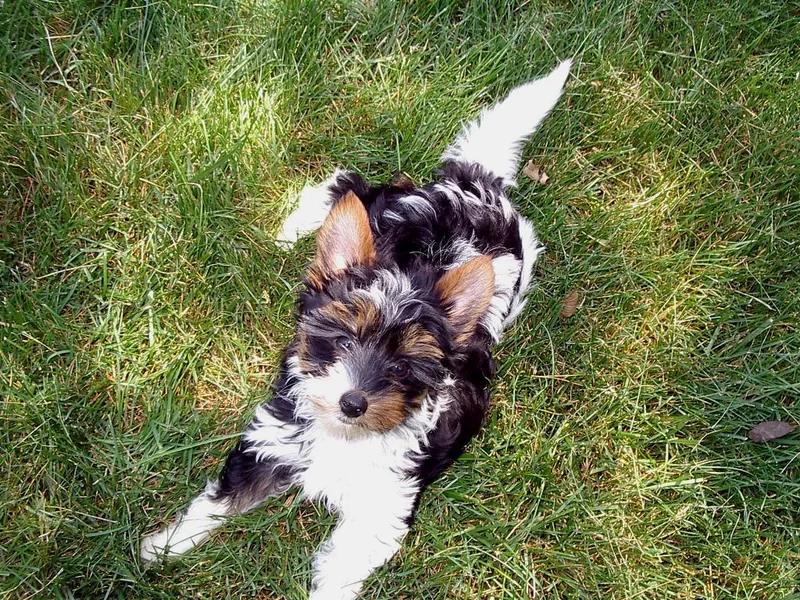 Featured photobiewer-terrier.jpg
The Biewer Terrier is a small German Toy terrier developed from Yorkshire Terriers by Werner and Gertrud Biewer, whose kennel produced a piebald tri-colored puppy in 1984. Its distinctive white, black or blue, and gold long silk coat marks it as a new breed. Scientific DNA testing in 2007 confirmed sufficient genetic differentiation from the Yorkshire Terrier — the first breed established by this method. The AKC admitted it in 2021. Males and females stand 20–23 cm and weigh 1.8–3.6 kg.
Quick facts
- AKC group
- Toy
- Origin country
- Germany
- Origin period
- Late 20th century
- Coat type
- Long
- Coat colors
- White Black and Gold, White Blue and Gold
- Average lifespan
- 16 years
- Recognition
- AKC 2021 · UKC 2016
Origin
The Biewer Terrier originated on January 20, 1984, at the kennel of Werner and Gertrud Biewer in Hunsrück, Rhineland-Palatinate, Germany. A piebald (parti-colored) puppy with white, blue, and gold markings — named Schneeflocken von Friedheck — appeared unexpectedly in a litter from two standard-coloured, fully registered Yorkshire Terrier parents. The piebald gene had apparently been recessive in the Yorkshire Terrier gene pool for generations. The Biewers began selectively breeding for the tri-colored type, naming the breed 'Biewer Terrier à la Pom Pon' in a playful reference to the traditional Yorkshire Terrier tail pom-pom.
Recognition
The Biewer Terrier Club of America commissioned a Mars Veterinary Wisdom Panel DNA study in 2007, which compared the Biewer Terrier's genetic markers with those of the Yorkshire Terrier and other toy breeds and found sufficient differentiation for the Biewer to be classified as a separate breed. This was the first time a breed had been formally established using scientific genetic analysis rather than traditional pedigree records alone. The AKC entered the Biewer Terrier in the Miscellaneous Class in 2019 and granted full Toy Group recognition in 2021.
Standard
The AKC standard describes a small, delicately structured dog with a long, flowing, silky coat that parts in the middle and falls straight down on both sides of the body to the floor. The body is compact and well-proportioned. The distinctive feature is the tri-colored coat in white, black or blue, and gold: the head is gold/tan with white and black; the body is blue or black, white, and gold/tan symmetrically distributed. The tail is carried over the back with a flowing plume. Males and females stand 20–23 cm and weigh 1.8–3.6 kg.
Sources & further reading (3)
- kennel-club-registry — accessed 2026-05-07
- encyclopedia — accessed 2026-05-07
- breed-club — accessed 2026-05-07
Frequently asked questions
What AKC group does the Biewer Terrier belong to?
The AKC places the Biewer Terrier in the Toy Group. The breed was recognised as a new Toy terrier breed in 2021 — the most recent breed to achieve full AKC recognition. Its small size (1.8–3.6 kg, 20–23 cm), flowing silk coat, and companion-dog function place it naturally in the Toy Group alongside the Yorkshire Terrier and other small terrier-origin Toy breeds.
How is the Biewer Terrier different from the Yorkshire Terrier?
The most obvious difference is the coat color pattern: the Biewer Terrier has a distinctive tri-colored piebald coat — white, black or blue, and gold — with white on the body, whereas the Yorkshire Terrier has a two-colored coat of black/blue and tan/gold without white on the body. The Biewer also tends to have a slightly more rounded head. Scientific DNA analysis in 2007 confirmed that the Biewer Terrier has sufficient genetic differentiation from the Yorkshire Terrier to be classified as a separate breed.
When was the Biewer Terrier recognised by the AKC?
The AKC granted full recognition to the Biewer Terrier in 2021, placing it in the Toy Group. This makes the Biewer Terrier the most recently recognised breed in the AKC Toy Group. The breed entered the AKC Miscellaneous Class in 2019. It was the first breed established by scientific DNA analysis rather than traditional pedigree documentation alone.