Felis catus
Scottish Straight
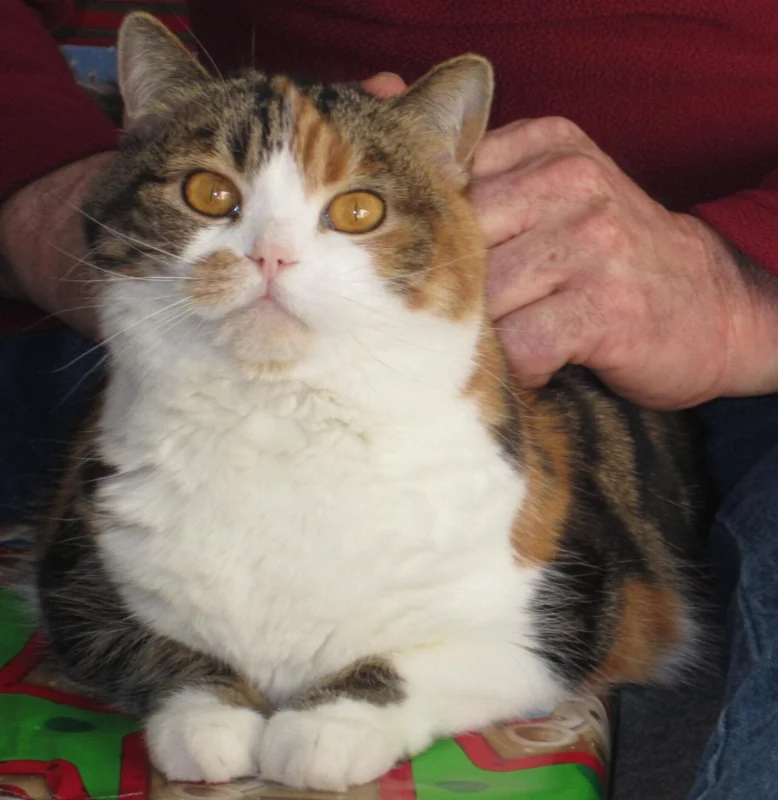 Featured photoscottish-straight.jpg
The Scottish Straight is the straight-eared variant of the Scottish Fold, carrying one copy of the fold gene without expressing the ear fold. First recorded in 1961 in Perthshire, Scotland, alongside Susie, the founding Scottish Fold, the straight-eared kittens are genetically essential to the breed's health. TICA recognizes the Scottish Straight as a separate breed designation, and all responsible Scottish Fold breeding programs pair a folded cat with a straight-eared partner.
Quick facts
- Origin country
- Scotland
- Origin period
- First recorded 1961; breed developed alongside Scottish Fold
- Coat type
- Short
- Coat colors
- All colors and patterns accepted, Tabby, Solid, Bicolor, Colorpoint
- Size category
- Medium
- Average lifespan
- 12-15 years
- Recognition
- TICA 1994
Origin
The Scottish Straight shares its origin story with the Scottish Fold. In 1961, William Ross of Perthshire, Scotland observed a white barn cat named Susie with uniquely forward-folding ears. Susie's litter included both folded and straight-eared kittens; the straight-eared kittens were the genetic counterparts essential to safe breeding. Geneticists subsequently determined that the Fd gene is dominant and that homozygous (Fd/Fd) cats develop osteochondrodysplasia, a painful skeletal condition. Heterozygous breeding (Fd/fd, folded × straight) avoids this condition, making straight-eared cats a required breeding partner.
Genetics and Breeding
The fold mutation in Scottish cats is caused by a single autosomal dominant mutation in the TRPV4 gene. Cats carrying two copies of the gene (homozygous Fd/Fd) develop severe osteochondrodysplasia affecting all cartilage and bone. Cats carrying one copy (heterozygous Fd/fd) display the folded ear and may develop milder skeletal signs. Cats carrying no copies (fd/fd) have straight ears and no skeletal risk from the fold mutation; these are the Scottish Straight. Responsible breeding requires mating a fold cat (Fd/fd) with a straight cat (fd/fd) to prevent homozygous offspring.
Appearance and Standard
Except for the ears, the Scottish Straight is physically identical to the Scottish Fold: a rounded, medium-sized cat with a round head, large round eyes, and a moderately long tail. The coat may be short or long (the long-coated version is the Highland Straight). All coat colors and patterns are accepted. TICA's standard emphasizes the rounded, plush appearance shared with the Fold while accepting the full upright ear set as the defining trait of the Straight class.
Sources & further reading (2)
- registry-breed-profile — accessed 2026-05-07
- encyclopedia — accessed 2026-05-07
Frequently asked questions
Is the Scottish Straight the same as the Scottish Fold?
The Scottish Straight is genetically related to the Scottish Fold but carries no copies of the fold gene, so its ears stand upright. Both originate from the same 1961 Scottish breeding line. TICA registers them as separate breed classes, and all responsible Scottish Fold programs require pairing a folded cat with a straight-eared partner to prevent skeletal disease.
Why are Scottish Straights necessary for breeding?
Cats homozygous for the fold gene (Fd/Fd) develop osteochondrodysplasia, a painful degenerative bone and cartilage disease. To avoid producing homozygous kittens, breeders must mate a heterozygous folded cat (Fd/fd) with a straight-eared cat (fd/fd). The Scottish Straight thus fulfills an essential health role in every responsible Fold breeding program.
When did TICA recognize the Scottish Straight?
TICA began accepting the Scottish Straight alongside the Scottish Fold in the early 1990s, with championship status established by approximately 1994. The registries that recognize the Scottish Fold as a breed typically also recognize its straight-eared counterpart, though some registries list them under a single breed standard with two ear-set divisions.