Felis catus
American Curl
 Featured photoamerican-curl.jpg
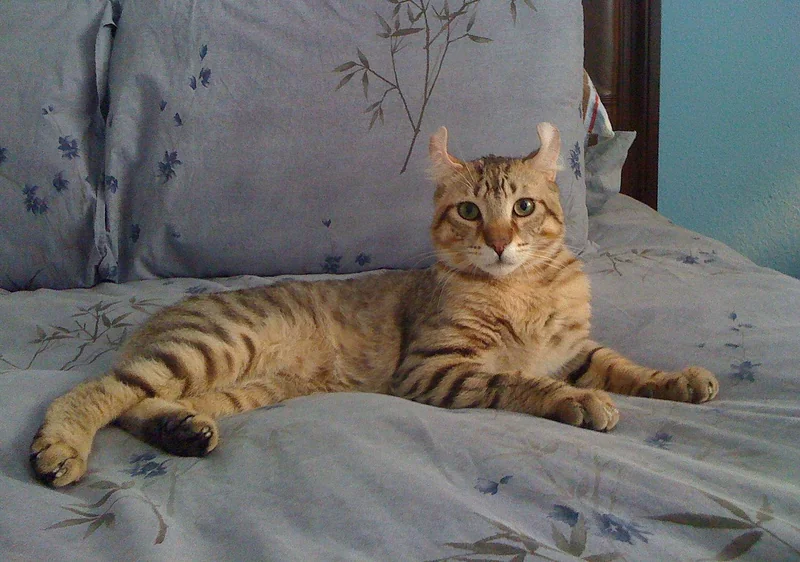
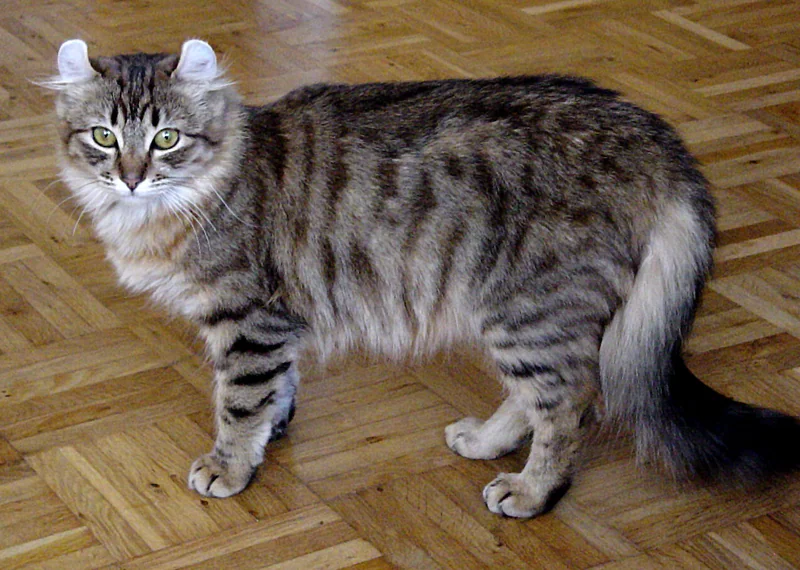
The American Curl is a breed defined by a natural dominant mutation causing the ears to curl backward in an arc. The foundation cat, Shulamith, was a stray longhaired black female found in Lakewood, California in 1981 by Joe and Grace Ruga. The Fd-like Curl gene is autosomal dominant. TICA recognized the American Curl in 1987; CFA granted championship status in 1993; and FIFe in 2002. The standard recognizes both short and long coat lengths.
Quick facts
- Origin country
- United States (Lakewood, California)
- Origin period
- 1981 natural curled-ear mutation (Shulamith; Joe and Grace Ruga); CFA championship 1993
- Coat type
- Short
- Coat colors
- All colours and patterns recognized (both shorthaired and longhaired varieties)
- Size category
- Medium
- Average lifespan
- 12-16 years
- Recognition
- CFA 1993 · TICA 1987 · FIFe 2002
Origin
Joe and Grace Ruga found a stray long-haired black kitten with distinctive backward-curling ears in Lakewood, California in 1981. They named her Shulamith. A litter sired by an unknown male tom included two curled-ear kittens, confirming the autosomal dominant nature of the Curl gene. Cat fancier Nancy Kiester recognized the breed's potential and introduced the Rugas to the cat fancy community. Genetics researcher Roy Robinson identified the gene as autosomal dominant without associated health concerns at normal curl arc.
Recognition
TICA recognized the American Curl in 1987 — one of the earliest recognitions among the newer US mutation breeds — and notably accepted both shorthaired and longhaired varieties as a single breed, a distinction unusual at the time. CFA granted championship status in 1993. FIFe published its standard in 2002. The GCCF does not maintain a separate American Curl championship register.
Standard
The CFA standard describes a medium-sized, well-balanced cat with a semi-foreign conformation and a moderately long body. The defining characteristic is the ear curl: ears must curve back in a smooth arc from the base of the ear to the tip, angled between 90 and 180 degrees in show cats. Ears curled less than 90 degrees are classified as 'pet quality' and not shown. The inner ear must be free of horizontal folds. Both shorthaired and longhaired varieties are fully recognized. All colours and patterns are accepted. Outcrosses to domestic cats without the curl gene are permitted to maintain genetic diversity.
Sources & further reading (3)
- registry-breed-profile — accessed 2026-04-30
- encyclopedia — accessed 2026-04-30
- fife-standard — accessed 2026-04-30
Frequently asked questions
When is an American Curl's ear curl evaluated?
Newborn American Curl kittens have straight ears. The ears begin to curl between two and ten days after birth, reaching their final configuration by around four months of age. Show-quality curl (90 to 180 degrees) is confirmed once the cartilage hardens. Kittens with less than 90 degrees of curl are considered pet-quality and are not shown in championship classes.
When was the American Curl recognized?
TICA recognized the American Curl in 1987. CFA granted championship status in 1993. FIFe published its standard in 2002. The GCCF does not maintain a separate American Curl register.
Is the American Curl available in both short and long coat lengths?
Yes. The American Curl is one of the few breeds recognized in both shorthaired and longhaired varieties under a single breed classification by CFA, TICA, and FIFe. The two coat-length varieties are judged by the same standard except for coat-specific criteria. This unified-breed approach was established at TICA's 1987 recognition and carried forward into CFA and FIFe standards.