Felis catus
Abyssinian
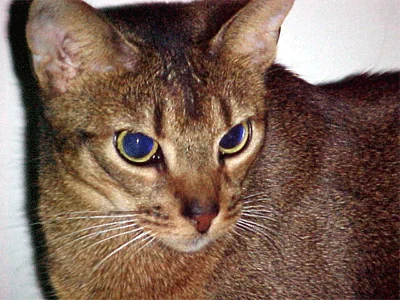 Featured photoabyssinian.jpg
The Abyssinian is one of the oldest recognized domestic cat breeds, often cited as resembling the cats depicted in ancient Egyptian art. The first Abyssinian shown in Britain is documented at the 1871 Crystal Palace cat show. The GCCF registered the breed in 1882; CFA admitted the Abyssinian among its founding breeds in 1906; FIFe in 1949; and TICA at its 1979 founding. The standard describes a slender, active, ticked-coat cat with large ears and a distinctive agouti pattern.
Quick facts
- Origin country
- Ethiopia (formerly Abyssinia)
- Origin period
- One of the oldest known breeds; introduced to UK c. 1868; CFA recognition 1906
- Coat type
- Short
- Coat colors
- Ruddy (burnt sienna with black ticking), Red (warm red with chocolate ticking), Blue (warm blue-grey with steel-blue ticking), Fawn (warm rose-beige with cocoa ticking)
- Size category
- Medium
- Average lifespan
- 9-15 years
- Recognition
- CFA 1906 · TICA 1979 · GCCF 1882 · FIFe 1949
Origin
The Abyssinian's historical documentation begins at the 1871 Crystal Palace cat show, where a cat named Zula was exhibited and described as captured during the Abyssinian War of 1867-1868. The Governing Council of the Cat Fancy registered the breed in 1882. Genetic studies published in the early 21st century suggest the closest ancestral wild sequences to the Abyssinian are found in cats from the coastal Indian Ocean region rather than from Northeast Africa, suggesting a more complex origin than the traditional account.
Recognition
The Governing Council of the Cat Fancy registered the Abyssinian in 1882. The Cat Fanciers' Association admitted the breed among its founding group in 1906. The Fédération Internationale Féline included the Abyssinian in its 1949 founding standards. The International Cat Association recognized the breed at its 1979 founding. All four major international registries maintain current Abyssinian standards.
Standard
The CFA standard describes a medium-sized, well-muscled, slender cat with a long body, long legs, and a fine, rounded wedge head with large ears and large almond-shaped eyes. The defining characteristic is the ticked agouti coat: each hair has multiple alternating bands of colour — lighter near the root, darker at the tip — producing the characteristic 'wild' appearance on a close-lying short coat. Four colour classes are recognized: ruddy, red, blue, and fawn. The coat is fine, dense, and resilient; banding must be visible on examination.
Sources & further reading (3)
- registry-breed-profile — accessed 2026-04-30
- encyclopedia — accessed 2026-04-30
- gccf-registry — accessed 2026-04-30
Frequently asked questions
Does the Abyssinian really come from Abyssinia?
The traditional account attributes the Abyssinian's origin to cats brought from Abyssinia (modern Ethiopia) by British soldiers returning from the 1867-1868 war. The 1871 Crystal Palace cat show documentation records a cat named Zula with this provenance. However, genetic studies in the early 21st century have found the closest ancestral wild sequences to the Abyssinian in cat populations from coastal Southeast Asia rather than Northeast Africa, suggesting the traditional Abyssinian-origin narrative may be apocryphal.
When was the Abyssinian recognized?
The GCCF registered the Abyssinian in 1882 — one of the earliest breed registrations in the cat fancy. CFA admitted the breed among its founding group in 1906. FIFe included the Abyssinian in its 1949 founding standards. TICA recognized the breed at its 1979 founding.
What is the agouti ticking pattern?
The agouti ticking pattern means each individual hair has multiple bands of alternating lighter and darker colour from root to tip — a feature technically called 'ticking'. On the Abyssinian, the base colour is warm and bright (ruddy, red, blue, or fawn) and the ticking bands are darker. The combination produces a 'wild' appearance on the body without discrete tabby stripes or spots. The head, legs, and tail may show faint tabby markings.