Felis catus
American Polydactyl
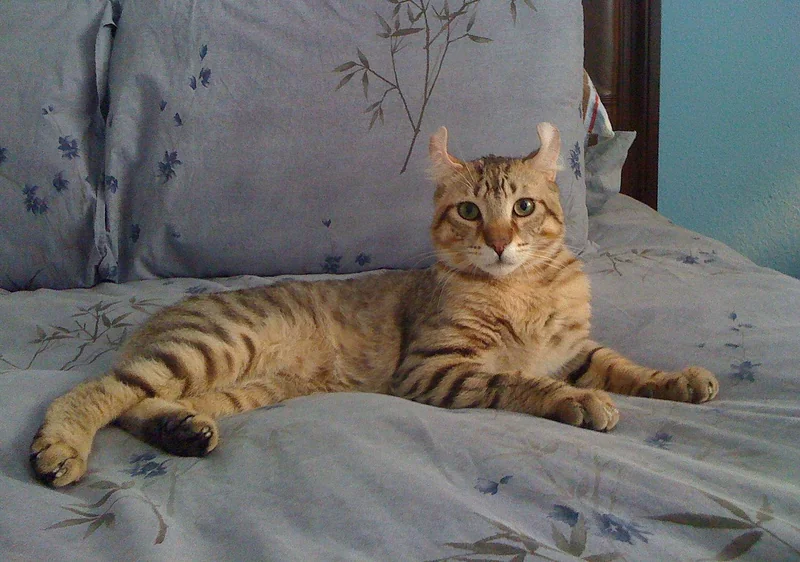 Featured photoamerican-polydactyl.jpg
The American Polydactyl is a domestic cat with extra toes (polydactyly) caused by a dominant genetic mutation. Polydactyl cats are strongly associated with the writer Ernest Hemingway, who kept them at his Key West home from the 1930s; over 40 polydactyl cats still live at the Hemingway Home and Museum. TICA tracks the American Polydactyl as a breed in development. The extra toes occur most commonly on the front feet and can give the paws a distinctive mitten-like appearance.
Quick facts
- Origin country
- United States
- Origin period
- Polydactyl trait ancient; breeding program and TICA tracking from 2000s
- Coat type
- Short
- Coat colors
- All colors and patterns accepted
- Size category
- Medium
- Average lifespan
- 12-16 years
- Recognition
- TICA 2000
Origin and History
Polydactyl cats occur worldwide through a dominant mutation at the Pd (polydactyly) locus. The trait became concentrated in eastern North America through its prevalence on sailing ships from Boston in the 18th-19th centuries; sailors considered polydactyl cats good luck and kept them aboard. The concentration of polydactyl cats in Maine, Massachusetts, and along the eastern seaboard is attributed to this maritime spread. The most famous association is with Ernest Hemingway: Captain Stanley Dexter gave Hemingway a six-toed cat named Snowball at his Key West home in the 1930s. Hemingway accumulated a large colony; the Hemingway Home and Museum in Key West maintains over 40 polydactyl cats descended from his line.
Genetics
The polydactyly in the American Polydactyl is caused by a dominant mutation in the Pd gene that affects limb development and causes extra digits to form. Cats typically have five toes on the front paws and four on the back; polydactyl cats may have six, seven, or occasionally more toes on the front paws (and sometimes on the rear paws as well). The extra toes may be fully formed with normal joints or may be vestigial. The dominant nature of the gene means a single copy produces the trait. The mutation does not cause health problems in heterozygous form; it is cosmetic. CFA does not recognize polydactyl cats as a separate breed within any standard.
Appearance
The American Polydactyl standard (as tracked by TICA) describes a cat of moderate to cobby type with no extreme features except the extra toes. The head is rounded to moderately wedge-shaped; the body is medium-sized and well-muscled; the coat may be short or semi-long. The defining feature is the paws: the extra toes on the front feet are most common and give the paws a broad, mitten-like appearance. In cats with fully formed extra toes, the paws appear noticeably wide and thumb-like. All colors and patterns are accepted. The standard emphasizes that the extra toes must be well-formed and not cause structural problems.
Sources & further reading (2)
- encyclopedia — accessed 2026-05-07
- encyclopedia — accessed 2026-05-07
Frequently asked questions
Why are polydactyl cats called Hemingway cats?
Ernest Hemingway kept a large colony of polydactyl cats at his home in Key West, Florida, beginning with a six-toed white cat named Snowball given to him by a ship captain in the 1930s. His home became famous for its polydactyl cat population, and the popular name Hemingway Cat attached itself to polydactyl cats broadly. The Hemingway Home and Museum in Key West maintains over 40 polydactyl cats to this day.
Is polydactyly harmful to cats?
The polydactyly mutation in American Polydactyl cats is cosmetic in nature and is not typically associated with health problems in heterozygous form. The extra toes are fully formed in most cases and do not impede the cat's movement. The nails of extra toes may require more frequent trimming than normal toes to prevent overgrowth. Veterinarians generally consider the trait benign.
How many toes can an American Polydactyl have?
Normal cats have five toes on each front paw and four on each back paw, for 18 total. American Polydactyl cats most commonly have six toes on each front paw; seven-toed cats exist. The Guinness World Record for most toes on a cat has been held by polydactyl cats with 28 toes. Most American Polydactyls have six front toes (the standard polydactyl configuration), giving each front paw a mitten-like appearance.