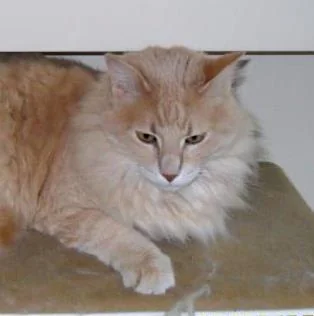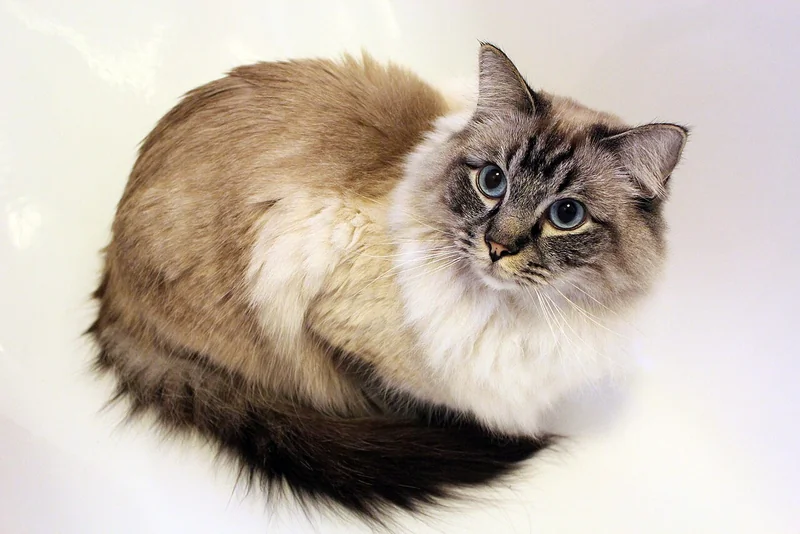
The Ragdoll is a long-haired pointed breed developed in Riverside, California in the 1960s by Ann Baker. The foundation queen Josephine — a free-roaming domestic longhair from Baker's neighbourhood — produced the first Ragdoll litters around 1963-1965. TICA recognized the breed at its 1979 founding; GCCF admitted it in 1990; FIFe followed in 1992; and CFA admitted the breed to championship status in 2000. The standard describes a large, semi-longhaired cat with blue eyes, point colouration, and a heavy-boned body.
Quick facts
- Origin country
- United States (Riverside, California)
- Origin period
- 1960s (Ann Baker breeding programme)
- Coat type
- Long
- Coat colors
- Seal Point, Blue Point, Chocolate Point, Lilac Point, Red Point, Cream Point, Mitted, Bicolor, Lynx, Tortoiseshell
- Size category
- Large
- Average lifespan
- 12-17 years
- Recognition
- CFA 2000 · TICA 1979 · GCCF 1990 · FIFe 1992
Origin
The Ragdoll was developed in Riverside, California in the 1960s by Ann Baker, who began the foundation programme around 1963 with Josephine — a free-roaming white domestic longhair queen from Baker's neighbourhood. Josephine's litters with several local longhaired toms produced the foundation kittens that established the breed name and the early standard. Baker registered the name 'Ragdoll' as a trademark in 1971 and operated the International Ragdoll Cat Association as a closed registry. A 1975 split led by Denny and Laura Dayton produced the open-registry line that pursued mainstream recognition with the major associations.
Recognition
The International Cat Association recognized the Ragdoll at its 1979 founding in Texas. The Governing Council of the Cat Fancy admitted the breed in 1990 in the United Kingdom. The Fédération Internationale Féline published its standard in 1992 in continental Europe, and the Cat Fanciers' Association admitted the breed to championship status in 2000 — completing recognition across the four major international registries within forty years of the breed's foundation.
Standard
The CFA and TICA standards describe a large, heavy-boned, slow-maturing semi-longhaired cat with deep-blue eyes and point colouration. The body is long and broad-chested with substantial bone and a heavy hindquarters. The head is a broad modified wedge with a flat plane between the ears, full cheeks, and medium-sized ears tipped slightly forward. The coat is medium to long, plush rather than woolly, and shorter on the face. Recognized colour divisions include the four traditional points (seal, blue, chocolate, lilac), the extended points (red, cream, tortoiseshell, lynx), and three pattern divisions (colorpoint, mitted, bicolor).
Sources & further reading (3)
- registry-breed-profile — accessed 2026-04-30
- encyclopedia — accessed 2026-04-30
- tica-standard — accessed 2026-04-30
Frequently asked questions
When did the Ragdoll achieve championship recognition?
The International Cat Association recognized the Ragdoll at its 1979 founding. The Governing Council of the Cat Fancy admitted the breed in 1990. The FIFe standard followed in 1992, and the Cat Fanciers' Association admitted the breed to championship status in 2000 — completing recognition across the four major international registries.
Who founded the Ragdoll breed?
The Ragdoll was developed by Ann Baker in Riverside, California in the 1960s. Baker began the foundation programme around 1963 with Josephine — a free-roaming white domestic longhair queen from her neighbourhood — and registered the name 'Ragdoll' as a trademark in 1971. A 1975 split led by Denny and Laura Dayton produced the open-registry line that pursued mainstream recognition with the major associations.
How large is a typical Ragdoll?
Adult males commonly weigh 5.4 to 9 kilograms; adult females weigh 3.6 to 6.8 kilograms. The breed matures slowly over three to four years and is among the largest recognized domestic cat breeds, alongside the Maine Coon and the Norwegian Forest Cat. Reported lifespan averages 12 to 17 years across CFA and TICA parent-club records.