Felis catus
American Ringtail
 Featured photoamerican-ringtail.jpg
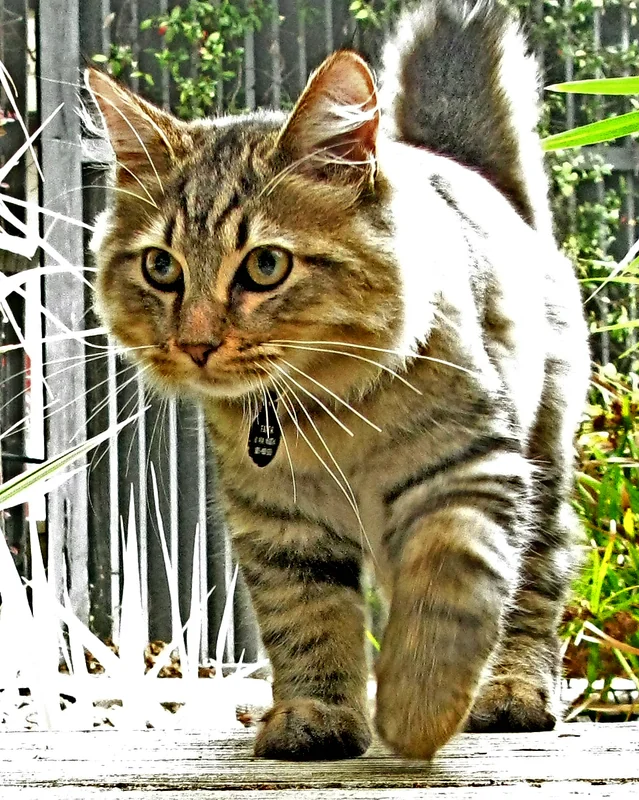
The American Ringtail is a TICA experimental breed defined by its characteristic tail posture: the tail curls over the back like a ring or question mark at rest. The breed traces to a single founding cat named Solomon, discovered as a stray in Stockton, California in 1998 by Susan Manley. Genetic studies have suggested the tail curl is caused by a dominant mutation distinct from the bobtail mutations in other breeds. TICA accepted the American Ringtail into its new breed program in 2005.
Quick facts
- Origin country
- United States
- Origin period
- Founded 1998; TICA experimental registration 2005
- Coat type
- Short
- Coat colors
- All colors and patterns accepted
- Size category
- Medium
- Average lifespan
- 12-15 years
- Recognition
- TICA 2005
Origin
The American Ringtail traces its entire breed history to a single cat: Solomon, a stray male kitten rescued in Stockton, California in 1998 by Susan Manley. Solomon consistently held his tail curled up over his back in a ring or question-mark shape. Veterinary examination excluded spinal injury, structural defect, or habitual behavior; the trait appeared to be a spontaneous genetic mutation. Manley began a controlled breeding program to propagate and study the trait, reaching out to TICA's registrar and geneticists to document the mutation. TICA accepted the American Ringtail into its experimental new breed program in 2005.
Genetics
The tail-curl trait in the American Ringtail appears to be caused by a dominant mutation affecting the musculature and connective tissue of the tail rather than the skeletal structure, based on early genetic and radiographic studies. Affected cats hold the tail over the back in a curl but can release it voluntarily. No health problems have been documented in association with the mutation. This distinguishes the breed from bobtail mutations (which shorten the tail) and from the folded-ear mutation in Scottish Folds (which causes skeletal disease). The genetic basis has not been fully characterized as of 2026.
Appearance
The American Ringtail standard, as submitted to TICA, describes a medium-sized, well-muscled cat of moderate foreign type with no extreme features other than the tail. The head is a moderate wedge with rounded contours; ears are medium-sized; eyes are almond-shaped and may be any color. The tail is full-length, not shortened, and is carried curled over the back at rest, though it can be straightened voluntarily. The coat may be any length, color, or pattern; shorthaired specimens are most common in the current breeding population.
Sources & further reading (2)
- encyclopedia — accessed 2026-05-07
- registry-breed-profile — accessed 2026-05-07
Frequently asked questions
Is the American Ringtail's tail curl inherited?
Evidence from the breeding program and TICA's early genetic evaluation suggests the tail curl is caused by a dominant mutation, meaning a cat needs only one copy to express the trait. The trait appears to be passed from the founding cat Solomon to offspring at the expected Mendelian ratios. Full genetic characterization of the responsible mutation had not been published as of 2026.
Is the ringtail posture painful or harmful to the cat?
Veterinary examinations of Solomon and his descendants have not found skeletal abnormality, nerve damage, or spinal injury associated with the tail curl. Affected cats can straighten the tail voluntarily. No documented health problems have been linked to the trait in the breeding population through 2026.
When did TICA recognize the American Ringtail?
TICA accepted the American Ringtail into its experimental new breed program in 2005, following the documentation of Solomon's founding line by Susan Manley beginning in 1998. The breed remains in experimental/development status; it has not achieved full TICA championship status as of 2026.