Felis catus
Bengal
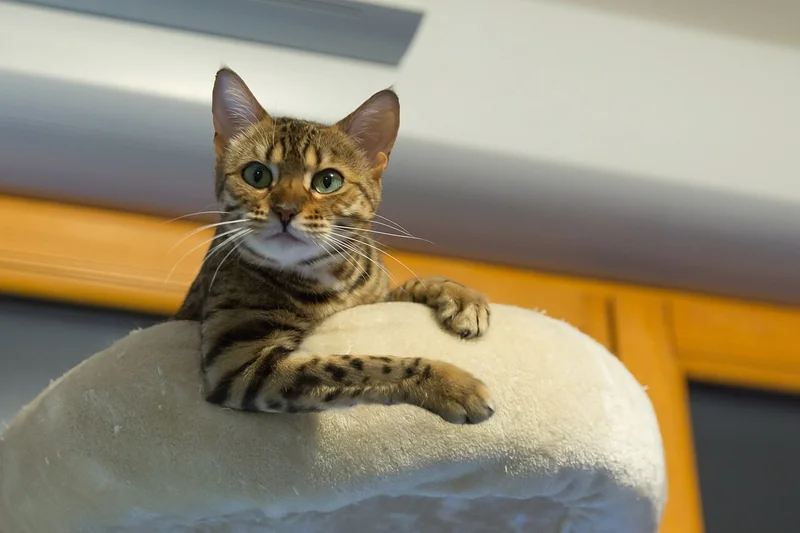 Featured photobengal.jpg
The Bengal is a hybrid domestic cat breed developed from crosses between the Asian Leopard Cat (Prionailurus bengalensis) and domestic shorthairs. Jean Mill made the first documented cross in 1963 and resumed the programme in the 1980s with wild-caught and domestic foundation stock. TICA granted championship status in 1991; GCCF recognized the breed in 1997. CFA does not grant the Bengal championship status. The standard describes a large, muscular cat with a spotted or marbled wild-type coat.
Quick facts
- Origin country
- United States
- Origin period
- 1963 hybrid (ALC × domestic, Jean Mill); TICA championship 1991
- Coat type
- Short
- Coat colors
- Brown Tabby (spotted or marbled), Silver (spotted or marbled), Snow (Seal Lynx Point, Seal Mink, Seal Sepia), Charcoal
- Size category
- Medium
- Average lifespan
- 12-16 years
- Recognition
- TICA 1991 · GCCF 1997
Origin
Jean Mill (formerly Jean Sugden) made the first documented cross between an Asian Leopard Cat (Prionailurus bengalensis) and a domestic shorthair in 1963. She resumed the programme in the early 1980s after receiving wild-caught ALCs from a Loma Linda University genetics study on feline leukemia. Concurrent breeding work was done by Dr. Willard Centerwall of Loyola University. Bengals four or more generations removed from the wild ALC ancestor (F4 and beyond) are recognized as fully domestic by TICA and GCCF for show and registration purposes.
Recognition
TICA registered the Bengal in the early 1980s and granted championship status in 1991. The Governing Council of the Cat Fancy recognized the breed in 1997. The Cat Fanciers' Association does not grant Bengal championship status on grounds of the wild-cat ancestry. FIFe has not published a Bengal standard. TICA is the primary international registry for the Bengal, and the Bengal Cat Club is the principal breed club worldwide.
Standard
The TICA standard describes a large, sleek, muscular cat with a long, substantial body and broad head with small rounded ears. The defining characteristic is the coat pattern: randomly arranged spots or marbled swirls derived from the ALC ancestor. The spotted tabby pattern must show high contrast with a clear ground colour; rosettes (two-toned spots with darker outlines) are preferred over simple solid spots. The coat texture is described as unusually soft and close-lying with a pearlescent or glittery sheen on individual hairs. Recognized base colours are brown tabby, silver, and snow (seal lynx point, seal mink, seal sepia).
Sources & further reading (3)
- tica-standard — accessed 2026-04-30
- encyclopedia — accessed 2026-04-30
- gccf-registry — accessed 2026-04-30
Frequently asked questions
Is the Bengal considered fully domestic?
Bengals four or more generations removed from the wild Asian Leopard Cat ancestor (F4 and beyond) are recognized as fully domestic by TICA and GCCF for show and registration purposes. Earlier-generation Bengals (F1-F3) are subject to legal restrictions in some jurisdictions. CFA does not grant Bengal championship status at any generation due to the wild-cat ancestry.
When was the Bengal recognized?
TICA granted the Bengal championship status in 1991 after accepting the breed for registration in the early 1980s. The GCCF recognized the breed in 1997. CFA does not grant championship status to the Bengal. FIFe has not published a Bengal standard.
What is the rosette coat pattern in Bengals?
A rosette is a two-toned spot with a lighter centre and a darker outer ring or arc, resembling the markings of a leopard or jaguar. The TICA standard prefers rosettes over simple monochrome spots as they more closely reflect the wild ALC ancestor's coat. Rosette types recognized by breeders include arrowhead, paw-print, doughnut, and cloud rosettes, though the TICA standard uses the broad term 'rosette' without specifying sub-types.