Mycteria leucocephala
Painted Stork (Mycteria leucocephala)
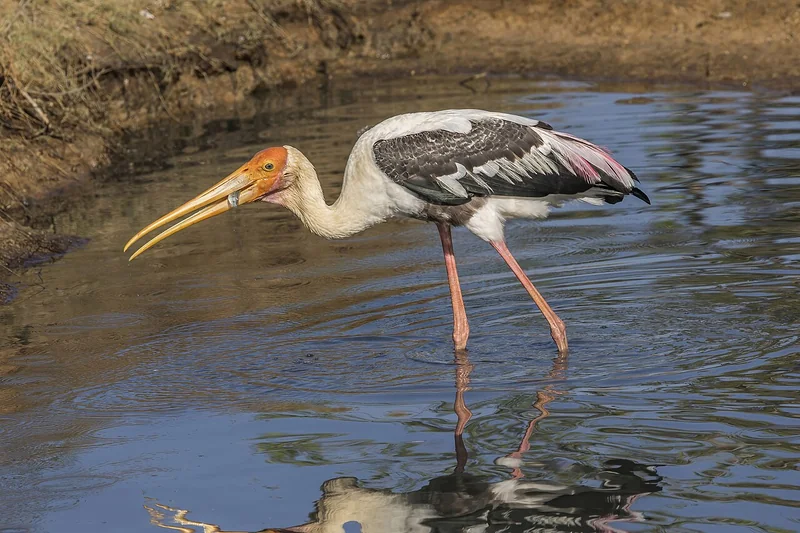 Featured photopainted-stork.jpg
Mycteria leucocephala, the painted stork, is a large stork of the family Ciconiidae native to the wetlands and floodplains of South and Southeast Asia. Adults are 93 to 102 cm long with a wingspan of 150 to 160 cm and weigh 2.0 to 3.5 kg. The species is recognised by its white and black plumage, vivid salmon-pink tertials, yellow-orange bare facial skin, and long decurved yellow bill. The IUCN lists the species as Near Threatened.
Quick facts
- Habitat
- Inland wetlands — freshwater marshes, river floodplains, large shallow lakes, seasonal inundated agricultural land, and rice paddies — across the Indian subcontinent, Sri Lanka, and Southeast Asia. Nests in large colonies in tall trees, often near villages and temples where disturbance is limited by cultural attitudes.
- Range
- South and Southeast Asia — from Pakistan and India east through Sri Lanka, Bangladesh, Myanmar, Thailand, Cambodia, and Vietnam. The largest populations are in India, particularly in the great river floodplain wetlands of Keoladeo Ghana, the Thar Desert canal zones, and the Deccan plateau wetlands.
- Size
- 93–102 cm body · 150–160 cm wingspan · 2000–3500 g
- Plumage
- Adults have predominantly white plumage with black flight feathers and a broad black breast band. The most distinctive feature is the salmon-pink to rose-pink tertial feathers that drape over the lower back and rump — visible both in standing birds and in flight. The head is bare, with orange-yellow skin. The long, decurved bill is yellow-orange. The legs are dull pink. In flight, the combination of white body, black wings, and pink tertials is unmistakable.
- Song
- Largely silent — painted storks, like most storks, have no voice box (the syrinx is vestigial or absent) and communicate through bill clattering, hissing, and wing displays at nest sites rather than by vocalisation.
- Migration
- Largely sedentary, with some local seasonal movements following the monsoon water cycle. Indian populations move between wetlands as water levels change with the monsoon. Not a long-distance migrant.
- Conservation
- Near Threatened (NT)
Overview
Mycteria leucocephala is a member of the genus Mycteria — the wood storks — within the family Ciconiidae. It is one of four wood stork species worldwide, the others being the wood stork (M. americana) of the Americas, the milky stork (M. cinerea) of Southeast Asia, and the yellow-billed stork (M. ibis) of Africa. The genus Mycteria is distinguished from other stork genera by the long, slightly decurved bill used for tactile fish capture rather than the straight heron-like stabbing bills of other storks. The painted stork is the most colourful member of the genus, with its salmon-pink tertials and orange facial skin.
Tactile fishing technique
The painted stork uses a distinctive tactile feeding method shared with other wood storks — it wades through shallow water with its bill partially open and submerged, relying on mechanoreceptors in the bill to detect contact with fish. When a fish contacts the partially open mandibles, the bill snaps shut reflexively — the closure speed is among the fastest recorded reflexes in any bird, taking approximately 25 milliseconds. This method allows painted storks to capture fish without relying on visual detection in murky water. Painted storks often feed in coordinated groups, walking slowly through shallow water and using their wings to create shade that attracts fish. They also follow ploughing or draining of agricultural fields to catch stranded fish.
Colonial nesting and conservation
Painted storks are colonial breeders — nesting colonies in India may number hundreds to thousands of pairs, often mixed with other large waterbirds including open-bill storks, night herons, egrets, and cormorants. The most famous colony is at Keoladeo Ghana National Park (Bharatpur), Rajasthan, which historically hosted tens of thousands of breeding storks. The species nests in tall trees — often banyan, peepal, and other large-canopy trees — and the cultural and religious significance of these tree species in Hindu and Buddhist traditions has historically provided some protection for nesting colonies. The IUCN classifies the species as Near Threatened due to ongoing declines from wetland drainage, pesticide contamination reducing fish prey, disturbance at colonial nesting sites, and decline in suitable nesting trees.
Sources & further reading (2)
- iucn-red-list — accessed 2026-05-07
- encyclopedia — accessed 2026-05-07
Frequently asked questions
Why does the painted stork have pink feathers?
The salmon-pink tertial feathers of the painted stork acquire their colour from carotenoid pigments derived from the diet — specifically from carotenoids in the fish and crustaceans the bird consumes. The pink colour intensifies with access to carotenoid-rich food and fades in captive birds fed diets low in carotenoids. This is the same mechanism by which flamingos acquire their pink colouring. The pink tertials are a sexually selected signal of dietary quality and individual fitness.
How does the painted stork catch fish without seeing them?
The painted stork uses tactile rather than visual fish detection. The bill is partially opened and swept slowly through the water with the sensitive bill tips submerged. Touch-sensitive mechanoreceptors in the bill tissue detect contact with a fish, triggering an extremely rapid reflexive bill closure (approximately 25 milliseconds). This allows effective fishing in turbid, murky water where visual hunting would be ineffective. The technique is shared by all four species of wood stork (genus Mycteria).
Why are painted stork colonies often found near temples?
Painted stork nesting colonies are frequently located in or near the large, old trees growing in and around Hindu temples and sacred groves — particularly banyan and peepal trees. These trees are protected by religious custom in India and are not felled, providing large stable nesting structures that persist for decades. The cultural and religious prohibition on cutting sacred trees near temples has inadvertently protected some of the most important stork nesting colonies. Temple authorities and local communities often actively protect the nesting birds out of a sense of religious obligation and community pride.