Somateria mollissima
Common Eider (Somateria mollissima)
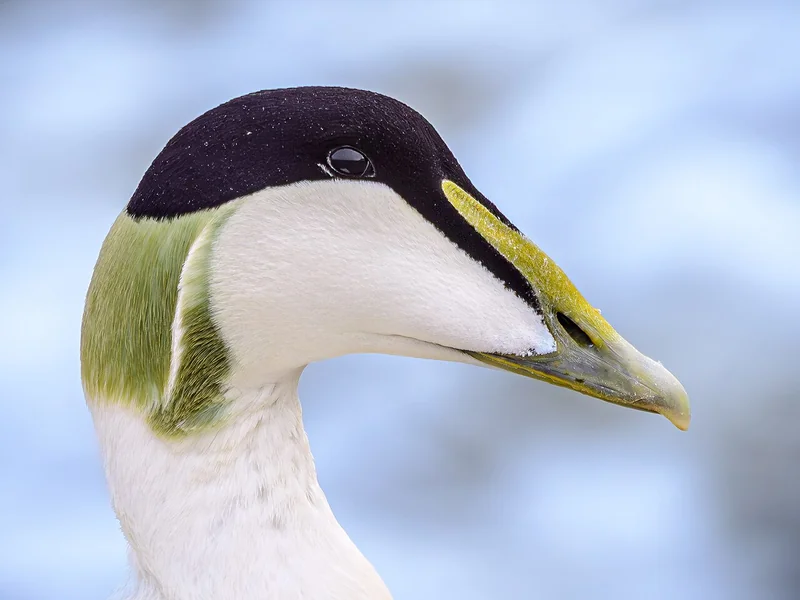 Featured photocommon-eider.jpg
Somateria mollissima, the common eider, is the largest duck species of the Northern Hemisphere. Adults are 50 to 71 cm long with a wingspan of 80 to 108 cm and weigh 1.2 to 2.8 kg. Adult males in breeding plumage are sharply pied — black-and-white with a green nape and pink-flushed breast — while females are uniformly brown. The IUCN lists the species as Near Threatened. The species is the source of eiderdown gathered from female nests for traditional Icelandic and Scandinavian quilt manufacture.
Quick facts
- Habitat
- Coastal seas, rocky islets, and tidal flats across the Holarctic Arctic and subarctic. The species nests on coastal islands and forages in shallow inshore waters.
- Range
- Coastal North America from northern Alaska through Canada and the eastern US Atlantic coast; coastal Europe from the British Isles north to Iceland, Scandinavia, Svalbard, and northern Russia. Multiple subspecies span the range.
- Size
- 50–71 cm body · 80–108 cm wingspan · 1.2–2.8 kg
- Plumage
- Adult males in breeding plumage show a sharply pied pattern — white head, neck, breast, and back; black belly, sides, and tail; a soft pale-green wash on the nape; and a salmon-pink flush on the breast. Adult females are uniformly mottled warm brown — superb camouflage on coastal nesting islets. The bill is heavy and wedge-shaped, sloping smoothly back into the forehead in a distinctive 'eider-bill' silhouette.
- Song
- Males give a soft cooing 'oo-oo' or 'aaa-ooh' during display — a surprisingly gentle voice for such a large bird. Females are mostly silent. Display calls carry only short distances and are best heard at breeding colonies in calm weather.
- Migration
- Partial migrant. Northern populations move south in winter to ice-free coasts; southern populations are largely resident.
- Conservation
- Near Threatened (NT)
Overview
Somateria mollissima is the type species of the genus Somateria. The Latin epithet 'mollissima' means 'softest' and refers to the species' famously soft down feathers. The species' down has been the foundation of the Icelandic and Scandinavian eiderdown industry for over a thousand years.
Eiderdown
Female eiders pluck down feathers from their own breast to line the nest cup, providing exceptional insulation for the eggs. Traditional Icelandic and Scandinavian eiderdown collection involves gathering the down from active nests after the eggs have hatched, without harming the birds or disturbing the colony. Iceland produces approximately 75 per cent of the world's eiderdown harvest, and the practice is one of the most traditional sustainable wildlife industries in Europe.
Conservation
The IUCN uplisted common eider to Near Threatened in 2015, reflecting documented declines across parts of the range. Drivers include reduced bivalve prey availability, oil-spill mortality on coastal flyways, and disease outbreaks at breeding colonies. Iceland's traditional eiderdown industry actively protects breeding colonies and is associated with stable or increasing local populations.
Sources & further reading (2)
- iucn-red-list — accessed 2026-04-30
- encyclopedia — accessed 2026-04-30
Frequently asked questions
What is eiderdown?
Eiderdown is the soft down feathers from the female common eider's nest lining. The female plucks the down from her own breast during egg-laying to insulate the eggs; traditional Icelandic and Scandinavian harvest gathers the down from active nests after the eggs have hatched and the female has moulted, without harming the birds. Eiderdown's exceptional insulation has made it the gold standard for traditional Scandinavian quilts for over a thousand years.
How does Iceland sustainably harvest eiderdown?
Icelandic eiderdown collection involves protected breeding colonies on coastal islands. Local farmers maintain the colonies (predator control, disturbance prevention) and harvest the down from nests after the chicks have hatched and departed. The female naturally moults the down at this point and abandons it; the harvest takes only the down that would otherwise be lost. Iceland produces approximately 75 per cent of the world's eiderdown.
Why are common eider females so well-camouflaged?
Female common eiders incubate eggs on coastal nesting islets exposed to gulls, ravens, and arctic foxes. The female's uniformly mottled warm-brown plumage matches the surrounding rocks, lichen, and grass with extraordinary precision — incubating females are nearly invisible from a few metres away. The cryptic plumage is one of the most effective in any northern duck.