Mellisuga helenae
Bee Hummingbird (Mellisuga helenae)
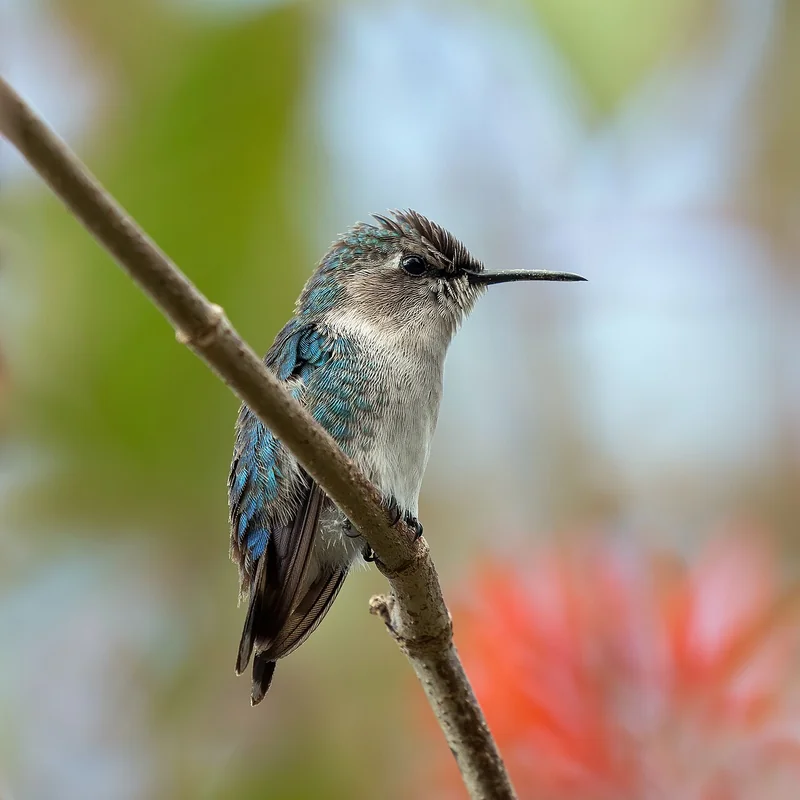 Featured photobee-hummingbird.jpg
Mellisuga helenae, the bee hummingbird, is the smallest bird species in the world. Adults are 5 to 6 cm long with a wingspan of about 7 cm and weigh 1.6 to 2 g. Adult males show iridescent blue-green upperparts and a fiery iridescent rose-pink gorget; females are duller green above and white below. The IUCN lists the species as Near Threatened, reflecting its restricted Cuban range and ongoing habitat loss. The species is endemic to Cuba and its small adjacent islands.
Quick facts
- Habitat
- Coastal and lowland forest, forest edges, and gardens across Cuba and a few adjacent small islands. The species depends on flowering shrubs and trees for nectar.
- Range
- Endemic to Cuba and the Isla de la Juventud (Isle of Youth). The species' total range is small and the population is restricted to the Cuban archipelago. No populations exist outside the Cuban region.
- Size
- 5–6 cm body · 7 cm wingspan · 1.6–2 g
- Plumage
- Adult males show iridescent blue-green upperparts (back, head, and crown), a brilliantly iridescent rose-pink gorget that extends down the sides of the throat as elongated 'whiskers', and a pale grey belly. Adult females are duller green above and white below, lacking the gorget. The structural rose-pink colour appears different shades depending on viewing angle. Both sexes are tiny — about half the body mass of the smallest North American hummingbirds.
- Song
- A high-pitched chittering call delivered both in flight and from a perch. The species' wingbeat produces an audible buzz at about 80 wingbeats per second — even faster than most other hummingbirds. The buzz is one of the most familiar sounds at flowering shrubs across Cuban gardens and nature reserves.
- Migration
- Sedentary on the breeding islands. The species does not undertake regular migration; movement is limited to local foraging trips between flowering plants.
- Conservation
- Near Threatened (NT)
Overview
Mellisuga helenae is the smallest of about 360 hummingbird species and the smallest bird in the world by body mass. The species is one of two Mellisuga species (with the slightly larger vervain hummingbird M. minima of Hispaniola and Jamaica). The species' small size approaches the lower theoretical limit for endothermic flight in vertebrates — a smaller body would have insufficient muscle mass to support flight, while a larger body would not face the metabolic constraints that drive the species' extreme flight characteristics.
Distribution and conservation
The species is endemic to Cuba and the Isla de la Juventud. The total population is estimated at fewer than 100,000 mature individuals, and the IUCN lists the species as Near Threatened reflecting its restricted range and ongoing habitat loss. Cuban garden and protected-area plantings support local populations near population centres; rural deforestation has reduced the species' total habitat over recent decades.
Extreme metabolism
Bee hummingbirds have the highest mass-specific metabolic rate documented for any vertebrate. Wing-beat frequencies of 80 per second support hovering flight; resting heart rate exceeds 1,000 beats per minute and rises to 1,200+ during flight. The species consumes about half its body mass in nectar each day. Without nightly torpor (the bird's body temperature drops by about 25 °C overnight), the species could not survive a night at high latitudes — the metabolic expenditure would exceed any possible food intake.
Sources & further reading (2)
- iucn-red-list — accessed 2026-04-30
- encyclopedia — accessed 2026-04-30
Frequently asked questions
How small is a bee hummingbird?
Adults are 5-6 cm long with a wingspan of about 7 cm and weigh 1.6-2 g — about the size of a large bumblebee. The bee hummingbird is the smallest bird species in the world by body mass; only the bumblebee bat (a mammal) and the Etruscan shrew (a mammal) match its body size among warm-blooded vertebrates. The female is slightly larger than the male — unusual among hummingbirds, where males typically exceed females.
Why is it endemic to Cuba?
Bee hummingbirds are endemic to Cuba and the Isla de la Juventud, with no populations elsewhere. The species likely evolved on the Cuban archipelago and was never present on the mainland. Several of the species' close relatives (Mellisuga vervain hummingbirds) are similarly restricted to Caribbean islands. The species' restricted range and small total population have led to the IUCN's Near Threatened listing.
How does the smallest bird stay warm?
Bee hummingbirds enter regulated nightly torpor, dropping body temperature by about 25 °C and reducing metabolic rate to about one-fifteenth of normal. Without torpor, the species' extraordinarily high mass-specific metabolic rate would exceed any possible food intake — the bird could not survive overnight without feeding. The same torpor strategy is shared with most other hummingbird species and is one of the textbook examples of metabolic regulation in tiny endotherms.