Quiscalus quiscula
Common Grackle (Quiscalus quiscula)
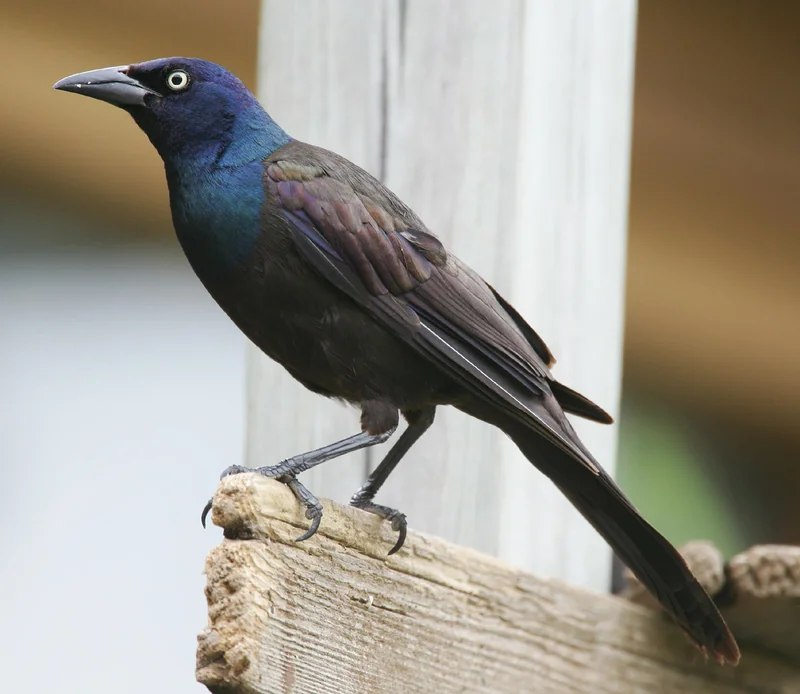 Featured photocommon-grackle.jpg
Quiscalus quiscula, the common grackle, is a large icterid blackbird distributed across the eastern and central United States and southern Canada. Adults are 28 to 34 cm long with a wingspan of 36 to 46 cm and weigh 74 to 142 g. The plumage is glossy black with strong iridescent purple, bronze, or green tones depending on the regional subspecies; the eye is pale yellow and the bill is heavy and dark. The IUCN lists the species as Near Threatened — a recent uplisting reflecting decades of population decline across most of the range.
Quick facts
- Habitat
- Open and partly wooded country, farmland, suburbs, and city parks. The species adapted readily to human-modified landscapes during the historical clearing of eastern North American forests and remains common in the resulting agricultural matrix.
- Range
- Eastern and central North America from southern Canada south through the contiguous United States east of the Rocky Mountains to the Gulf Coast. Three regional subspecies (purple, bronzed, Florida) differ in iridescent body colouration and overlap along narrow contact zones.
- Size
- 28–34 cm body · 36–46 cm wingspan · 74–142 g
- Plumage
- Adults are uniformly glossy black with strong iridescent body sheen — purple in the northeastern 'purple grackle' subspecies, bronze in the midwestern 'bronzed grackle', and similar to the purple form but with brighter blue heads in the Florida subspecies. The bill is heavy and dagger-like, the legs long, and the eye is conspicuously pale yellow. The tail is long and keel-shaped — held in a prominent V from the rear.
- Song
- A series of harsh, creaky, mechanical notes delivered from a perch — sometimes likened to a rusty hinge — followed by a sharp 'chack' call note. The song is unmistakably grating and unmusical.
- Migration
- Partial migrant. Northern populations move south for winter to form large communal roosts on the Gulf Coast; southern populations are resident. Winter roosts can number in the millions.
- Conservation
- Near Threatened (NT)
Overview
Quiscalus quiscula is one of three Quiscalus grackles in eastern North America (with the boat-tailed grackle Q. major and the great-tailed grackle Q. mexicanus). The species' iridescent plumage is structural — produced by light scattering in feather microstructure — so a damaged or wet feather appears dull black-brown until it dries and the structure resumes scattering light. The species is one of the most familiar large blackbirds across the eastern half of the continent.
Distribution
The breeding range covers eastern and central North America from southern Canada to the Gulf Coast. The species expanded west across the Great Plains during the historical European clearing of the eastern forest, displacing or partially overlapping with western icterids in the process. Three named subspecies show geographic plumage variation: purple grackle (northeast), bronzed grackle (midwest), and Florida grackle.
Population decline
Despite remaining locally numerous, the common grackle has declined by more than half across most of its range over the last fifty years — a trend that prompted the IUCN's uplisting from Least Concern to Near Threatened. Drivers proposed include reduced grain-spillage availability with modern agricultural efficiency, intentional control on agricultural lands, and habitat changes in suburban and farmland mosaics. The decline is one of the most striking among formerly very common North American songbirds.
Sources & further reading (2)
- iucn-red-list — accessed 2026-04-29
- encyclopedia — accessed 2026-04-29
Frequently asked questions
Why has the common grackle been declining?
Long-term breeding bird surveys show the species has declined by more than fifty per cent across most of its range since the 1970s. Proposed drivers include reduced grain-spillage availability with cleaner modern agricultural harvest, intentional control programmes on grain farms (the species is regarded as an agricultural nuisance), and habitat changes in suburban and farmland matrices. The IUCN uplisted the species to Near Threatened reflecting the trend.
Why does the iridescent colour vary by region?
Three named subspecies show different iridescent body tones: the northeastern 'purple grackle' has a uniform glossy purple sheen, the midwestern 'bronzed grackle' has a bronze-coloured back contrasting with the purple-iridescent head and breast, and the Florida grackle resembles the purple form with a brighter blue head. The colour is structural, produced by feather microstructure; subspecies differ slightly in the underlying scattering geometry.
Are common grackles really thieves of other birds' eggs?
Yes — common grackles are documented predators of other birds' eggs and nestlings, particularly in suburban settings. The species takes house-sparrow, robin, and other open-cup-nesting songbird eggs opportunistically. The behaviour reflects the grackle's broadly omnivorous foraging strategy and is one of the reasons many garden birders regard the species as a nuisance at feeders.