Ramphastos vitellinus
Channel-billed Toucan (Ramphastos vitellinus)
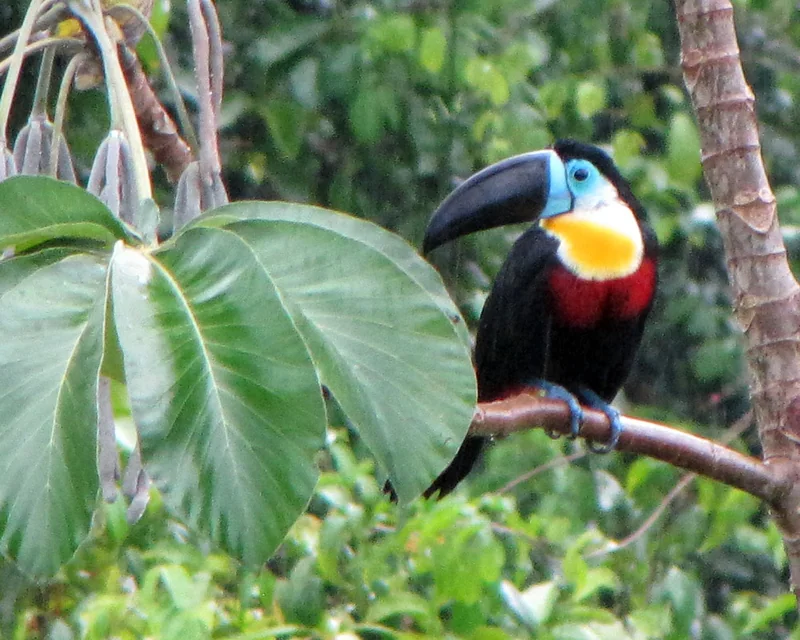 Featured photochannel-billed-toucan.jpg
Ramphastos vitellinus, the channel-billed toucan, is a large toucan of the family Ramphastidae widespread across the Amazon basin and northern South America. Adults are 48 to 56 cm long and weigh 300 to 430 g. The species is recognised by its large black bill with a yellow channel running along the upper mandible and a vivid red rump. The IUCN lists the species as Near Threatened following significant population declines from deforestation.
Quick facts
- Habitat
- Humid tropical and subtropical forest, gallery forest, forest edges, and tall secondary growth from sea level to about 1,700 m across the Amazon basin, the Guiana Shield, Trinidad, and parts of Venezuela and Colombia. Uses both interior forest and edges with emergent fruiting trees.
- Range
- Amazon basin and Guiana Shield region of South America — from Colombia, Venezuela, and Trinidad south through Brazil, Peru, Bolivia, and Ecuador. One of the most widespread toucans of lowland Amazonia. Four subspecies are recognised.
- Size
- 48–56 cm body · 50–62 cm wingspan · 300–430 g
- Plumage
- Adults have predominantly black plumage with a white or pale yellow throat and upper breast, a vivid red rump, and a yellow-green periorbital ring. The bill is large and strongly arched, predominantly black with a distinctive yellow groove (channel) running along the upper mandible — the feature that gives the species its common name. The underside of the tail is red.
- Song
- A loud, yelping 'yip-yip-yip' or 'creak' call repeated persistently — audible across long distances in the forest canopy. Channel-billed toucans call frequently in the early morning and can be heard well before they are seen.
- Migration
- Largely sedentary. Undertakes local movements tracking fruiting trees but does not make long-distance seasonal migrations. Pairs and small groups roam a large home range.
- Conservation
- Near Threatened (NT)
Overview
Ramphastos vitellinus is a member of the genus Ramphastos — the large Neotropical toucans — within the family Ramphastidae. It is one of the most common and widespread toucans of the Amazon basin, and one of several large Ramphastos species that overlap in range across lowland South America. The 'channel' in the common name refers to the yellow groove running along the culmen (ridge) of the upper mandible, distinguishing this species from the similar but more brightly billed toco toucan (R. toco) and red-billed toucan (R. tucanus). Recent molecular studies suggest R. vitellinus may represent a complex of closely related forms.
Bill anatomy and function
The channel-billed toucan's bill is disproportionately large but lightweight — composed of hollow keratin reinforced by an internal bony lattice, combining rigidity with low mass. The bill reaches fruit at branch tips too slender to support the bird's full weight; the bird then tosses the fruit back into the throat. The bill is also used in territorial display and predation of small lizards and nestlings. Research has shown that toucan bills function as thermal radiators — blood flow to the bill surface increases to dissipate excess body heat in warm conditions.
Fruit dispersal and forest ecology
Channel-billed toucans are important seed dispersers in Amazonian forest. They consume large quantities of fruit, swallowing seeds whole and depositing them intact in their droppings away from the parent tree. Their large bills allow them to take fruit too large for most other frugivores, and their wide-ranging movements mean that seeds are dispersed over considerable distances. Some large-seeded trees in the Amazon are thought to have coevolved with large-billed frugivores such as toucans and tapirs. Ongoing deforestation and the hunting of toucans for the pet trade reduce their effectiveness as seed dispersers, with potential cascading effects on forest regeneration.
Sources & further reading (2)
- iucn-red-list — accessed 2026-05-07
- encyclopedia — accessed 2026-05-07
Frequently asked questions
Why does the channel-billed toucan have such a large bill?
The channel-billed toucan's large bill serves multiple functions: reaching fruit at the ends of fine branches that would not support the bird's weight; manipulating and tossing large fruit; display in territorial interactions; and thermoregulation — research has shown that blood flow to the bill surface can be modulated to dissipate body heat. The bill is hollow-cored and lightweight despite its size, built from a keratin shell over a bony internal lattice.
What is the 'channel' on the channel-billed toucan's bill?
The 'channel' refers to a distinctive yellow groove or furrow running along the ridge (culmen) of the upper mandible — a feature that distinguishes this species from related Ramphastos toucans with more uniformly coloured or differently marked bills. The contrast between the yellow channel and the surrounding black bill is visible in the field and was noted by early naturalists who named the species.
Are channel-billed toucans threatened by deforestation?
Yes — the channel-billed toucan is classified as Near Threatened by the IUCN, with the population declining due to large-scale deforestation in the Amazon basin and adjacent regions. The species requires large tracts of humid forest and is adversely affected by forest fragmentation. It is also taken from the wild for the pet trade in some areas. The rate of Amazon deforestation in recent decades has reduced the range and density of this and many other forest-dependent species.