Rhaphidophora hayi
Rhaphidophora hayi Care Guide
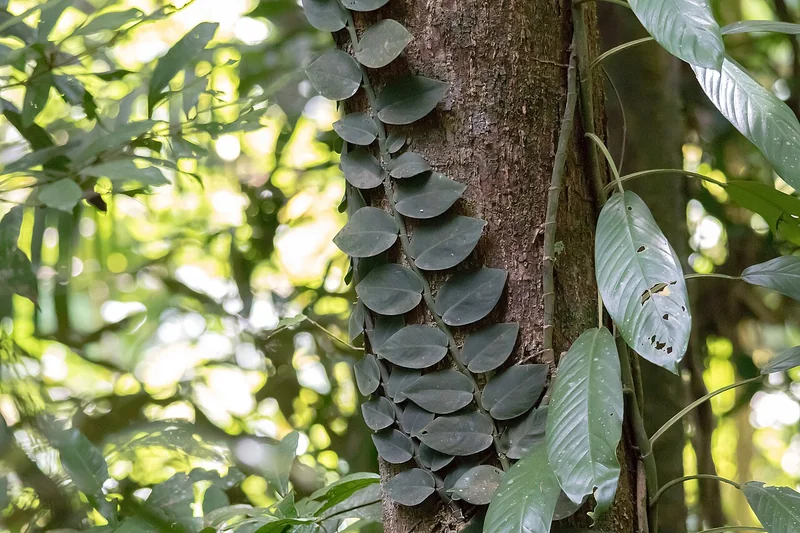 Featured photorhaphidophora-hayi.jpg
Rhaphidophora hayi is an Australian shingle vine from the rainforests of North Queensland, producing compact, rounded, dark-green leaves that tile along its stems in tight, overlapping rows. It is smaller-leafed than its close relative R. cryptantha, making it a more manageable choice for terrariums and vertical plant walls. Its care requirements mirror those of other Rhaphidophora shingle plants: high humidity, a grippy climbing surface, and consistent moisture.
Care facts at a glance
- Light
- Bright indirect
- Water
- Water when the top 2 cm of medium dries; mist the climbing support regularly to maintain adhesion.
- Humidity
- 65–90 %
- Temperature
- 18–30 °C
- Soil
- Chunky aroid mix: equal parts orchid bark, perlite, and coco coir.
- Origin
- Rainforests of North Queensland, Australia.
- Mature size
- Climbing stems to 2 m+; juvenile leaves 3–6 cm, mature leaves to 15 cm.
Overview
Rhaphidophora hayi Schott ex Engl. is endemic to the wet tropical rainforests of far north Queensland. Like other shingle aroids, it has evolved a flat, adhesive growth form that allows it to climb tree trunks by pressing its entire stem and leaf undersides flush against the bark, creating minimal wind resistance and maximising moisture retention. It is smaller-leafed and slightly hardier than R. cryptantha, adapting somewhat better to the humidity ranges found in typical heated homes.
Care Priorities
- A moist moss pole or rough-textured climbing surface is non-negotiable — on a smooth surface the plant simply trails and loses the shingling habit.
- Keep humidity above 65% using a humidifier; the leaves will splay outward and become dull in dry conditions.
- Bright, indirect light keeps the leaves compact and tightly shingled.
- Avoid repotting unnecessarily — the plant prefers a slightly root-bound condition.
Common Problems
If leaves stop pressing against the support, increase humidity and mist the pole frequently. Root rot develops when the pot substrate stays saturated — ensure the growing medium has excellent drainage and airflow. Leaves that yellow from the base upward suggest overwatering; from the tips inward usually indicate low humidity or underwatering. Thrips leave fine silver streaking on the leaf surface; treat promptly with an insecticidal soap or neem spray.
Sources & further reading (2)
- botanical-garden — accessed 2026-05-27
- encyclopedia — accessed 2026-05-27
Frequently asked questions
Is R. hayi easier than R. cryptantha?
Marginally. Both require high humidity and a proper climbing surface. R. hayi has a slightly wider humidity tolerance and adapts a little better to home conditions, making it a good starting point for growers new to shingle aroids.
Can I grow it in a terrarium?
Yes — R. hayi is one of the best shingle aroids for a large closed or semi-closed terrarium. Install a textured background panel or cork bark for it to climb, and it will create a dramatic living wall effect over time.
Does it ever produce fenestrations?
Mature leaves can develop small perforations in very good conditions, but fenestration is not characteristic of the species. The main appeal is the tiled, mosaic-like shingling pattern rather than fenestrated foliage.