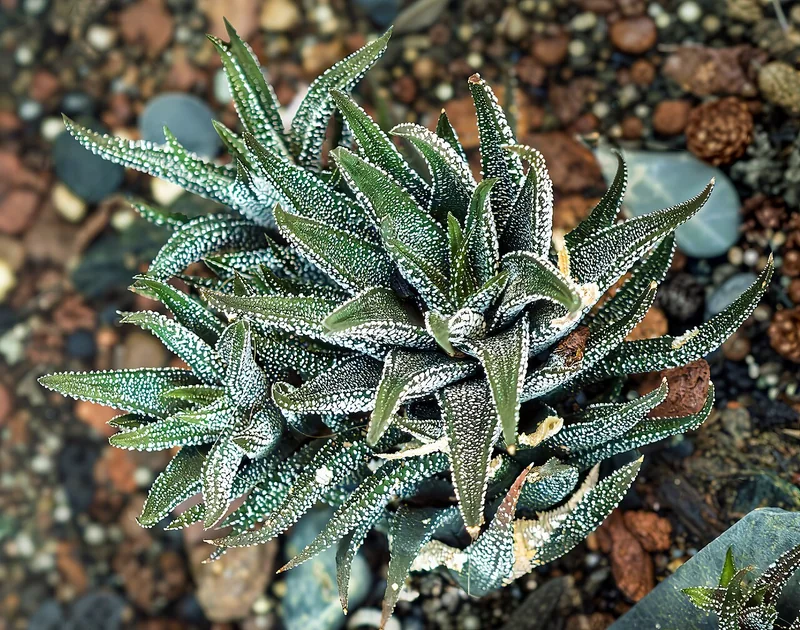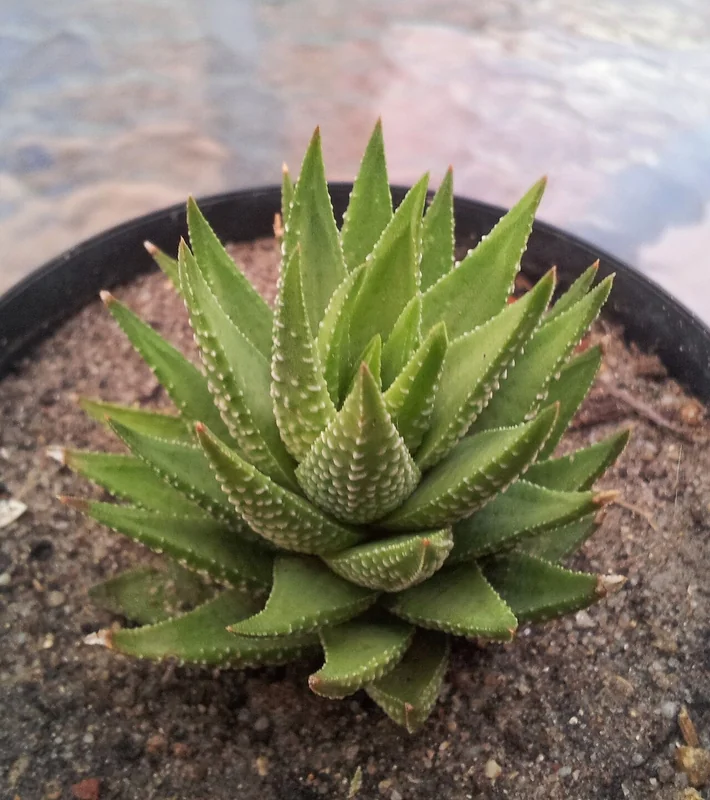
Haworthiopsis fasciata, formerly Haworthia fasciata, is the zebra haworthia — a South African rosette succulent with dark green, upright, lance-shaped leaves striped horizontally with raised white pearl-like bands. It tolerates lower light than most succulents (it grows under shrub cover in the wild) and is ideal for east windowsills and shaded balconies.
Care facts at a glance
- Light
- Bright indirect
- Water
- Water when the mix is fully dry.
- Humidity
- 30–50 %
- Temperature
- 15–27 °C
- Soil
- Free-draining cactus or succulent mix.
- Origin
- Eastern Cape, South Africa.
- Mature size
- 10 to 15 cm tall and wide.
Overview
Haworthiopsis fasciata was reclassified out of Haworthia in 2013, although the older name persists in trade. The white tubercles on the leaf undersides give the zebra striping. It is sometimes confused with H. attenuata, which has tubercles on both upper and lower leaf surfaces.
Care Priorities
- Bright indirect light or a little direct morning sun; tolerates lower light than most succulents.
- Water rarely; rot is the leading killer.
- Free-draining mix.
- Detach offsets to keep clumps tidy.
Common Problems
Mushy base is rot from overwatering. Pale stretched rosette is too little light. Brown leaf tips are usually old age.
Sources & further reading (2)
- encyclopedia — accessed 2026-04-28
- botanical-garden — accessed 2026-04-28
Frequently asked questions
Fasciata vs attenuata — same plant?
Different species. Fasciata has bands only on the leaf undersides; attenuata has them on both surfaces. Both are sold as zebra plant.
Will it tolerate office light?
Yes — haworthias are some of the most low-light-tolerant succulents.
Why are the leaves browning at the tips?
Browning leaf tips are normal aging. Trim with scissors at the natural angle for cosmetic appeal.