Goeppertia rufibarba
Goeppertia rufibarba (Furry Feather) Care Guide
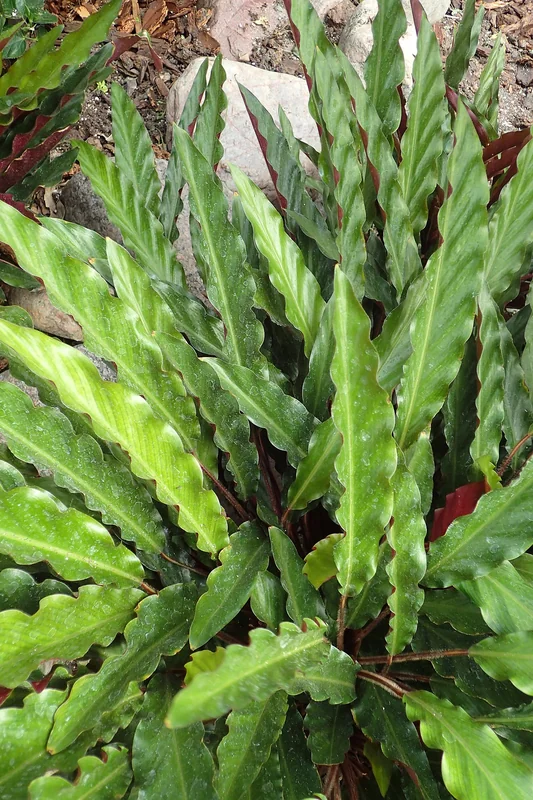 Featured photogoeppertia-rufibarba.jpg
Goeppertia rufibarba, formerly Calathea rufibarba, is the furry feather calathea — a Brazilian prayer plant with long wavy-edged lance-shaped leaves and a soft reddish fuzz on the petioles and leaf undersides. It is more humidity-tolerant than typical calatheas, making it one of the easier prayer plants for ordinary rooms.
Care facts at a glance
- Light
- Bright indirect
- Water
- Water when the top 1 to 2 cm of mix has dried.
- Humidity
- 50–70 %
- Temperature
- 18–27 °C
- Soil
- Peat-rich, well-draining mix with perlite.
- Origin
- Forests of southeastern Brazil.
- Mature size
- 60 to 90 cm tall.
Overview
Goeppertia rufibarba was reclassified out of Calathea in 2012. The species name refers to the red beard — the reddish fuzz on the petioles and leaf undersides.
Care Priorities
- Soft filtered light.
- Filtered or rain water.
- Keep evenly moist; do not let the mix dry to bone-dry.
- Higher humidity above 60 percent prevents crispy edges.
Common Problems
Crispy edges are dry air or hard water. Yellow leaves are overwatering. Curled leaves are usually thirst or low humidity.
Sources & further reading (2)
- encyclopedia — accessed 2026-04-28
- botanical-garden — accessed 2026-04-28
Frequently asked questions
Easier than other calatheas?
Yes — rufibarba is one of the more humidity-tolerant prayer plants and forgives ordinary indoor air better than orbifolia or makoyana.
Why is the underside reddish?
Species-typical pigmentation. The reddish fuzz on petioles and leaf reverses is the source of the trade name.
Best position?
An east window or a few metres back from a south-facing one. Avoid direct midday sun.