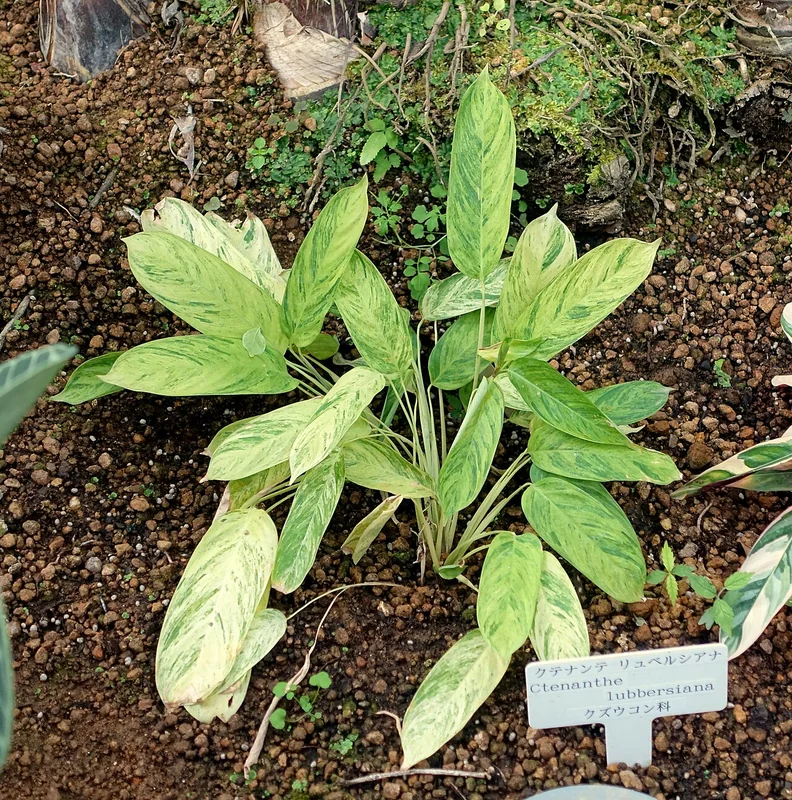
Ctenanthe lubbersiana, sold as Bamburanta, is a Marantaceae prayer plant native to tropical American forest understorey. A Brazilian Marantaceae with elongate ovate leaves marked in irregular cream-yellow streaks on a green base. Reaches 60 cm tall and forms dense clumps as the rhizome extends. Like all members of the family the leaves fold upward at night and open in the morning — the nyctinasty that gives the family its name and makes prayer plants distinctive among foliage indoors.
Care facts at a glance
- Light
- Bright indirect
- Water
- Water when the top 1 to 2 cm of mix has dried.
- Humidity
- 60–80 %
- Temperature
- 18–27 °C
- Soil
- Peat-based, well-draining houseplant mix with extra perlite.
- Origin
- Tropical forest understorey of Central and South America.
- Mature size
- 30 to 90 cm tall depending on species.
Overview
Ctenanthe lubbersiana belongs to Marantaceae, the prayer-plant family of about 550 tropical species across the Americas, Africa, and Asia. A Brazilian Marantaceae with elongate ovate leaves marked in irregular cream-yellow streaks on a green base. Reaches 60 cm tall and forms dense clumps as the rhizome extends. The nightly leaf folding is mediated by a swelling at the base of each leaf called a pulvinus, which contracts to lift the leaf upward as light fades.
Care Priorities
- Bright filtered light, never direct midday sun.
- Evenly moist soil — neither dry nor soggy.
- Humidity above 60 percent.
- Use filtered or rainwater to avoid leaf-edge burn.
Common Problems
Crispy leaf edges signal dry air or hard water. Curled leaves indicate thirst. Pale washed-out colour means too much direct light.
Sources & further reading (2)
- encyclopedia — accessed 2026-04-29
- botanical-garden — accessed 2026-04-29
Frequently asked questions
Why are the cream patches irregular?
C. lubbersiana variegation is sectoral chimerism — different cell layers carry different chlorophyll levels, producing irregular cream and yellow patches that vary leaf-to-leaf. The pattern is genetic but never repeats exactly between leaves, which is what gives the cultivar its slightly painterly look.
Why do prayer plants fold at night?
Prayer plants fold their leaves upward at night through the action of pulvini at the base of each leaf — pressure changes in the pulvinus tissue lift the leaf as light fades. The behaviour is called nyctinasty and is the family signature of Marantaceae.
Can I divide my prayer plant?
Yes — Marantaceae divide cleanly in spring. Unpot the rootball, gently separate the rhizome into clumps each carrying several leaves and roots, and pot each clump into fresh peat-based mix. Divisions establish quickly with steady humidity.