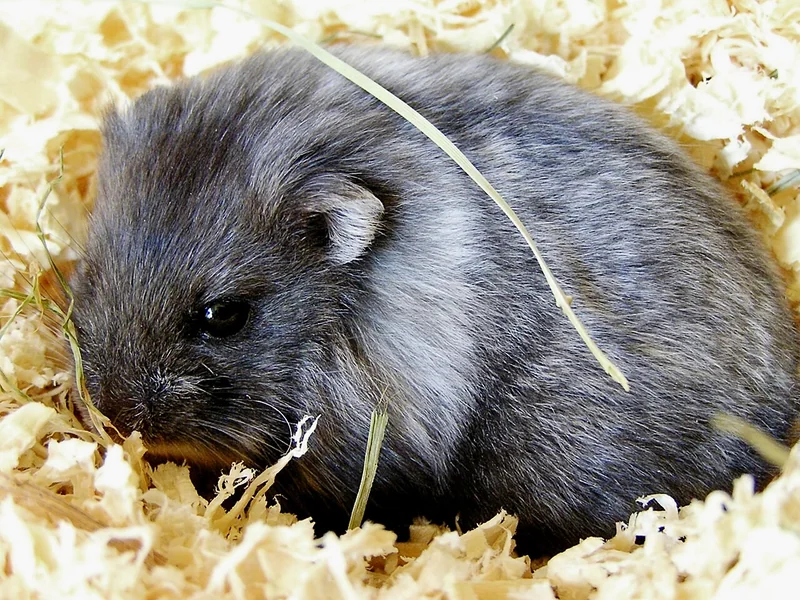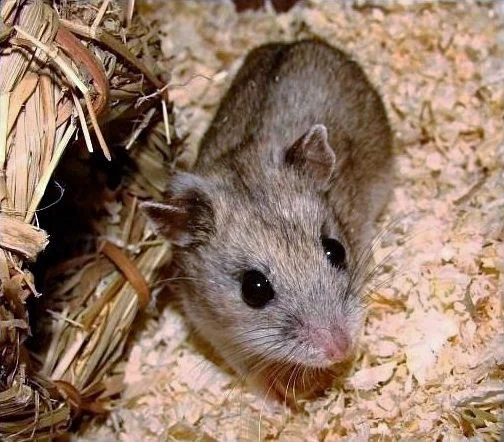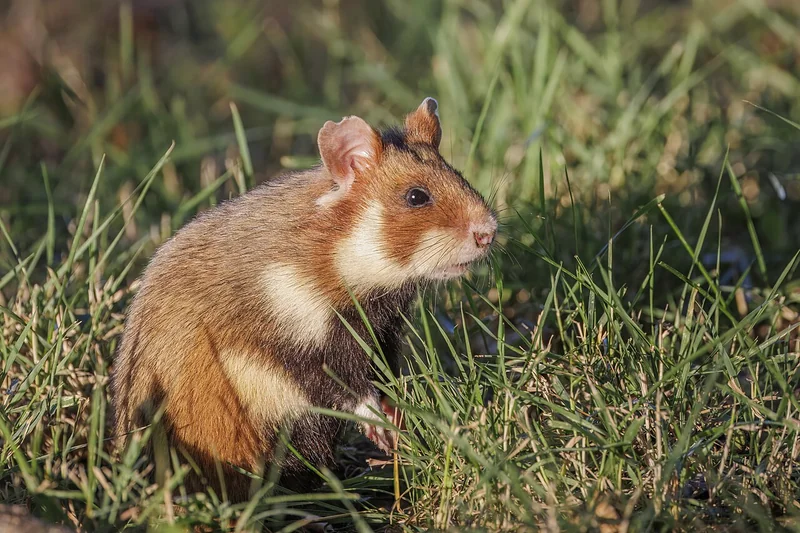
The Syrian or golden hamster, Mesocricetus auratus, is a small Cricetidae rodent native to a single dry valley region near Aleppo in northern Syria. The global captive population descends from a litter collected by the zoologist Israel Aharoni in 1930. Adults reach 13 to 18 cm and are strictly nocturnal, occupying solitary burrow systems in the wild. The IUCN lists the species as Endangered: the wild range is small, fragmented, and continuing to decline.
Quick facts
- Lifespan
- 2–3 years
Overview
Mesocricetus auratus is a member of the subfamily Cricetinae and the largest of the commonly known hamsters. Adults are uniformly sandy-gold above with a paler underside. The genus' diagnostic cheek pouches extend back along the flanks toward the shoulder and are used in the wild to carry seeds and bedding back to the burrow.
Distribution
The wild range is restricted to a region in northern Syria around Aleppo, with historic records from adjacent southern Turkey. The IUCN Red List assesses Mesocricetus auratus as Endangered: the wild range is restricted, fragmented, and declining as rocky-steppe habitat is converted to agriculture.
Behaviour
Solitary and nocturnal in the wild — the species occupies a burrow system with separate chambers for nesting, food caching, and waste, and adults defend the burrow against conspecifics. Surface activity peaks after dusk; daytime is spent below ground.
Discovery
Almost every captive Syrian hamster descends from a single litter collected near Aleppo in 1930 by the Hebrew University zoologist Israel Aharoni. The mother and most siblings were lost during transport; three surviving juveniles founded the entire downstream lineage. The bottleneck makes the captive population genetically narrow compared to the wild stock.
Sources & further reading (2)
- iucn-red-list — accessed 2026-04-29
- encyclopedia — accessed 2026-04-29
Frequently asked questions
Why is the Syrian hamster considered endangered?
The IUCN lists Mesocricetus auratus as Endangered because the wild range is restricted to a small area of northern Syria, the population is fragmented, and the rocky-steppe habitat is being converted to agriculture. The captive population is abundant; the wild populations are not.
Are all captive Syrian hamsters from one wild family?
Effectively yes. The 1930 Aharoni expedition near Aleppo recovered one litter; only three surviving juveniles founded the captive lineage that became the global pet and laboratory population. Subsequent wild collections have been rare and most have not entered the breeding pool.
What does Mesocricetus auratus mean?
Mesocricetus combines the Greek mesos (middle) with cricetus (hamster), a reference to the species' medium-to-large body size relative to other Cricetinae. Auratus is Latin for golden, after the uniformly sandy-gold coat.