August Birthstone
Peridot — volcanic olivine; lime green gem of the sun and the ancient island of Zabargad.
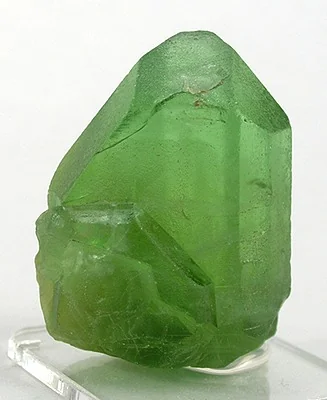
August's birthstone is peridot, the gem variety of olivine ((Mg,Fe)₂SiO₄), a magnesium-iron silicate that occurs in mafic and ultramafic rocks. Peridot's lime green to yellowish-green colour is caused by iron (Fe²⁺) — it is one of only a few gems that occurs in only one colour. Peridot rates 6.5–7 Mohs and has a vitreous to oily lustre. It is one of the few gems that forms in the Earth's upper mantle (brought to the surface by volcanic activity) and is also found in pallasitic meteorites (iron-nickel meteorites with olivine crystals). The most ancient source is Zabargad (St. John's Island) in the Red Sea, mined since approximately 1500 BCE; major modern sources are Pakistan (Kohistan), Myanmar, the United States (San Carlos Apache Reservation, Arizona), China, and Ethiopia.
Quick facts
- Item type
- Birthstone month
- Color range
- lime green, yellowish green, olive green, golden green
- Birthstone month
- August (traditional)
Peridot's Colour and Chemistry
Peridot's colour range — from lime yellow-green through olive to medium green — is entirely controlled by the ratio of iron (Fe²⁺) to magnesium (Mg²⁺) in the olivine structure. More iron produces a darker, more olive or brownish-green; less iron (more magnesium-rich) produces a lighter, purer yellow-green. The ideal peridot colour is a medium lime green with minimal brownish or yellowish modifier. Pakistani peridot from the Sapat Gali area of the Karakoram (discovered 1994) is considered among the finest, often showing a vivid, pure lime green; Arizona peridot tends toward darker olive tones. San Carlos Apache tribal land in Arizona produces significant commercial peridot from volcanic mantle xenoliths. Peridot's iron content is intrinsic to the mineral and cannot be altered by heat treatment — unlike most coloured gems, peridot is not treated commercially.
Mantle Origin and Meteorites
Olivine is one of the most abundant minerals in Earth's upper mantle; most peridot originates in mantle peridotite nodules (xenoliths) carried to the surface by basaltic volcanic eruptions. The gem crystals found at San Carlos, Arizona, occur as glassy green crystals in volcanic bombs of basalt erupted from Quaternary volcanic vents. This mantle origin means peridot's geological history extends further into Earth's interior than most gems. Additionally, olivine crystals are found in pallasitic meteorites — iron-nickel meteorites containing silicate minerals — sometimes in gem-quality transparent form. Pallasite peridot is scientifically significant and occasionally faceted as collector gems; the Esquel meteorite (Argentina) contains large, clear peridot crystals. Extraterrestrial peridot has been found in cometary dust samples and in lunar soil returned by Apollo missions.
Zodiac Connection: Leo
August birthstones align with Leo (the lion), governing approximately July 23 to August 22. Leo is a fire sign associated with confidence, generosity, solar energy, and the warmth of high summer — ruled by the Sun itself. Peridot's historic name as the 'gem of the sun' (ancient Egyptians called it 'pitdah' and associated it with the sun god Ra) creates a direct thematic connection to Leo's solar rulership. The yellowish-green colour of peridot evokes the golden-green light of late summer, the season Leo governs. Ancient Egyptians used peridot from Zabargad extensively in royal jewellery; the yellow-green stone was associated with the sun, prosperity, and the warding off of evil — attributes aligned with Leo's regal, protective character. The bold, bright quality of peridot's colour matches Leo's confident, vivid presence.
Sources & further reading (2)
- gemological-institute — accessed 2026-05-08
- encyclopedia — accessed 2026-05-08
Frequently asked questions
Can peridot be confused with other green gems?
Peridot's lime yellow-green colour is distinctive, but it can be confused with chrysoberyl, green tourmaline, or green sapphire in some colour ranges. The key distinguishing features of peridot include its double refraction (strong birefringence of 0.036 means doubling of back facet edges visible through a loupe), its characteristic oily or greasy lustre, and its refractive index (1.635–1.690) measeable by refractometer. In practice, the combination of lime yellow-green colour, distinct doubling effect, and oily lustre make peridot quite identifiable to an experienced gemologist. Synthetic peridot does not exist commercially. Glass imitations are easily distinguished by absence of double refraction. Simulants such as synthetic spinel and glass do not show the characteristic doubling.
Is it true that peridot comes from space?
Partially. Olivine — the mineral of which peridot is the gem variety — is found in pallasitic meteorites that originate from asteroid belt parent bodies, and olivine minerals were detected in cometary dust collected by the Stardust mission and in interstellar space. Faceted peridot from pallasitic meteorites (notably Esquel, Argentina) has been offered by gem dealers as genuine extraterrestrial peridot. However, the vast majority of commercial peridot — the material that appears in all jewellery — is terrestrial, sourced from mantle xenolith deposits in Pakistan, Arizona, Myanmar, and other locations. The meteorite connection is scientifically accurate and fascinating but applies to a tiny fraction of available peridot. Calling all peridot 'space gem' would be an overstatement; calling pallasitic peridot 'space gem' is scientifically legitimate.
Why is peridot considered appropriate for late summer?
Peridot's lime yellow-green colour visually evokes the palette of high summer to early autumn — the colour of sunlight through leaves, of late-season grass, of the transition from the intense yellow-green of spring growth to the deeper, slightly more golden tones of late summer. August's harvest associations (the beginning of harvest season in temperate agriculture) and the intensity of summer sun align with peridot's solar-green quality. Ancient Egyptians harvested peridot from Zabargad at a time when the agricultural calendar centered on the Nile flood cycle (August was the flood month, bringing fertility and renewal), and the gem's association with protection from night terrors may have derived from its glowing yellow-green quality — like a stone that absorbed the sun and carried its light into darkness. These cultural associations, though ancient, continue to give peridot a distinct seasonal identity.