Leo · Leonis
Leo Constellation
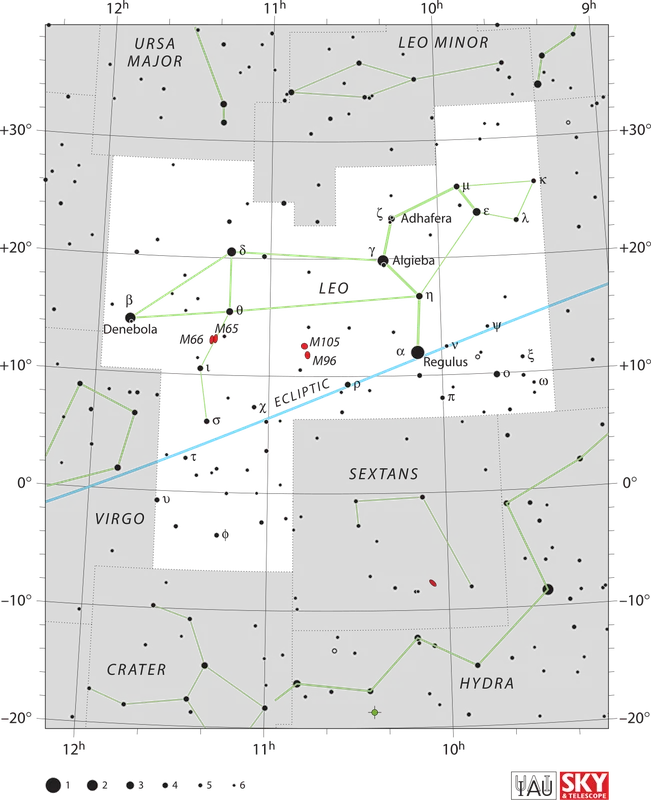 IAU constellation mapLeo
Leo (Leo) is one of the 88 constellations recognised by the International Astronomical Union. It covers 947 square degrees of the northern sky in quadrant NQ2. Its brightest star is Regulus. The Latin genitive of the name is Leonis, used to form star names within the constellation. In Greek mythology, Leo is associated with greek tradition. The IAU standardised all constellation boundaries in 1930.
Quick facts
- IAU name
- Leo
- Abbreviation
- Leo
- Latin genitive
- Leonis
- Hemisphere
- northern
- Area
- 947 sq deg
- Brightest star
- Regulus
- Quadrant
- NQ2
- Family
- Zodiac
- Mythology origin
- Greek
- Discovery era
- Ptolemy's 48 (Almagest, c. 150 CE)
Mythology
Read the Leo story Apple-style scroll · astronomy + classical mythology · public-domain art.
Leo represents the Nemean Lion, the monstrous creature with an impenetrable golden hide that plagued the valley of Nemea. Heracles was dispatched to slay it as the first of his Twelve Labours. Finding that no sword, arrow, or club could pierce the lion's skin, he chased it into a cave with two entrances and, blocking one, strangled the beast with his bare hands. Heracles thereafter wore the lion's impenetrable pelt as armour, which became his most recognisable attribute. The goddess Hera, who had sent the lion to torment the region, placed it among the stars after its death. Leo has been associated with a lion since at least Babylonian astronomy (around 4000 BCE), when it served as a marker of the summer solstice — one theory holds the ancient Egyptians also connected it to the flooding of the Nile, since the floods began when the Sun entered Leo. Regulus (Alpha Leonis), the 'Heart of the Lion', is a blue-white star 79 light-years from Earth with an apparent magnitude of 1.35, making it the 21st brightest star in the night sky. It lies almost exactly on the ecliptic, so it is regularly occulted by the Moon.
Sources: Apollodorus Bibliotheca 2.5.1; Aratus Phaenomena 146-155; Hesiod Theogony 327-332.
Overview
Leo is one of the 88 constellations formally recognised by the International Astronomical Union (IAU). It occupies 947 square degrees of sky in the northern hemisphere sky, best visible at latitudes between +90 and -60 degrees in March. The constellation belongs to the Zodiac family of constellations. Its Latin genitive is Leonis, the form used when naming stars within the constellation — for example, the brightest star Regulus may appear in catalogues as Alpha Leonis or similar. The IAU standardised the boundaries of all 88 constellations in 1930 under the direction of Eugène Delporte, using straight lines of right ascension and declination to eliminate the ambiguities of earlier variable-boundary systems.
Notable stars
The brightest star in Leo is Regulus. Individual stars within Leo are conventionally named using Bayer designation — Greek letters followed by the Latin genitive of the constellation name (Leonis) — introduced by Johann Bayer in his 1603 star atlas Uranometria. Flamsteed numbers (numeric designators followed by Leo) were added by John Flamsteed in his 1712 catalogue. Variable stars, double stars, and deep-sky objects within the Leo boundary are catalogued by the IAU with the abbreviation Leo.
History and mythology
The figure of Leo appears in the classical astronomical tradition. Ptolemy included this constellation in the Almagest (c. 150 CE), the definitive ancient catalogue of 48 constellations, which formed the foundation for Islamic, medieval European, and Renaissance astronomy. The constellation's figure and mythology were transmitted through works such as Aratus's Phaenomena, Eratosthenes's Catasterismi, and Hyginus's Astronomica. See the Mythology section above for the full narrative.
Sources & further reading (2)
- official-iau — accessed 2026-05-06
- encyclopedia — accessed 2026-05-06
Frequently asked questions
What does the name Leo mean?
Leo is the Latin name used by the IAU to designate this constellation. The name comes from classical Latin and Greek astronomical tradition. In star catalogues, stars within Leo are designated using the genitive form of the name (e.g. Alpha Leo or similar Latin genitive forms) — a naming convention introduced by Johann Bayer in his 1603 atlas Uranometria and still in use today.
How large is Leo compared to other constellations?
Leo covers 947 square degrees of sky. The full sphere of the sky contains 41,253 square degrees, so Leo occupies about 2.3% of the total sky. For comparison, the largest constellation is Hydra at 1303 square degrees; the smallest is Crux at 68 square degrees.
When and where is Leo visible?
Leo is primarily a northern hemisphere constellation, best seen from mid-northern latitudes. Southern hemisphere observers may see it low on the horizon depending on their latitude. The brightest star, Regulus, serves as the main visual anchor for locating the constellation. As with all constellations, the best viewing conditions are a dark sky away from artificial light pollution, with the constellation high enough above the horizon to minimise atmospheric absorption.