Canis lupus familiaris
Tibetan Mastiff
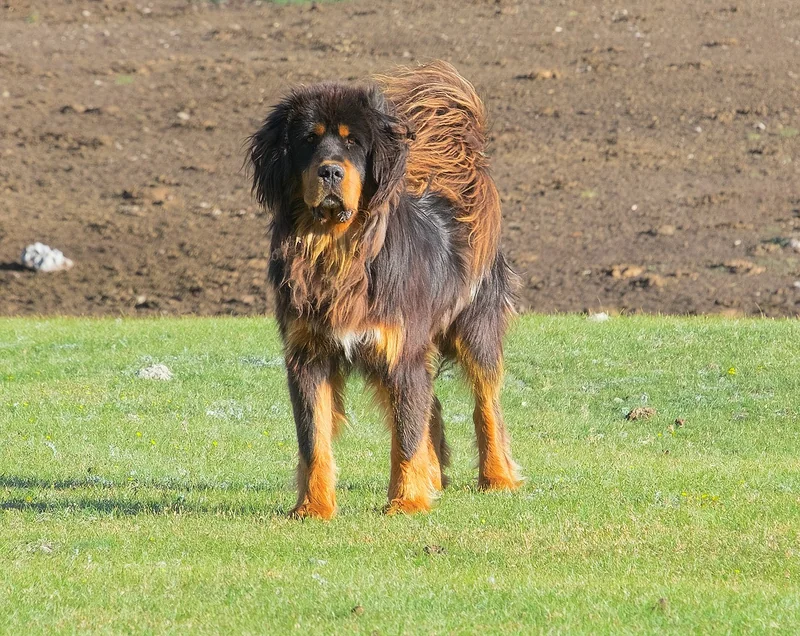 Featured phototibetan-mastiff.jpg
The Tibetan Mastiff is a ancient Tibetan-Plateau livestock-guarding mastiff of nomad tents and yak herds. The Tibetan Mastiff is an ancient livestock-guarding breed kept by the nomadic peoples of the Tibetan Plateau and the Himalayas, where the dogs were used to protect sheep, goats, yak, horses, and tents from wolves, snow leopards, and bears at altitudes above 3,000 metres.
Quick facts
- AKC group
- Working
- Origin country
- Tibet (Tibetan Plateau)
- Origin period
- Antiquity
- Coat type
- Double
- Coat colors
- Black, Brown, Blue/Grey, Gold — all with or without tan markings
- Average lifespan
- 10-14 years
- Recognition
- AKC 2007 · FCI 1961 · UKC 1990 · Group 2 — Pinscher and Schnauzer-Molossoid breeds-Swiss Mountain and Cattle Dogs (Section 2.2: Molossoid breeds, Mountain type)
Origin
The Tibetan Mastiff is an ancient livestock-guarding breed kept by the nomadic peoples of the Tibetan Plateau and the Himalayas — Tibetans, Sherpas, Mongols, Bhutanese, and the people of Ladakh — where the dogs were used to protect flocks of sheep and goats, herds of yak and horses, and the tents of nomadic households from wolves, snow leopards, and bears at altitudes above 3,000 metres. Marco Polo described the dogs in his 13th-century travels. The breed reached the West when Lord Hardinge presented Queen Victoria with a Tibetan Mastiff in 1847; the modern Western line descends from a small number of post-WWII imports plus the post-1970 reconstruction following the 1959 Tibetan diaspora. The AKC admitted the breed in 2007.
Recognition
The American Kennel Club admitted the breed in 2007, the United Kennel Club followed in 1990, and the Federation Cynologique Internationale published the international standard (FCI No. 230) in 1961. The FCI assigns the breed to Group 2 — Pinscher and Schnauzer-Molossoid breeds-Swiss Mountain and Cattle Dogs (Section 2.2: Molossoid breeds, Mountain type).
Standard
The AKC and FCI standards describe a noble and impressive working dog of large size, sturdy build, and very heavy bone — a dog of solemn and serious aspect with a thoughtful expression. The defining feature is the massive double coat: a thick, coarse, weather-resistant outer coat with a dense, woolly undercoat that becomes especially heavy in cold weather and develops a lion-like mane around the neck and shoulders. Recognized colours are black, brown, blue/grey, and gold — all with or without tan markings above the eyes, on the muzzle, lower legs, and underside of the tail. Males stand 66-78 cm at the withers, females 60-71 cm.
Sources & further reading (3)
- kennel-club-registry — accessed 2026-04-30
- encyclopedia — accessed 2026-04-30
- fci-standard — accessed 2026-04-30
Frequently asked questions
What is the Tibetan Mastiff's AKC group?
The American Kennel Club places the Tibetan Mastiff in the Working Group. The Working Group gathers breeds developed for jobs other than herding or hunting — guarding, draft, sled work, and water rescue — including the Boxer, Rottweiler, Saint Bernard, and Newfoundland. The breed's foundation working role was as a ancient Tibetan-Plateau livestock-guarding mastiff of nomad tents and yak herds.
When was the Tibetan Mastiff officially recognized?
The American Kennel Club admitted the breed in 2007; the United Kennel Club followed in 1990; the Federation Cynologique Internationale published the international standard (FCI No. 230) in 1961.
What is the average lifespan of a Tibetan Mastiff?
Kennel-club longevity surveys place the Tibetan Mastiff's average lifespan in the 10-14 years range. The figure here represents the spread reported by the major parent-club studies and the Kennel Club (UK) purebred-dog health surveys.