Canis lupus familiaris
Thai Ridgeback
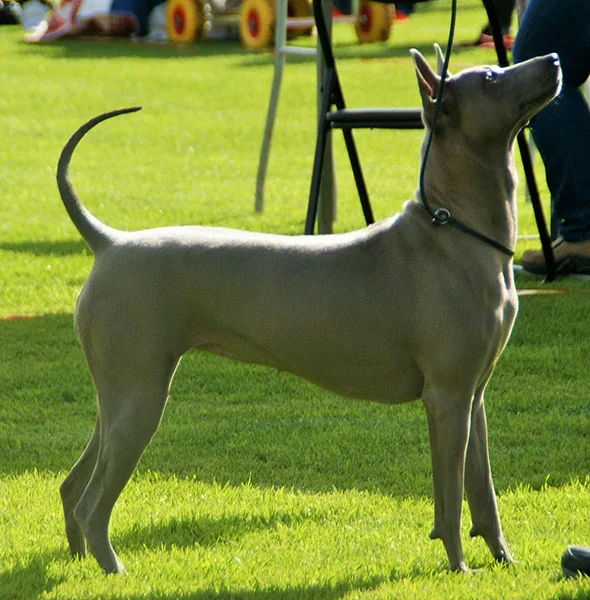 Featured photothai-ridgeback.jpg
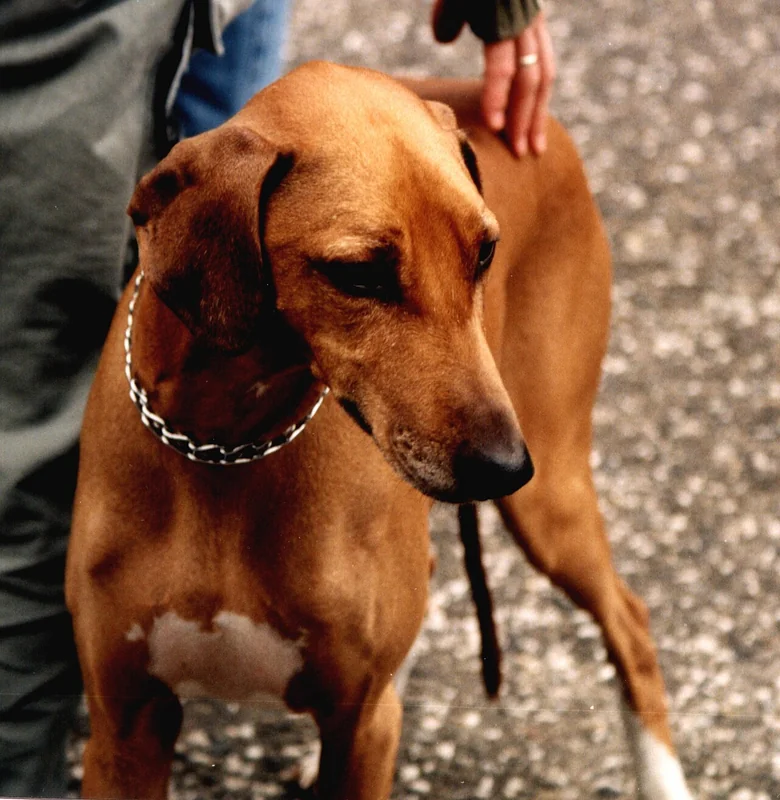
The Thai Ridgeback is an ancient primitive breed from eastern Thailand, one of only three breeds in the world known for the distinctive ridge of backward-growing hair along the spine. The breed was used for centuries in eastern Thailand as a village guard dog, cart escort, and hunter of small game including cobras. Largely isolated in eastern Thailand until the 1970s, the Thai Ridgeback was developed through natural selection. The FCI registers it as No. 338 under Thailand's patronage. Males stand 56–61 cm.
Quick facts
- AKC group
- Hound
- Origin country
- Thailand
- Origin period
- Ancient, isolated development
- Coat type
- Short
- Coat colors
- Blue, Black, Red, Fawn
- Average lifespan
- 12-13 years
- Recognition
- FCI 1993 · UKC 1996 · Group 5 — Spitz and Primitive Types (Section 7: Primitive type — Hunting Dogs)
Origin
The Thai Ridgeback's origin in eastern Thailand is supported by cave paintings and ancient illustrated manuscripts found in Kanchanaburi and neighbouring provinces, depicting dogs with a dorsal ridge. Geographic isolation — eastern Thailand was relatively inaccessible from the Thai central plains until the late 20th century — preserved the breed's genetic distinctiveness. The ridge itself is the result of a mutation in the direction of hair growth along the spine; it is independently documented in only two other breeds, the Rhodesian Ridgeback of southern Africa and the Phu Quoc dog of Vietnam.
Recognition
The Thai Kennel Club submitted documentation to the FCI, which granted provisional recognition in 1993 under standard No. 338, classifying the Thai Ridgeback in Group 5 — Spitz and Primitive Types (Section 7: Primitive type — Hunting Dogs) with Thailand as patron country. The UKC recognised the breed in 1996. The AKC has not granted full recognition. The FCI standard identifies eight officially recognised ridge forms, of which the needle and saddle types are most valued.
Standard
The FCI standard describes a medium-sized, well-balanced, athletic dog with a slightly wedge-shaped head, almond-shaped eyes, and upright ears that lean slightly forward. The very short, smooth coat comes in four colours: blue, black, red, and fawn. The defining feature is the ridge — a strip of reversed-growing hair along the dorsal midline running from the withers toward the tail. The FCI standard identifies eight recognised ridge shapes (needle, feather, arrow, violin, saddleback, bowling pin, lute, and leaf). Males stand 56–61 cm; females 51–56 cm.
Sources & further reading (3)
- fci-standard — accessed 2026-05-27
- encyclopedia — accessed 2026-05-27
- kennel-club-registry — accessed 2026-05-27
Frequently asked questions
What is the dorsal ridge on the Thai Ridgeback?
The dorsal ridge is a strip of fur that grows in the opposite direction to the surrounding coat — backward toward the head rather than forward toward the tail — along the midline of the back. This creates a visible raised ridge pattern. The ridge results from a genetic mutation in hair follicle direction. Only three dog breeds in the world are known for this ridge: the Rhodesian Ridgeback of southern Africa, the Thai Ridgeback of eastern Thailand, and the Phu Quoc Ridgeback of Vietnam.
When was the Thai Ridgeback recognised by the FCI?
The FCI granted provisional recognition to the Thai Ridgeback in 1993 under standard No. 338, with Thailand as patron country. The UKC recognised the breed in 1996. The AKC has not granted full recognition.
How does the Thai Ridgeback differ from the Rhodesian Ridgeback?
The Thai Ridgeback and the Rhodesian Ridgeback both carry a dorsal ridge, but they developed independently on different continents and are not closely related. The Rhodesian Ridgeback is larger (61–69 cm), lighter in colour (wheaten/red), and was developed in southern Africa specifically for lion hunting. The Thai Ridgeback is smaller, comes in blue, black, red, and fawn, and developed in eastern Thailand as a village guard and small-game hunter. The ridge mutation appears to have arisen independently in both breeds.