Canis lupus familiaris
Saint Bernard
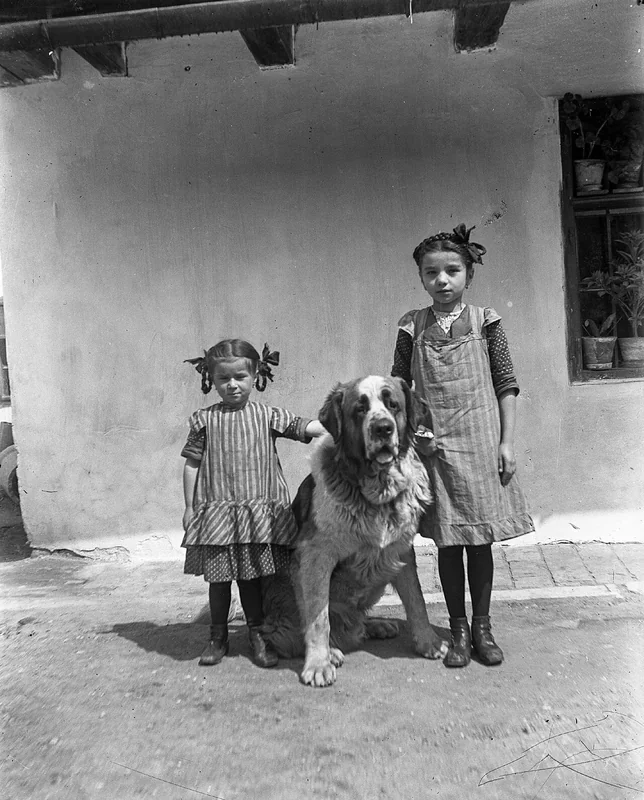 Featured photosaint-bernard.jpg
The Saint Bernard is a Swiss alpine rescue dog kept at the Great St Bernard hospice from the 11th century. The Saint Bernard descends from Roman-descended Molossus stock crossed with local Swiss farm dogs, kept at the Great St Bernard hospice in the Western Alps from at least the 11th century.
Quick facts
- AKC group
- Working
- Origin country
- Switzerland (Great St Bernard Pass)
- Origin period
- 11th century (modern type formalized 1880s)
- Coat type
- Long
- Coat colors
- White and Red, White and Brown, Brindle and White, with the classic mantle markings
- Average lifespan
- 8-10 years
- Recognition
- AKC 1885 · FCI 1954 · UKC 1934 · Group 2 — Pinscher and Schnauzer-Molossoid breeds-Swiss Mountain and Cattle Dogs (Section 2.2: Molossoid breeds, Mountain type)
Origin
The hospice at the Great St Bernard Pass was founded around 1050 AD by Saint Bernard of Menthon as a refuge for travellers crossing the Western Alps between Switzerland and Italy. The earliest documented use of dogs at the hospice is from 1707, when the monks describe using their dogs to find lost travellers in deep snow. The most famous individual, Barry der Menschenretter (1800-1814), was credited with saving more than 40 lives and is preserved in the Natural History Museum of Bern. The breed was formalized in the 1880s; the Schweizerischer St. Bernhards-Club was founded in Basel in 1884 and the first international standard was adopted at Zurich in 1887.
Recognition
The American Kennel Club admitted the breed in 1885, the United Kennel Club followed in 1934, and the Federation Cynologique Internationale published the international standard (FCI No. 61) in 1954. The FCI assigns the breed to Group 2 — Pinscher and Schnauzer-Molossoid breeds-Swiss Mountain and Cattle Dogs (Section 2.2: Molossoid breeds, Mountain type).
Standard
The AKC and FCI standards describe a powerful, proportionately tall figure, strong and muscular in every part, with a powerful head and most intelligent expression. Two coat varieties are recognized: shorthaired (smooth, very dense, lying smooth) and longhaired (medium length, plain to slightly wavy). Recognized colours are white-and-red and red-and-white in many shades, with the classic mantle pattern (red mantle with white blaze, chest, paws, and tail tip) being the most common. Males stand 70-90 cm at the withers as a minimum, females 65-80 cm.
Sources & further reading (3)
- kennel-club-registry — accessed 2026-05-04
- encyclopedia — accessed 2026-05-04
- fci-standard — accessed 2026-05-04
Frequently asked questions
What is the Saint Bernard's AKC group?
The American Kennel Club places the Saint Bernard in the Working Group. The Working Group gathers breeds developed for jobs other than herding or hunting — guarding, draft, sled work, and water rescue — including the Boxer, Rottweiler, Saint Bernard, and Newfoundland. The breed's foundation working role was as a Swiss alpine rescue dog kept at the Great St Bernard hospice from the 11th century.
When was the Saint Bernard officially recognized?
The American Kennel Club admitted the breed in 1885; the United Kennel Club followed in 1934; the Federation Cynologique Internationale published the international standard (FCI No. 61) in 1954.
What is the average lifespan of a Saint Bernard?
Kennel-club longevity surveys place the Saint Bernard's average lifespan in the 8-10 years range. The figure here represents the spread reported by the major parent-club studies and the Kennel Club (UK) purebred-dog health surveys.