Canis lupus familiaris
Portuguese Water Dog
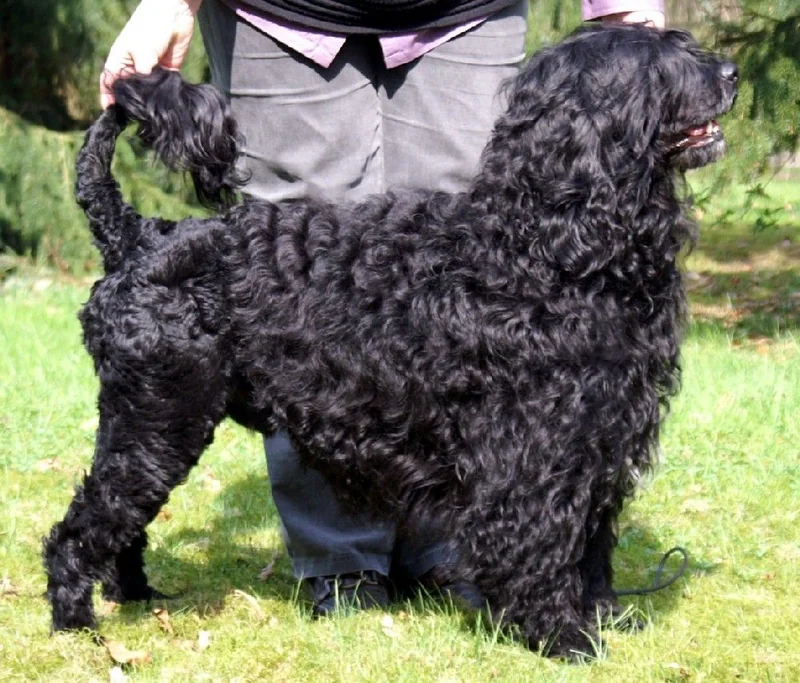 Featured photoportuguese-water-dog.jpg
The Portuguese Water Dog is a Portuguese Algarve fisherman's water-retriever — net-herding boat-dog rebuilt by Vasco Bensaude in 1934. The Portuguese Water Dog was kept for centuries by Portuguese fishermen of the Algarve coast as a working water-retriever — the dogs accompanied fishing boats out to sea, herded fish into nets, retrieved broken nets and lost tackle, and acted as boat-to-boat couriers.
Quick facts
- AKC group
- Working
- Origin country
- Portugal (Algarve coast)
- Origin period
- Pre-modern (formalized 1934)
- Coat type
- Curly
- Coat colors
- Black, White, Various Shades of Brown, Combinations of Black or Brown with White
- Average lifespan
- 11-14 years
- Recognition
- AKC 1983 · FCI 1955 · UKC 1984 · Group 8 — Retrievers, Flushing Dogs, Water Dogs (Section 3: Water Dogs)
Origin
The Portuguese Water Dog was kept for centuries by Portuguese fishermen of the Algarve and Estremadura coasts of Portugal as a working water-retriever. The dogs accompanied fishing boats out to sea, where they herded fish into the nets, retrieved broken nets and lost tackle from the water, and acted as boat-to-boat couriers in the days before radio. The breed shares ancestry with the Spanish Water Dog, the Standard Poodle, and the Lagotto Romagnolo — all derived from a common pre-modern European water-dog landrace. The breed nearly went extinct in the early 20th century with the mechanization of Portuguese fishing fleets; by 1930 the breed was reduced to fewer than 50 dogs. From 1934, Lisbon shipping magnate Dr Vasco Bensaude rebuilt the breed from a foundation of approximately a dozen dogs, working with breeder Conchita Cintron. The first PWDs reached the United States in 1958 and the AKC admitted the breed in 1983. The breed achieved international fame as the breed of choice of the Obama family during their 2009-2017 White House residence.
Recognition
The American Kennel Club admitted the breed in 1983, the United Kennel Club followed in 1984, and the Federation Cynologique Internationale published the international standard (FCI No. 37) in 1955. The FCI assigns the breed to Group 8 — Retrievers, Flushing Dogs, Water Dogs (Section 3: Water Dogs).
Standard
The AKC and FCI standards describe a medium-sized dog with substantial bone and muscle, well able to do a hard day's work in the water. The defining feature is the curly coat: either curly (compact cylindrical curls, somewhat lustreless) or wavy (falling gently in waves, with a slight sheen). Recognized colours are solid black, solid white, various shades of brown, and combinations of black or brown with white. The traditional 'lion clip' (face, muzzle, and rear half of the body shaved, with a tassel left at the tail tip) and the 'retriever clip' (coat shorn evenly all over) are both permitted under the standard. Males stand 50-58 cm at the withers, females 43-53 cm.
Sources & further reading (3)
- kennel-club-registry — accessed 2026-04-30
- encyclopedia — accessed 2026-04-30
- fci-standard — accessed 2026-04-30
Frequently asked questions
What is the Portuguese Water Dog's AKC group?
The American Kennel Club places the Portuguese Water Dog in the Working Group. The Working Group gathers breeds developed for jobs other than herding or hunting — guarding, draft, sled work, and water rescue — including the Boxer, Rottweiler, Saint Bernard, and Newfoundland. The breed's foundation working role was as a Portuguese Algarve fisherman's water-retriever — net-herding boat-dog rebuilt by Vasco Bensaude in 1934.
When was the Portuguese Water Dog officially recognized?
The American Kennel Club admitted the breed in 1983; the United Kennel Club followed in 1984; the Federation Cynologique Internationale published the international standard (FCI No. 37) in 1955.
What is the average lifespan of a Portuguese Water Dog?
Kennel-club longevity surveys place the Portuguese Water Dog's average lifespan in the 11-14 years range. The figure here represents the spread reported by the major parent-club studies and the Kennel Club (UK) purebred-dog health surveys.