Canis lupus familiaris
Norwich Terrier
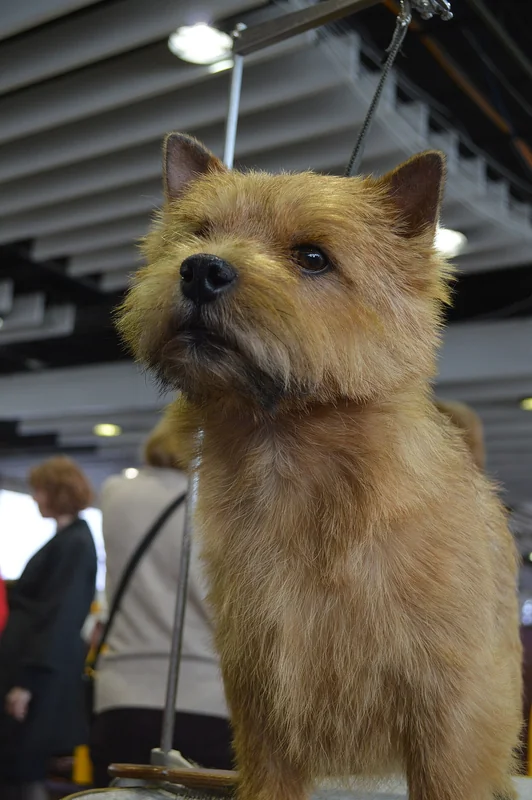 Featured photonorwich-terrier.jpg
The Norwich Terrier is one of the smallest terrier breeds in the world, developed in East Anglia, England, in the second half of the 19th century as a ratter and small-game hunter. Distinguished from the closely related Norfolk Terrier solely by its prick ears, the Norwich was popularised by Cambridge University students in the 1870s. The AKC recognised the Norwich as a separate breed from the Norfolk in 1979. Males stand 23–25 cm.
Quick facts
- AKC group
- Terrier
- Origin country
- England
- Origin period
- Late 19th century
- Coat type
- Wirehaired
- Coat colors
- Red, Red Wheaten, Tan, Black and Tan, Grizzle
- Average lifespan
- 12-15 years
- Recognition
- AKC 1936 · FCI 1954 · UKC 1936 · Group 3 — Terriers (Section 2: Small-sized Terriers)
Origin
The Norwich Terrier was developed in the Norfolk/Suffolk region of East Anglia in the 1870s. The exact founding crosses are not fully documented, but small working terriers of Cairn, Irish, and possibly Border Terrier type contributed to the early stock. Cambridge University students in the 1870s adopted a small red terrier as a collegiate mascot; this 'Trumpington Terrier' or 'Cambridge Terrier' was bred and sold by Frank Jones of Norwich, a horse trader who standardised the type for sale across England and to the United States in the 1880s–1890s. In America the dogs were called 'Jones Terriers' in their founder's honour.
Recognition
The Kennel Club (UK) recognised the Norwich Terrier in 1932 under a single standard that covered both prick-eared and drop-eared variants. The AKC admitted the breed in 1936. The two ear types were separated into distinct breeds — Norfolk Terrier (drop-eared) and Norwich Terrier (prick-eared) — by the AKC in 1979 and the Kennel Club (UK) in 1964. The FCI assigned the Norwich Terrier to Group 3, Section 2 (Small-sized Terriers).
Standard
The AKC and FCI standards describe a small, compact, nearly square-built terrier with a fox-like muzzle, bright, oval dark eyes, and upright, prick ears — the definitive distinction from the Norfolk Terrier's drop ears. The wiry, hard outer coat lies close to the body with a slight tousle; it is longer and rougher on the shoulders and forms a mane on the neck. Recognised colours include red, red wheaten, tan, black and tan, and grizzle. Males stand approximately 23–25 cm and weigh 4.5–5.5 kg.
Sources & further reading (3)
- kennel-club-registry — accessed 2026-05-27
- encyclopedia — accessed 2026-05-27
- fci-standard — accessed 2026-05-27
Frequently asked questions
What is the difference between the Norwich Terrier and the Norfolk Terrier?
The Norwich Terrier and Norfolk Terrier were recognised as separate breeds by the AKC in 1979 (the Kennel Club UK had separated them in 1964). The sole distinguishing feature is ear carriage: the Norwich Terrier has upright prick ears, while the Norfolk Terrier has folded drop ears. In all other respects — size, coat, colour, and build — the two breeds are virtually identical and share the same East Anglian working terrier origin.
When did Cambridge students start keeping Norwich Terriers?
In the 1870s, a small red terrier kept by students at Cambridge University became a popular collegiate mascot, known as the 'Trumpington Terrier' after Trumpington Street. The type was popularised and commercially bred by Frank Jones of Norwich in the 1880s; he sold specimens to wealthy clients including American sportsmen, and the breed was sometimes called the 'Jones Terrier' in the United States.
When were the Norwich and Norfolk Terriers separated into distinct breeds?
The Kennel Club (UK) separated the drop-eared Norfolk Terrier and prick-eared Norwich Terrier into distinct breeds in 1964. The AKC followed in 1979. Previously, both ear types had been registered together under the single name 'Norwich Terrier'. The FCI also separates them as distinct standards.