Canis lupus familiaris
Bull Terrier
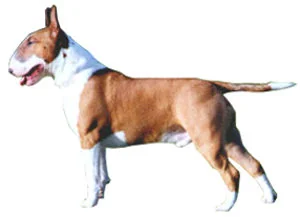 Featured photobull-terrier.jpg
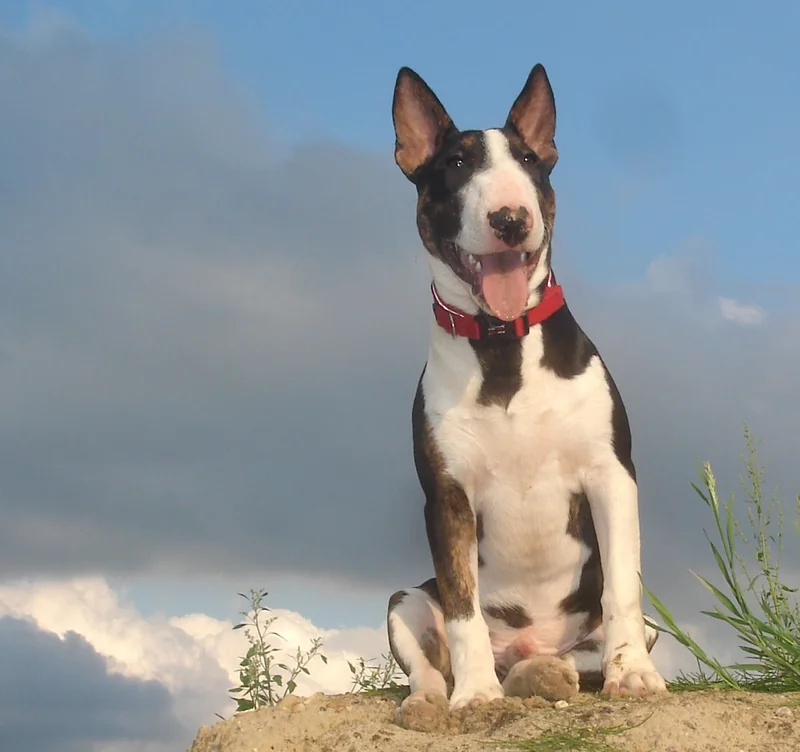
The Bull Terrier is a James Hinks's 1862 Birmingham refinement of the bull-and-terrier into the all-white show dog. The Bull Terrier was developed in mid-19th-century England by James Hinks of Birmingham, who crossed the now-extinct Old English Bulldog with the now-extinct White English Terrier and the Dalmatian to produce a refined, all-white show dog from the rougher pit-fighting bull-and-terrier crosses of the 1830s.
Quick facts
- AKC group
- Terrier
- Origin country
- England
- Origin period
- Mid-19th century
- Coat type
- Short
- Coat colors
- Pure White, Brindle, Brindle and White, Fawn and White, Tricolor
- Average lifespan
- 10-14 years
- Recognition
- AKC 1885 · FCI 1957 · UKC 1948 · Group 3 — Terriers (Section 3: Bull type Terriers)
Origin
In the early 19th century, English dog-fighters crossed the Old English Bulldog with various now-extinct working terriers (the English White Terrier, the Black-and-Tan Terrier, the Old English Terrier) to produce a 'bull-and-terrier' suited to the pit. After bull-baiting was outlawed in 1835 and dog-fighting in 1911, James Hinks of Birmingham refined the type from 1850 by crossing in additional Dalmatian, Spanish Pointer, and English Greyhound to produce a clean, all-white, more upright dog suited to the show ring. Hinks's 'White Cavalier' debuted at the Birmingham show in 1862 and dominated the new Bull Terrier classes within a decade. The egg-shaped head — the modern breed's defining feature — was selectively bred for from the 1890s onward.
Recognition
The American Kennel Club admitted the breed in 1885, the United Kennel Club followed in 1948, and the Federation Cynologique Internationale published the international standard (FCI No. 11) in 1957. The FCI assigns the breed to Group 3 — Terriers (Section 3: Bull type Terriers).
Standard
The AKC and FCI standards describe a strongly-built, muscular, well-balanced and active dog with a keen, determined and intelligent expression. The defining breed feature is the egg-shaped head: long, strong, and deep, with no stop and a downward curve from skull to tip of nose, viewed in profile. The short, flat, harsh, glossy coat is recognized in pure white (with permitted skin pigmentation and head markings) and any colour other than white (brindle, brindle and white, fawn and white, red and white, tricolour). A miniature variety (FCI No. 359) is registered as a separate breed.
Sources & further reading (3)
- kennel-club-registry — accessed 2026-05-04
- encyclopedia — accessed 2026-05-04
- fci-standard — accessed 2026-05-04
Frequently asked questions
What is the Bull Terrier's AKC group?
The American Kennel Club places the Bull Terrier in the Terrier Group. The Terrier Group gathers breeds developed to hunt and dispatch vermin or to go to ground after fox and badger; the name derives from the Latin terra ('earth'). The breed's foundation working role was as a James Hinks's 1862 Birmingham refinement of the bull-and-terrier into the all-white show dog.
When was the Bull Terrier officially recognized?
The American Kennel Club admitted the breed in 1885; the United Kennel Club followed in 1948; the Federation Cynologique Internationale published the international standard (FCI No. 11) in 1957.
What is the average lifespan of a Bull Terrier?
Kennel-club longevity surveys place the Bull Terrier's average lifespan in the 10-14 years range. The figure here represents the spread reported by the major parent-club studies and the Kennel Club (UK) purebred-dog health surveys.