Canis lupus familiaris
Komondor
 Featured photokomondor.jpg
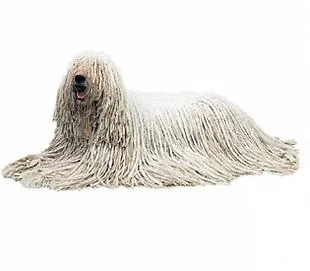
The Komondor is a Hungarian corded-coat livestock guardian, brought to the Carpathian basin by 13th-century Cumans. The Komondor is a Hungarian livestock-guarding breed brought into the Carpathian basin by the Cuman people who fled the Mongol invasion of Eurasia and were granted refuge in 13th-century Hungary.
Quick facts
- AKC group
- Working
- Origin country
- Hungary
- Origin period
- Pre-modern (Cuman migration, 12th-13th century)
- Coat type
- Long
- Coat colors
- Pure White only — corded coat that hangs in long, ropelike cords
- Average lifespan
- 10-12 years
- Recognition
- AKC 1937 · FCI 1954 · UKC 1948 · Group 1 — Sheepdogs and Cattledogs (Section 1: Sheepdogs)
Origin
The Komondor is a Hungarian livestock-guarding breed brought into the Carpathian basin by the Cuman people, a Turkic people of the Eurasian steppe who fled the Mongol invasion of 1241 and were granted refuge in 13th-century Hungary by King Béla IV. The Cumans brought their working sheepdogs, ancestors of the modern Komondor, with them; the breed has been kept on the Hungarian puszta (plains) ever since to guard flocks of the Hungarian Racka sheep against wolf and bear. The breed was nearly extinguished by the Second World War — German and Soviet armies poisoned or shot Komondors during their movements across Hungary, leaving fewer than 30 dogs surviving in 1945. The modern population was rebuilt from these survivors plus exports made before the war.
Recognition
The American Kennel Club admitted the breed in 1937, the United Kennel Club followed in 1948, and the Federation Cynologique Internationale published the international standard (FCI No. 53) in 1954. The FCI assigns the breed to Group 1 — Sheepdogs and Cattledogs (Section 1: Sheepdogs).
Standard
The AKC and FCI standards describe a large, muscular, imposing white livestock-guarding dog of impressive strength and dignity. The defining feature is the unique coat: a soft, woolly undercoat covered by a coarser outer coat that, in adults, mats into long, characteristic cords (the corded coat begins to develop at 8-12 months and is fully corded by 2 years). The corded coat is pure white only — coloured dogs are disqualified — and provides both visual camouflage among white sheep and protection from wolf bites and harsh weather. Males stand 71-80 cm at the withers, females 65-71 cm.
Sources & further reading (3)
- kennel-club-registry — accessed 2026-04-30
- encyclopedia — accessed 2026-04-30
- fci-standard — accessed 2026-04-30
Frequently asked questions
What is the Komondor's AKC group?
The American Kennel Club places the Komondor in the Working Group. The Working Group gathers breeds developed for jobs other than herding or hunting — guarding, draft, sled work, and water rescue — including the Boxer, Rottweiler, Saint Bernard, and Newfoundland. The breed's foundation working role was as a Hungarian corded-coat livestock guardian, brought to the Carpathian basin by 13th-century Cumans.
When was the Komondor officially recognized?
The American Kennel Club admitted the breed in 1937; the United Kennel Club followed in 1948; the Federation Cynologique Internationale published the international standard (FCI No. 53) in 1954.
What is the average lifespan of a Komondor?
Kennel-club longevity surveys place the Komondor's average lifespan in the 10-12 years range. The figure here represents the spread reported by the major parent-club studies and the Kennel Club (UK) purebred-dog health surveys.