Canis lupus familiaris
Hovawart
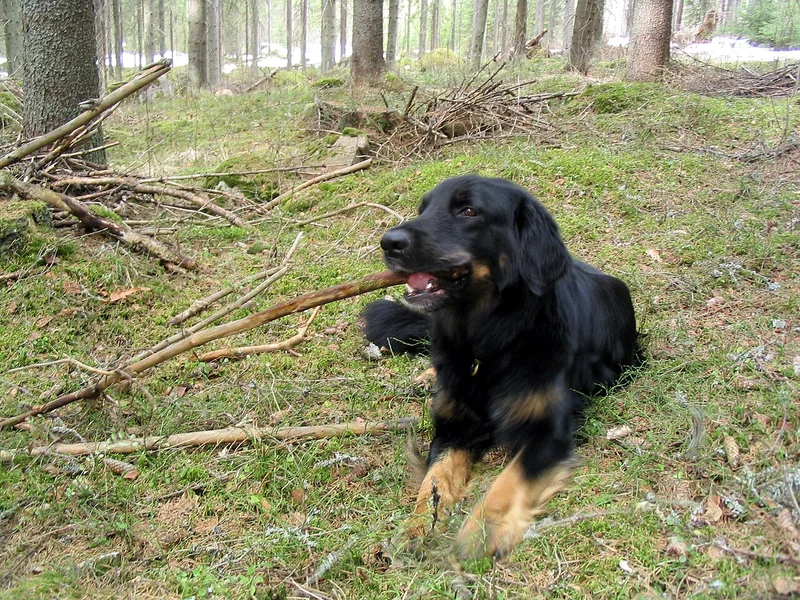 Featured photohovawart.jpg
The Hovawart is a large German working dog whose name derives from the Middle High German words 'hova' (estate, farmstead) and 'wart' (guardian) — literally 'the guardian of the estate'. The breed is documented in medieval German writings from the 13th century, where it is described as a loyal estate and property guardian. The modern breed was re-established from 1915 to 1922 by Kurt Friedrich König using farm dogs found in the Black Forest that resembled medieval descriptions. The FCI recognised the breed in 1937. Males stand 63–70 cm and weigh 30–50 kg.
Quick facts
- AKC group
- Working
- Origin country
- Germany
- Origin period
- Medieval, revived early 20th century
- Coat type
- Long
- Coat colors
- Black, Blond, Black and Gold
- Average lifespan
- 10-14 years
- Recognition
- FCI 1937 · Group 2 — Pinscher and Schnauzer-Molossoid Breeds, Swiss Mountain and Cattle Dogs (Section 2.2: Molossoid breeds, Mountain type)
Origin
The Hovawart's name appears in the writings of Albertus Magnus in the 1220s and in the Saxon legal code Sachsenspiegel (c. 1220–1235), which describes the 'Hofewart' as an estate guardian whose worth was legally codified — stealing or killing one was a punishable offense. The 15th-century German text 'Das Buch von den Heiligen Geschlechten' lists the Hovawart among the five noble Germanic breeds. By the 19th century, the working breed had disappeared into the general farm dog population. Kurt Friedrich König began a systematic reconstruction in the Black Forest and Thüringia regions in 1915, identifying farm dogs that matched the medieval physical type and crossing them with Leonberger, Kuvász, and German Shepherd Dog to restore the breed.
Recognition
The Hovawart-Vereinigung, founded in 1922, documented König's reconstruction program. The FCI granted formal recognition in 1937 (FCI No. 190) with Germany as patron country, placing the breed in Group 2, Section 2.2 (Molossoid breeds, Mountain type). The Hovawart is widely used in Germany as a search-and-rescue, tracking, and service dog. The AKC has not formally recognised the breed; it is classed in the AKC Foundation Stock Service (FSS) and available through some UKC-affiliated clubs.
Standard
The FCI standard describes a medium-to-large, strong, slightly longer than tall dog with a broad, slightly domed skull and a powerful muzzle. The long coat lies close and slightly wavy, with no undercoat; it is longer on the neck, chest, belly, and backs of the legs, giving a handsome feathered appearance. Three colours are recognised and equally valued: black, blond (golden), and black with gold (bicolor). All colours are disqualified if they carry white markings other than a small spot on the chest. Males stand 63–70 cm.
Sources & further reading (3)
- fci-standard — accessed 2026-05-07
- encyclopedia — accessed 2026-05-07
- breed-club — accessed 2026-05-07
Frequently asked questions
What does 'Hovawart' mean?
Hovawart derives from the Middle High German 'hova' (farmstead or estate) and 'wart' (guardian or watchman), meaning 'guardian of the estate'. This name accurately describes the breed's historic function as a loyal, versatile property guardian on German farms and estates from at least the 13th century. The modern spelling is a simplified form of the medieval 'Hofewart' documented in the Sachsenspiegel legal code of c. 1220–1235.
Is the Hovawart recognised by the AKC?
The AKC has not granted full recognition to the Hovawart. The breed is listed in the AKC Foundation Stock Service (FSS), which records rare breeds working toward full recognition. The FCI has recognised the Hovawart since 1937 (FCI No. 190) with Germany as patron country. The breed is widely used in Germany, Austria, and Switzerland for search-and-rescue, tracking, and service work.
How was the Hovawart reconstructed after it nearly disappeared?
Kurt Friedrich König began the Hovawart's reconstruction in 1915 in the Black Forest and Thüringia regions, locating farm dogs that matched the medieval physical type described in historical texts. He systematically crossed these dogs with Leonberger, Kuvász, and German Shepherd Dog to restore the correct size, coat, and working character. The Hovawart-Vereinigung was founded in 1922 to document the program, and FCI recognition followed in 1937.