Canis lupus familiaris
Great Dane
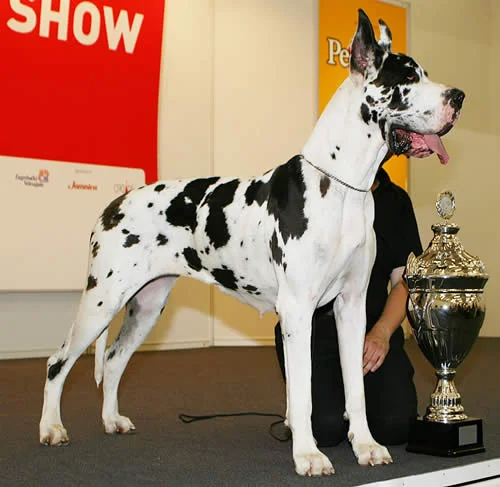 Featured photogreat-dane.jpg
The Great Dane is a German aristocratic boar-hound — the Deutsche Dogge, German national dog. The Great Dane was developed in 16th- and 17th-century Germany from English Mastiff and Irish Wolfhound crosses to hunt European wild boar.
Quick facts
- AKC group
- Working
- Origin country
- Germany
- Origin period
- 16th-17th century (modern type formalized 1880)
- Coat type
- Short
- Coat colors
- Fawn, Brindle, Black, Blue, Harlequin, Mantle
- Average lifespan
- 7-10 years
- Recognition
- AKC 1887 · FCI 1955 · UKC 1923 · Group 2 — Pinscher and Schnauzer-Molossoid breeds-Swiss Mountain and Cattle Dogs (Section 2.1: Molossoid breeds, Mastiff type)
Origin
The Great Dane was developed in 16th- and 17th-century Germany as an aristocratic boar-hound, with foundation crosses involving the English Mastiff and the Irish Wolfhound. Despite the English name 'Great Dane' (which comes from the 18th-century French Grand Danois — itself a misnomer; the breed has no documented Danish origin), the breed is German. At the Berlin dog show of 1880, German breeders formally adopted the name Deutsche Dogge (German Mastiff) as the official breed name and proclaimed the Great Dane the German national dog. The Deutsche Doggen-Club was founded the following year.
Recognition
The American Kennel Club admitted the breed in 1887, the United Kennel Club followed in 1923, and the Federation Cynologique Internationale published the international standard (FCI No. 235) in 1955. The FCI assigns the breed to Group 2 — Pinscher and Schnauzer-Molossoid breeds-Swiss Mountain and Cattle Dogs (Section 2.1: Molossoid breeds, Mastiff type).
Standard
The AKC and FCI standards describe a regal, imposing dog of great size and powerful, well-formed, smoothly-muscled body. The breed combines pride, strength, and elegance with great size and a powerful, well-formed, smoothly muscled body. The short, thick, glossy coat is recognized in six colours: fawn, brindle, black, blue, harlequin (white with irregular black patches), and mantle (black-and-white). Males stand 76-86 cm at the withers as a minimum (no upper limit), females 71-81 cm.
Sources & further reading (3)
- kennel-club-registry — accessed 2026-05-04
- encyclopedia — accessed 2026-05-04
- fci-standard — accessed 2026-05-04
Frequently asked questions
What is the Great Dane's AKC group?
The American Kennel Club places the Great Dane in the Working Group. The Working Group gathers breeds developed for jobs other than herding or hunting — guarding, draft, sled work, and water rescue — including the Boxer, Rottweiler, Saint Bernard, and Newfoundland. The breed's foundation working role was as a German aristocratic boar-hound — the Deutsche Dogge, German national dog.
When was the Great Dane officially recognized?
The American Kennel Club admitted the breed in 1887; the United Kennel Club followed in 1923; the Federation Cynologique Internationale published the international standard (FCI No. 235) in 1955.
What is the average lifespan of a Great Dane?
Kennel-club longevity surveys place the Great Dane's average lifespan in the 7-10 years range. The figure here represents the spread reported by the major parent-club studies and the Kennel Club (UK) purebred-dog health surveys.