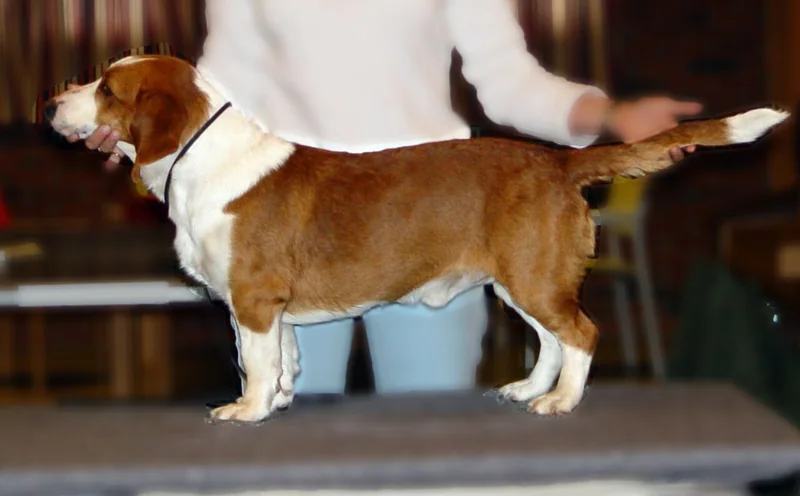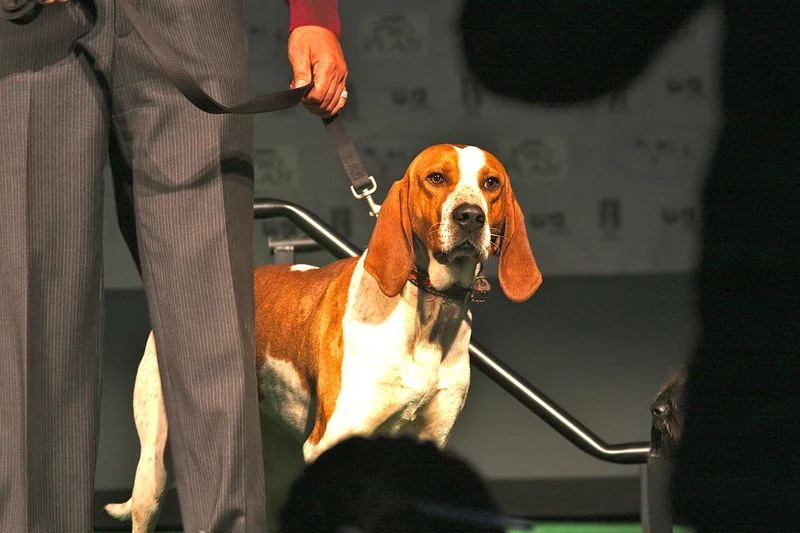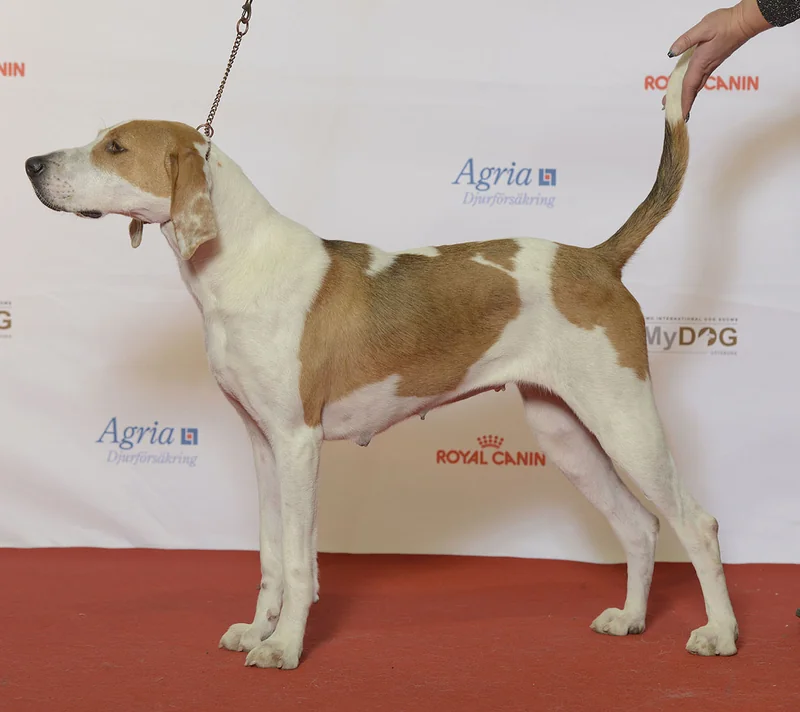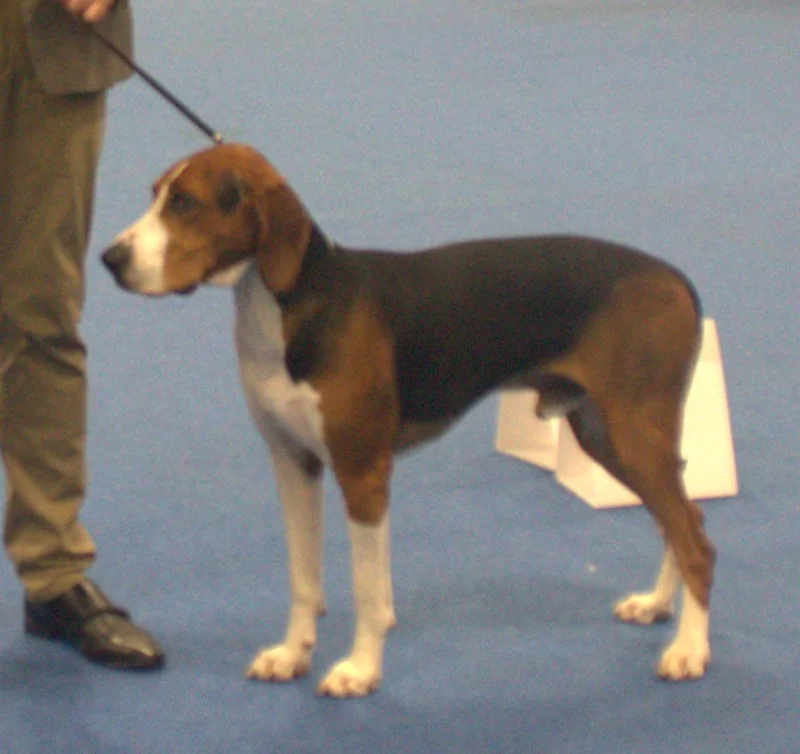
The Hamiltonstövare is a medium-large Swedish scenthound created in the 1880s by Count Adolf Patrick Hamilton — the founder of the Swedish Kennel Club — by crossing English Foxhounds with the Hanoverian Hound and the Holstein Hound. The breed is Sweden's most popular hunting dog and hunts hare and fox alone rather than in packs. The FCI registers it as No. 101 under Sweden's patronage; the AKC lists the Hamiltonstövare in the Foundation Stock Service. Males stand 57–61 cm.
Quick facts
- AKC group
- Hound
- Origin country
- Sweden
- Origin period
- 1880s
- Coat type
- Short
- Coat colors
- Tri-colour: Black Saddle, Rich Tan, White Markings
- Average lifespan
- 12-13 years
- Recognition
- FCI 1953 · Group 6 — Scenthounds and Related Breeds (Section 1.2: Medium-sized Hounds)
Origin
Count Adolf Patrick Hamilton designed the breed in the 1880s with a precise working goal: a Swedish dog capable of hunting hare and fox alone, driving game through thick Scandinavian forest and announcing its location by voice so the hunter could intercept. He used three foundation breeds — the English Foxhound for speed and voice, the Hanoverian Schweisshund for tracking ability on cold scent, and the Holstein Hound for hardiness. The first public exhibition of the type was at the 1886 Stockholm Dog Show. Hamilton founded the Swedish Kennel Club in 1889 and used it to standardise and promote his hound.
Recognition
The Swedish Kennel Club (SKK) formally recognised the breed, and the FCI registered it under standard No. 101 in 1953 with Sweden as patron country, classifying it in Group 6 — Scenthounds and Related Breeds (Section 1.2: Medium-sized Hounds). The Hamiltonstövare is the most registered hunting dog in Sweden and is also maintained as a companion. It is listed in the AKC Foundation Stock Service but has not received full AKC recognition. The FCI standard requires all three colours — the black saddle, rich tan markings, and white chest and neck — to be present.
Standard
The FCI standard describes a medium-large, well-balanced, strongly built dog with a clean, noble head, a moderately long muzzle, and pendulous ears of medium length. The tri-colour coat is a distinguishing feature: a black saddle over the back and sides, rich tan on the head, legs, and under the tail, and white on the chest, neck, muzzle, feet, and tail tip. The coat is short, hard, and close-lying. Males stand 57–61 cm; females 53–57 cm. The breed is built for endurance rather than speed.
Sources & further reading (3)
- fci-standard — accessed 2026-05-27
- encyclopedia — accessed 2026-05-27
- kennel-club-registry — accessed 2026-05-27
Frequently asked questions
Who created the Hamiltonstövare?
Count Adolf Patrick Hamilton (1827–1920), the founder of the Swedish Kennel Club in 1889, created the breed in the 1880s. He crossed the English Foxhound with the Hanoverian Schweisshund and the Holstein Hound to produce a hunting dog suited to Swedish terrain and the single-dog hunting style practised in Scandinavia. The breed was renamed after him posthumously.
Is the Hamiltonstövare AKC recognised?
The Hamiltonstövare is not fully recognised by the AKC and is listed in the AKC Foundation Stock Service (FSS). The FCI has recognised the breed since 1953 under standard No. 101, with Sweden as patron country. The breed is widely recognised by Scandinavian and European kennel clubs.
How does the Hamiltonstövare hunt compared to English Foxhounds?
The Hamiltonstövare was designed to hunt alone (as a single dog) rather than in a pack, which is the traditional English Foxhound style. In Sweden, the hunter typically follows one or two hounds on foot through dense forest; the dog drives hare or fox before it, announcing its location with a continuous voice. Pack-hunting of the English or American style is not part of the Hamiltonstövare's working tradition.