Canis lupus familiaris
Great Pyrenees
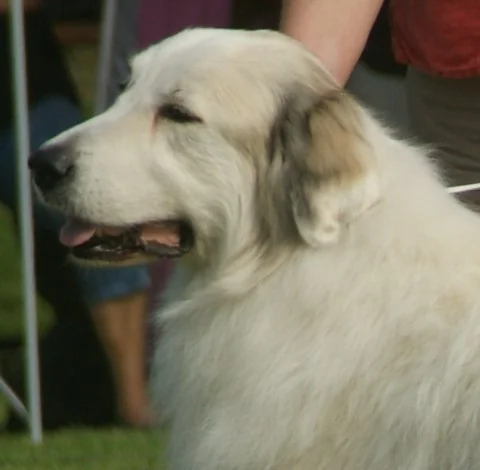 Featured photogreat-pyrenees.jpg
The Great Pyrenees is a Pyrenean white livestock-guardian of the French and Spanish Pyrenees mountains — Louis XIV's royal dog. The Great Pyrenees (called Pyrenean Mountain Dog in the FCI registries and Patou in regional French) is a livestock-guardian breed native to the Pyrenees mountains on the French-Spanish border, where the breed has been kept by Pyrenean shepherds for at least 1,000 years to guard sheep flocks from wolf, brown bear, and the Pyrenean lynx.
Quick facts
- AKC group
- Working
- Origin country
- France / Spain (Pyrenees mountains)
- Origin period
- Pre-modern (formalized 1923)
- Coat type
- Long
- Coat colors
- Pure White, White with markings of grey, Reddish-Brown, Wolf-Grey, or Tan on the head, ears, and tail
- Average lifespan
- 10-12 years
- Recognition
- AKC 1933 · FCI 1955 · UKC 1936 · Group 2 — Pinscher and Schnauzer-Molossoid breeds-Swiss Mountain and Cattle Dogs (Section 2.2: Molossoid breeds, Mountain type)
Origin
The Great Pyrenees is a livestock-guardian breed native to the Pyrenees mountains on the French-Spanish border, where the breed has been kept by Pyrenean shepherds for at least 1,000 years to guard sheep flocks from wolf, Pyrenean brown bear, and the Pyrenean lynx during the long summer transhumance to the high alpine pastures. The breed shares ancestry with the Spanish Mastiff, the Maremma Sheepdog, the Estrela Mountain Dog, and the Pyrenean Mastiff (a separate, larger Spanish breed) — all derived from the same Roman-descended Iberian livestock-guardian stock. King Louis XIV of France declared the Great Pyrenees the official dog of the French royal court in 1675; the Réunion des Amateurs de Chiens Pyrénéens formalized the breed in 1923 and the AKC admitted it in 1933.
Recognition
The American Kennel Club admitted the breed in 1933, the United Kennel Club followed in 1936, and the Federation Cynologique Internationale published the international standard (FCI No. 137) in 1955. The FCI assigns the breed to Group 2 — Pinscher and Schnauzer-Molossoid breeds-Swiss Mountain and Cattle Dogs (Section 2.2: Molossoid breeds, Mountain type).
Standard
The AKC and FCI standards describe a great-sized, immensely strong, alert, and majestic dog with a steady, serious bearing, of rustic and elegant appearance. The defining feature is the abundant double coat: a soft, dense undercoat under a long, flat, thick outer coat — straight or slightly wavy. The only main coat colour is pure white; markings of grey, reddish-brown, wolf-grey, or tan on the head, ears, and tail base are permitted but must not exceed one-third of the body. The breed shows a mandatory double dewclaw on each rear leg. Males stand 70-81 cm at the withers, females 65-74 cm.
Sources & further reading (3)
- kennel-club-registry — accessed 2026-04-30
- encyclopedia — accessed 2026-04-30
- fci-standard — accessed 2026-04-30
Frequently asked questions
What is the Great Pyrenees's AKC group?
The American Kennel Club places the Great Pyrenees in the Working Group. The Working Group gathers breeds developed for jobs other than herding or hunting — guarding, draft, sled work, and water rescue — including the Boxer, Rottweiler, Saint Bernard, and Newfoundland. The breed's foundation working role was as a Pyrenean white livestock-guardian of the French and Spanish Pyrenees mountains — Louis XIV's royal dog.
When was the Great Pyrenees officially recognized?
The American Kennel Club admitted the breed in 1933; the United Kennel Club followed in 1936; the Federation Cynologique Internationale published the international standard (FCI No. 137) in 1955.
What is the average lifespan of a Great Pyrenees?
Kennel-club longevity surveys place the Great Pyrenees's average lifespan in the 10-12 years range. The figure here represents the spread reported by the major parent-club studies and the Kennel Club (UK) purebred-dog health surveys.