Canis lupus familiaris
English Springer Spaniel
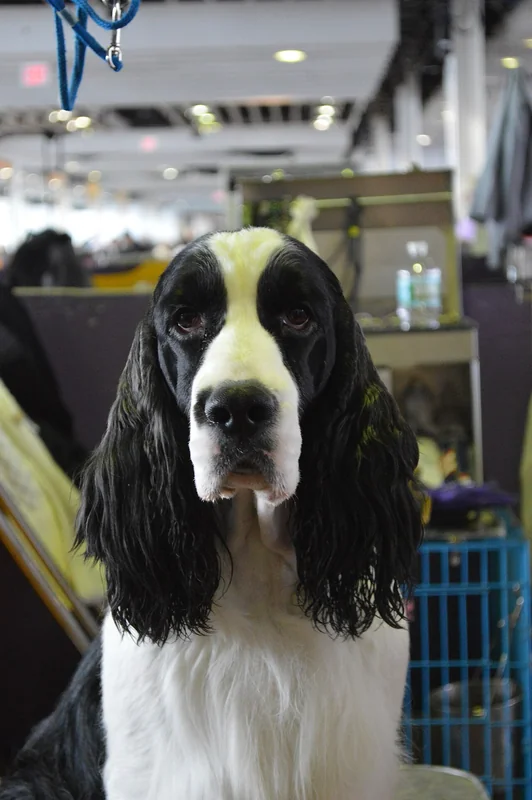 Featured photoenglish-springer-spaniel.jpg
The English Springer Spaniel is a medium-sized gundog of English origin, developed over centuries as a versatile flushing and retrieving spaniel for upland and rough shooting. The name 'springer' refers to the breed's working function of springing game from cover. The AKC admitted the breed in 1910 and assigns it to the Sporting Group; the FCI registers it as No. 125 in Group 8. The breed splits in modern practice into show and working field lines with markedly different physical builds. Males stand 48–51 cm and weigh 20–25 kg.
Quick facts
- AKC group
- Sporting
- Origin country
- England
- Origin period
- 17th century (standardised 1902)
- Coat type
- Medium
- Coat colors
- Liver and White, Black and White, Liver and White with Tan Points, Black and White with Tan Points
- Average lifespan
- 12-14 years
- Recognition
- AKC 1910 · FCI 1954 · UKC 1913 · Group 8 — Retrievers, Flushing Dogs, Water Dogs (Section 2: Flushing Dogs)
Origin
English land spaniels used to spring game from cover for falconers and fowlers appear in Tudor-era writings and paintings from at least the early 17th century. Throughout the 17th and 18th centuries, litters from English sporting spaniels might contain both large dogs that 'sprung' game and small ones that 'cockered' beneath cast nets — the future Springers and Cockers grew from the same working stock. The first field trials specifically for Springer Spaniels were held in 1899, and the Kennel Club recognised the English Springer as a distinct breed in 1902.
Recognition
The Kennel Club (UK) recognised the English Springer Spaniel as a distinct breed in 1902, separating it formally from the Welsh Springer Spaniel. The AKC admitted the breed in 1910 and placed it in the Sporting Group. The FCI registered the breed under standard No. 125 in 1954, assigning it to Group 8, Section 2 (Flushing Dogs). The English Springer Spaniel Field Trial Association, founded in 1921, governs the working field trial programme.
Standard
The AKC and FCI standards describe a symmetrical, compact, strong, merry dog — built for endurance with a balanced, effortless gait. The coat is flat or wavy, of medium length, dense and weather-resistant, with feathering on the ears, chest, belly, and legs. Recognised colours are liver and white, black and white, and either colour with tan points. The breed has diverged substantially into show and working field lines: field-bred dogs are typically lighter, shorter-coated, with a higher-set tail, whereas show dogs carry a heavier coat and a lower tail set. Males stand approximately 48–51 cm at the withers.
Sources & further reading (3)
- kennel-club-registry — accessed 2026-05-27
- encyclopedia — accessed 2026-05-27
- fci-standard — accessed 2026-05-27
Frequently asked questions
What does 'springer' mean in English Springer Spaniel?
The name refers to the breed's working function of 'springing' game — that is, flushing birds and other quarry from dense cover so they are driven into the air or a net for the waiting hunter or falcon. The term distinguishes the larger flushing Springers from the smaller Cockers, which historically 'cockered' (crouched) under the net while the fowler cast.
When did the AKC recognise the English Springer Spaniel?
The American Kennel Club admitted the English Springer Spaniel in 1910, placing it in the Sporting Group. The Kennel Club (UK) had recognised the breed as distinct from the Welsh Springer Spaniel in 1902, and the FCI published the international standard (No. 125) in 1954.
What is the difference between show and field English Springer Spaniels?
Over more than a century of separate breeding programs, the English Springer Spaniel has diverged into two distinct types. Field-bred dogs are lighter-boned, with shorter coats, a higher tail-set, and greater speed and stamina for competitive field work. Show dogs carry heavier, longer coats, a lower tail set, and a more substantial build suited to the conformation ring. Both are registered under the same breed standard, but the physical differences are now so marked that crossing between lines is uncommon.