Canis lupus familiaris
Curly-Coated Retriever
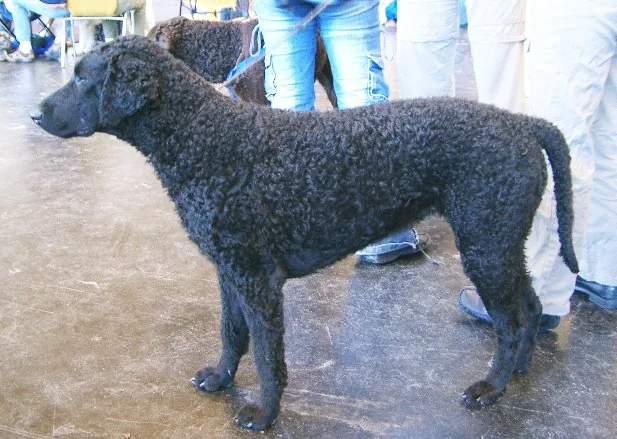 Featured photocurly-coated-retriever.jpg
The Curly-Coated Retriever is a oldest British duck-retrieving water dog, distinguished by the tight all-over coat curl. The Curly-Coated Retriever is the oldest of the British retriever breeds, fixed in late-18th-century England from crosses between the now-extinct English Water Spaniel, the now-extinct St John's water dog, and a small dose of Poodle (introduced for the tight curls).
Quick facts
- AKC group
- Sporting
- Origin country
- England
- Origin period
- Late 18th century
- Coat type
- Curly
- Coat colors
- Black, Liver
- Average lifespan
- 9-14 years
- Recognition
- AKC 1924 · FCI 1954 · UKC 1948 · Group 8 — Retrievers, Flushing Dogs, Water Dogs (Section 1: Retrievers)
Origin
The Curly-Coated Retriever is the oldest of the British retriever breeds and was fixed in late-18th-century England as a duck-retrieving water dog. Foundation crosses involved the now-extinct English Water Spaniel (which contributed the curly coat), the now-extinct St John's water dog of Newfoundland (which contributed the retrieving aptitude), and a small dose of Poodle (which intensified the tight curls). The breed was the most popular British gundog at the first organized dog show in Newcastle-upon-Tyne in 1859, and a Curly placed first in the Retriever class at the 1860 Birmingham National Dog Show.
Recognition
The American Kennel Club admitted the breed in 1924, the United Kennel Club followed in 1948, and the Federation Cynologique Internationale published the international standard (FCI No. 110) in 1954. The FCI assigns the breed to Group 8 — Retrievers, Flushing Dogs, Water Dogs (Section 1: Retrievers).
Standard
The AKC and FCI standards describe a strong, smart, upstanding dog of medium-large build, the longest-legged of the retrievers, conveying the impression of elegance combined with hardiness. The defining feature is the coat: a thick, dense mass of small, tight, crisp curls covering the entire body except for the muzzle and front of the legs, where the hair is short and smooth. Recognized colours are solid black and solid liver. Males stand 64-69 cm at the withers, females 63-66 cm.
Sources & further reading (3)
- kennel-club-registry — accessed 2026-04-30
- encyclopedia — accessed 2026-04-30
- fci-standard — accessed 2026-04-30
Frequently asked questions
What is the Curly-Coated Retriever's AKC group?
The American Kennel Club places the Curly-Coated Retriever in the Sporting Group. The Sporting Group gathers pointers, setters, retrievers, and spaniels — breeds developed to assist hunters in locating, flushing, or retrieving game birds. The breed's foundation working role was as a oldest British duck-retrieving water dog, distinguished by the tight all-over coat curl.
When was the Curly-Coated Retriever officially recognized?
The American Kennel Club admitted the breed in 1924; the United Kennel Club followed in 1948; the Federation Cynologique Internationale published the international standard (FCI No. 110) in 1954.
What is the average lifespan of a Curly-Coated Retriever?
Kennel-club longevity surveys place the Curly-Coated Retriever's average lifespan in the 9-14 years range. The figure here represents the spread reported by the major parent-club studies and the Kennel Club (UK) purebred-dog health surveys.