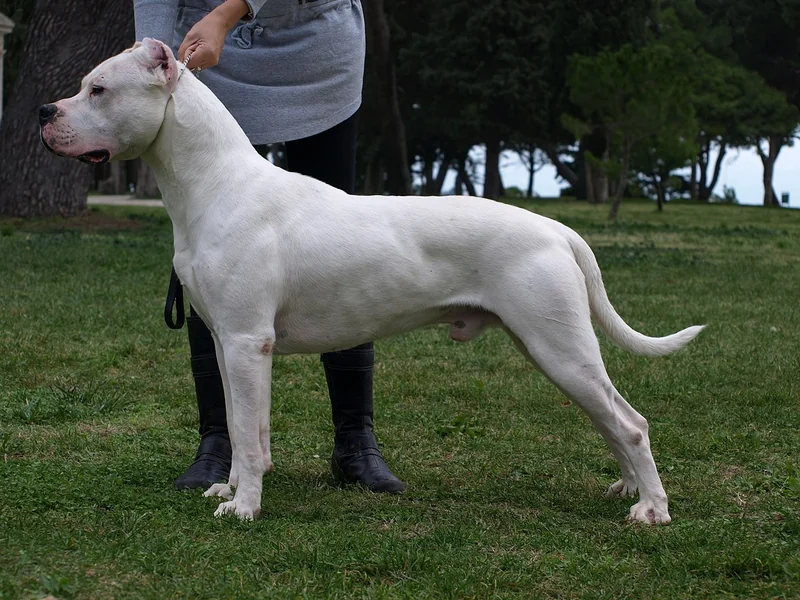
The Dogo Argentino is a 1928 Argentine pure-white pack-hunting Molossoid — national dog of Argentina. The Dogo Argentino was created in 1928 by Argentine physician Antonio Nores Martínez (1907-1956) of Córdoba Province, who crossed the now-extinct Cordoba Fighting Dog with Great Dane, Boxer, Spanish Mastiff, Old English Bulldog, Bull Terrier, German Pointer, Pyrenean Mastiff, Irish Wolfhound, and Dogue de Bordeaux to produce a pure-white pack-hunting dog capable of pursuing puma and wild boar across the Argentine Pampas.
Quick facts
- AKC group
- Working
- Origin country
- Argentina
- Origin period
- Early 20th century (formalized 1928)
- Coat type
- Short
- Coat colors
- Pure White only — small dark patch on the head (around the eye or ear) tolerated
- Average lifespan
- 10-15 years
- Recognition
- AKC 2020 · FCI 1973 · UKC 1996 · Group 2 — Pinscher and Schnauzer-Molossoid breeds-Swiss Mountain and Cattle Dogs (Section 2.1: Molossoid breeds, Mastiff type)
Origin
The Dogo Argentino was created in 1928 by Argentine physician Antonio Nores Martínez (1907-1956) and his brother Agustín Nores Martínez of Córdoba Province, Argentina. Antonio crossed the now-extinct Cordoba Fighting Dog (the foundation breed) with Great Dane (for size), Boxer (for tenacity), Spanish Mastiff (for substance), Old English Bulldog (for grip), Bull Terrier (for fearlessness), German Pointer (for scenting ability), Pyrenean Mastiff (for cold tolerance), Irish Wolfhound (for sighthound speed), and Dogue de Bordeaux (for power) — ten breeds blended over decades and seven generations into a pure-white pack-hunting dog capable of pursuing puma and wild boar across the Argentine Pampas. Antonio published the first formal breed standard in 1928. The breed is the national dog of Argentina and is heavily restricted under dangerous-dog legislation in the United Kingdom, Australia, and several European countries. The FCI registered the breed in 1973 and the AKC followed in 2020.
Recognition
The American Kennel Club admitted the breed in 2020, the United Kennel Club followed in 1996, and the Federation Cynologique Internationale published the international standard (FCI No. 292) in 1973. The FCI assigns the breed to Group 2 — Pinscher and Schnauzer-Molossoid breeds-Swiss Mountain and Cattle Dogs (Section 2.1: Molossoid breeds, Mastiff type).
Standard
The FCI and AKC standards describe a strong, athletic, well-muscled, harmonious dog of large size, white in colour, with a powerful build and a courageous bearing. The defining feature is the pure-white coat — short, smooth, and thick, with a small dark patch on the head (around the eye or ear) tolerated under FCI but disqualifying under most lines. The breed has thick, dense skin with substantial pigmentation underneath the white coat. Males stand 62-68 cm at the withers, females 60-65 cm.
Sources & further reading (3)
- kennel-club-registry — accessed 2026-04-30
- encyclopedia — accessed 2026-04-30
- fci-standard — accessed 2026-04-30
Frequently asked questions
What is the Dogo Argentino's AKC group?
The American Kennel Club places the Dogo Argentino in the Working Group. The Working Group gathers breeds developed for jobs other than herding or hunting — guarding, draft, sled work, and water rescue — including the Boxer, Rottweiler, Saint Bernard, and Newfoundland. The breed's foundation working role was as a 1928 Argentine pure-white pack-hunting Molossoid — national dog of Argentina.
When was the Dogo Argentino officially recognized?
The American Kennel Club admitted the breed in 2020; the United Kennel Club followed in 1996; the Federation Cynologique Internationale published the international standard (FCI No. 292) in 1973.
What is the average lifespan of a Dogo Argentino?
Kennel-club longevity surveys place the Dogo Argentino's average lifespan in the 10-15 years range. The figure here represents the spread reported by the major parent-club studies and the Kennel Club (UK) purebred-dog health surveys.