Felis catus
Seychellois
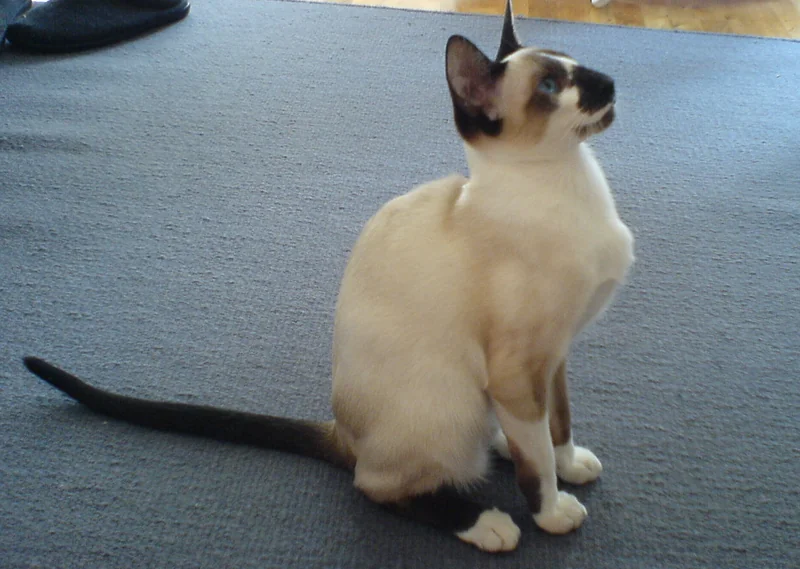 Featured photoseychellois.jpg
The Seychellois is a Siamese-type breed carrying a Van-pattern bicolour coat — predominantly white with coloured markings on the head and tail. The breed was developed by British geneticist Patricia Turner from the 1980s through Siamese, Persian, and Turkish Van crosses, with the goal of producing an Oriental cat with the Turkish Van pattern. FIFe recognized the Seychellois in 1988 (provisional). CFA, TICA, and GCCF do not maintain Seychellois standards. The breed exists in shorthair and longhair varieties.
Quick facts
- Origin country
- France / United Kingdom
- Origin period
- Bicolour Oriental developed in 1980s; FIFe recognition 1988 (provisional)
- Coat type
- Short
- Coat colors
- Septieme (Van pattern — white body with coloured head and tail), Huitieme (intermediate bicolour), Neuvieme (predominantly coloured with white spotting), Each in seal, blue, chocolate, lilac, red, cream, and tortoiseshell point colours
- Size category
- Medium
- Average lifespan
- 12-15 years
- Recognition
- FIFe 1988
Origin
British geneticist Patricia Turner began developing the Seychellois in the 1980s by crossing Siamese cats with Persian and Turkish Van foundation stock. The goal was a cat carrying the Turkish Van's bicolour Van pattern (white body with coloured head and tail) on a Siamese-type body with pointed colouration. The breed was named for the Seychelles islands as a tropical-island reference paralleling the Bali and Java naming conventions used for related Siamese-derived breeds (Balinese, Javanese).
Recognition
The Fédération Internationale Féline recognized the Seychellois in 1988 with provisional status. The breed has remained provisional in some FIFe categories. CFA, TICA, and GCCF do not maintain Seychellois standards. The breed is distinguished into Seychellois Shorthair and Seychellois Longhair varieties under the FIFe standard.
Standard
The FIFe standard describes a medium-sized cat of moderate-foreign type with a long body, long legs, and a long whippy tail. The head is a moderate wedge with almond-shaped blue eyes. The coat is short or medium-long. The defining characteristic is the bicolour pattern, classified into three coverage degrees: Septieme (most white — Van pattern with coloured head and tail only), Huitieme (intermediate), and Neuvieme (least white — predominantly coloured with white spotting). All Siamese-type point colours are accepted in the bicolour pattern.
Sources & further reading (3)
- fife-standard — accessed 2026-04-30
- encyclopedia — accessed 2026-04-30
- tica-standard — accessed 2026-04-30
Frequently asked questions
What is the Septieme coat pattern?
Septieme (French for 'seventh') is the most-white classification of the Seychellois bicolour pattern: a chalk-white body with coloured markings confined to the head and tail. This pattern parallels the Turkish Van's Van pattern. The Huitieme and Neuvieme classifications denote progressively more coloured coverage.
When was the Seychellois recognized?
FIFe recognized the Seychellois in 1988 with provisional status. CFA, TICA, and GCCF do not maintain Seychellois standards.
Is the Seychellois related to the Seychelles islands?
No. The breed name was chosen for tropical-island evocative effect, paralleling the Balinese (Bali) and Javanese (Java) Siamese-derived breeds. The Seychellois has no actual connection to the Seychelles or Indian Ocean. The breed was developed in the United Kingdom by Patricia Turner from the 1980s.