Felis catus
Serengeti
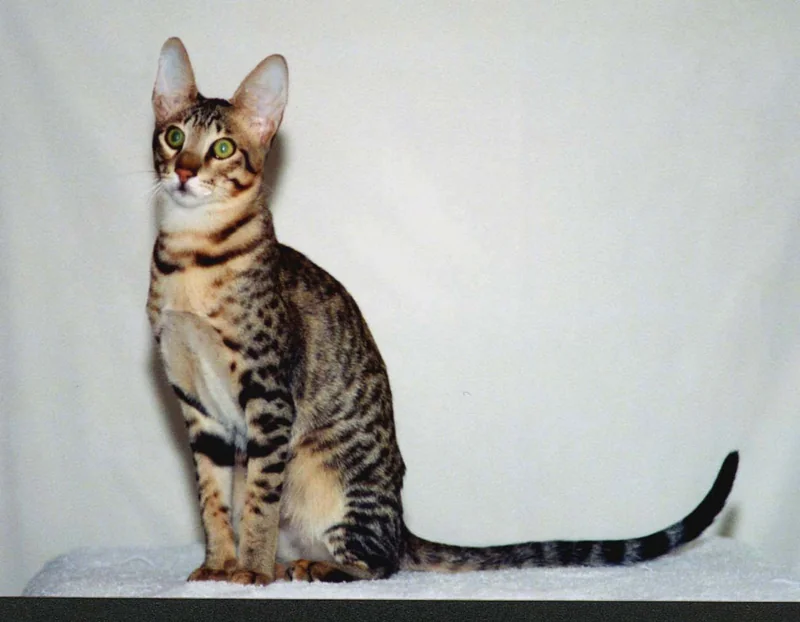 Featured photoserengeti.jpg
The Serengeti is a domestic spotted breed developed by Karen Sausman, a Californian biologist, beginning in 1994. The breeding programme crossed Bengal cats with Oriental Shorthairs to produce a tall, lean, long-legged cat resembling the African Serval — without using actual serval ancestry. TICA accepted the Serengeti for preliminary registration in 2004. CFA, GCCF, and FIFe have not published Serengeti standards. The standard describes a tall, athletic cat with very long legs, large ears, and a spotted tabby coat.
Quick facts
- Origin country
- United States
- Origin period
- 1994 Bengal x Oriental Shorthair cross by Karen Sausman; TICA preliminary 2004
- Coat type
- Short
- Coat colors
- Brown Spotted Tabby, Black Spotted Tabby, Solid Black, Smoke, Snow (lynx-point spotted)
- Size category
- Medium
- Average lifespan
- 10-15 years
- Recognition
- TICA 2004
Origin
Karen Sausman, a Californian biologist and director of The Living Desert zoo, began developing the Serengeti in 1994 by crossing Bengal cats with Oriental Shorthairs. The goal was a domestic cat resembling the African Serval — tall, lean, long-legged, with large ears and a spotted coat — but without using actual serval ancestry. The Bengal contributed the spotted coat genetics (Asian Leopard Cat ancestry, F4 or beyond, fully domestic), and the Oriental Shorthair contributed the long, lean conformation and large ear size. The breed name references the Serengeti grasslands of East Africa.
Recognition
TICA accepted the Serengeti for preliminary registration in 2004, placing it in the new-breed category. The breed has not yet advanced to championship. CFA, GCCF, and FIFe have not published Serengeti standards. The Serengeti is shown primarily through TICA-affiliated experimental classes in North America and Europe.
Standard
The TICA standard describes a medium-sized, tall, lean, athletic cat with very long legs and a long body resembling the African Serval. The head is medium-sized with a slightly rounded contour. The defining characteristics are the very large erect ears (described in the standard as 'as large as possible'), the long legs, and the spotted tabby coat. Recognized colours include brown spotted, black spotted, solid black, smoke, and snow (lynx-point spotted). The Serengeti is one of the longest-legged domestic cat breeds without wild-cat hybridization.
Sources & further reading (3)
- tica-standard — accessed 2026-04-30
- encyclopedia — accessed 2026-04-30
- encyclopedia — accessed 2026-04-30
Frequently asked questions
Is the Serengeti a serval hybrid?
No. Despite the resemblance to the African Serval and the breed name referencing the Serengeti grasslands, the Serengeti is a fully domestic breed with no serval ancestry. The breed was developed by crossing Bengal cats (F4 or beyond — fully domestic) with Oriental Shorthairs to achieve the serval-like silhouette through domestic genetics alone. This distinguishes the Serengeti from the Savannah, which uses actual serval ancestry.
When was the Serengeti recognized?
TICA accepted the Serengeti for preliminary registration in 2004. CFA, GCCF, and FIFe have not published Serengeti standards. The breed has not advanced to championship.
How does the Serengeti differ from the Savannah?
Both breeds are intended to resemble the Serval, but the Savannah uses actual serval ancestry (an Asian Leopard Cat hybrid programme equivalent for the serval), while the Serengeti uses only domestic foundation breeds (Bengal F4+ and Oriental Shorthair). The Savannah is therefore a wild-cat hybrid in early generations; the Serengeti is fully domestic from inception.