Felis catus
California Spangled
 Featured photocalifornia-spangled.jpg
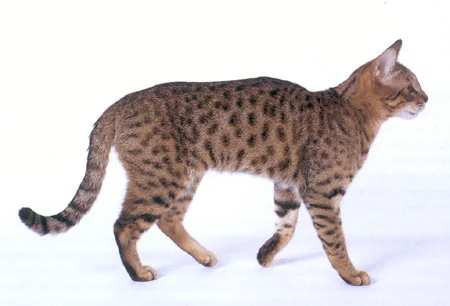
The California Spangled is a domestic spotted-tabby breed developed in the United States from 1971 by screenwriter Paul Casey. The breeding programme aimed to produce a domestic cat resembling a wild spotted leopard, using outcrosses to ten different breeds and feral populations from California, Egypt, and Asia. TICA recognized the California Spangled in 1986. The breed declined dramatically after the 1990s and is currently considered near-extinct. CFA, GCCF, and FIFe have not published California Spangled standards.
Quick facts
- Origin country
- United States
- Origin period
- Created by Paul Casey from 1971 leopard-spotted programme; TICA recognition 1986; declined dramatically post-1990s
- Coat type
- Short
- Coat colors
- Brown Spotted, Black Spotted, Bronze Spotted, Charcoal, Gold Spotted, Silver Spotted, Blue Spotted, Red Spotted, Solid Black
- Size category
- Medium
- Average lifespan
- 9-16 years
- Recognition
- TICA 1986
Origin
The California Spangled was conceived in 1971 by Paul Casey, an American screenwriter and conservationist. Casey aimed to produce a domestic cat with a spotted-leopard appearance using only domestic genetics, deliberately avoiding wild-cat hybridization unlike the contemporaneous Bengal. The eleven-year breeding programme used outcrosses to ten different breeds and feral populations including the British Shorthair, Manx, American Shorthair, Abyssinian, Siamese, and feral Egyptian, Cairo, and Asian street cats. The first California Spangled litters were produced in the early 1980s.
Recognition
The breed was launched commercially through a 1986 advertisement in the Neiman Marcus Christmas catalogue, where the kittens were offered at high prices to fund continued breeding work. TICA recognized the California Spangled in 1986. CFA, GCCF, and FIFe have not published California Spangled standards. The breed declined dramatically after the 1990s; many breeders moved to the more popular spotted breeds (Bengal, Ocicat). The breed is currently considered near-extinct, with very few breeders worldwide.
Standard
The TICA standard describes a medium to large, well-muscled, athletic cat with a long body, long legs, and a low-slung silhouette resembling a wild cat. The head is medium-sized with a slightly rounded forehead and well-defined muzzle. The defining characteristic is the spotted tabby pattern: distinct round, oval, or square spots randomly scattered across the body in high contrast against the ground colour. Recognized colours include brown, black, bronze, charcoal, gold, silver, blue, red, and a solid black variant.
Sources & further reading (3)
- tica-standard — accessed 2026-04-30
- encyclopedia — accessed 2026-04-30
- encyclopedia — accessed 2026-04-30
Frequently asked questions
Is the California Spangled a wild-cat hybrid?
No. The California Spangled was developed exclusively from domestic and feral domestic genetics. Paul Casey deliberately avoided wild-cat hybridization, distinguishing the breed from the contemporaneous Bengal (which used Asian Leopard Cat ancestry). The leopard-spotted appearance of the California Spangled was achieved through selective breeding of domestic spotted patterns alone.
When was the California Spangled recognized?
TICA recognized the California Spangled in 1986. CFA, GCCF, and FIFe have not published California Spangled standards. The breed remains TICA-recognized but its small population means it is rarely shown today.
Why is the California Spangled near-extinct?
The breed declined dramatically after the 1990s as breeders moved to the more popular Bengal and Ocicat. The Neiman Marcus catalogue launch attracted attention but few sustained breeders, and Paul Casey's commercial breeding model did not transition into a broad amateur breeder community. By the 2000s the breed had a very small worldwide population, and it remains near-extinct today.