Felis catus
Scottish Fold
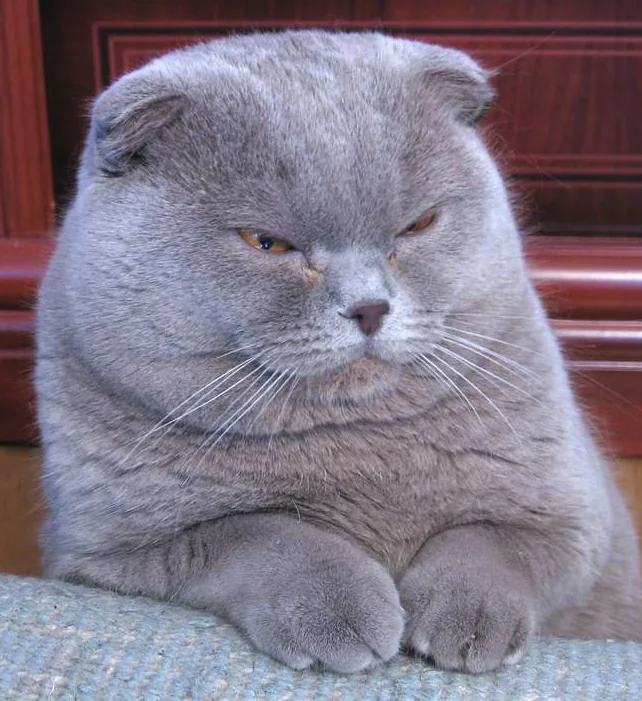 Featured photoscottish-fold.jpg
The Scottish Fold is a breed defined by a natural dominant mutation causing the ear cartilage to fold forward and downward, giving the cat an owl-like appearance. The foundation cat, Susie, was found by shepherd William Ross on a farm in Coupar Angus, Tayside in 1961. CFA recognized the breed in 1978; TICA at its 1979 founding. GCCF withdrew recognition in 1974 due to concerns about associated osteochondrodysplasia. FIFe has not published a Scottish Fold standard.
Quick facts
- Origin country
- Scotland (Tayside)
- Origin period
- 1961 natural folded-ear mutation (Susie, William Ross); CFA recognition 1978
- Coat type
- Short
- Coat colors
- All colours and patterns recognized (including folded-ear longhaired variety — Scottish Fold Longhair)
- Size category
- Medium
- Average lifespan
- 11-15 years
- Recognition
- CFA 1978 · TICA 1979
Origin
A white-coated cat with both ears folded forward was noticed by shepherd William Ross on a farm near Coupar Angus, Tayside in 1961. Ross named the cat Susie. With the assistance of genetics researcher Pat Turner, Ross confirmed the dominant autosomal nature of the Fd gene — a single copy produces the folded ear. Early crosses used British Shorthairs and American Shorthairs to provide an outcross population for the breeding programme. The GCCF initially recognized the Scottish Fold but withdrew recognition in 1974.
Recognition
The Governing Council of the Cat Fancy recognized the Scottish Fold from the early 1970s but withdrew recognition in 1974 due to concerns about osteochondrodysplasia risk and ear problems associated with homozygous (Fd/Fd) individuals. American breeders continued the breed, and CFA recognized the Scottish Fold in 1978. The International Cat Association recognized it at its 1979 founding. FIFe has not published a Scottish Fold standard. Many European countries restrict or discourage breeding Scottish Folds due to welfare concerns about the osteochondrodysplasia phenotype.
Standard
The CFA standard describes a medium-sized, well-rounded cat with a round head, large round eyes, and medium-short legs. The defining characteristic is the ear fold: both ears fold forward and downward, lying flat against the skull and framing the round face. The CFA standard specifies that ears must be folded; straight-eared kittens (Folds that did not inherit the Fd gene) are not shown. Both shorthaired and longhaired (Scottish Fold Longhair) varieties are recognized. All colours and patterns are accepted.
Sources & further reading (3)
- registry-breed-profile — accessed 2026-04-30
- encyclopedia — accessed 2026-04-30
- tica-standard — accessed 2026-04-30
Frequently asked questions
Why did the GCCF withdraw recognition of the Scottish Fold?
The Governing Council of the Cat Fancy withdrew recognition of the Scottish Fold in 1974 due to documented concerns about osteochondrodysplasia — a skeletal disorder associated with the Fd gene that can cause painful joint stiffness, particularly in homozygous (Fd/Fd) individuals. The GCCF concluded that the health risks associated with the mutation outweighed the breed's show qualities. FIFe has also declined to publish a Scottish Fold standard. Many European countries have enacted restrictions on breeding Scottish Folds.
When was the Scottish Fold recognized by CFA?
CFA recognized the Scottish Fold in 1978. TICA recognized the breed at its 1979 founding. The GCCF withdrew recognition in 1974. FIFe has not published a Scottish Fold standard.
What is the genetic basis of the Scottish Fold's folded ears?
The ear fold is caused by the autosomal dominant Fd gene. A single copy (Fd/fd — heterozygous) produces the characteristic folded ear with variable degree of fold. Two copies (Fd/Fd — homozygous) produce extreme ear folding and are associated with a higher risk of severe osteochondrodysplasia. All Scottish Folds bred for the folded-ear phenotype must be heterozygous; CFA rules require outcrosses to straight-eared British Shorthairs or American Shorthairs to avoid homozygous matings.